|
shyscyberchamber.com
|
|
BAD PEOPLE |
Date
Added |
|
 |
Dr Carl
Weiss |
January 2003 |
|
|
|
|
|
Bio |
|
|
Full Name |
Dr. Carl Austin Weiss |
|
|
Date of Birth |
UNKNOWN |
|
|
Date of Death |
8th September 1935 |
|
|
Known Also As |
UNKNOWN |
|
|
Hit Count |
1 |
|
|
Information & Pictures |
|
|
By the autumn of 1935,
Huey Long had become the country's most fiery demagogue. In the seven
years since his election as governor of Louisiana, he had transformed
his image as a typical Southern backwoodsman into that of a virtual
dictator. Opponents branded him 'the Despot of the Delta' and 'Caesar
of the Bayous'. He called himself the 'Kingfish' after a crafty
character in the popular radio show Amos 'n Andy. |
|
|
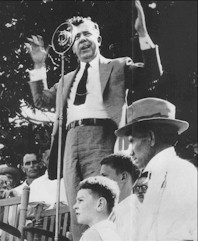
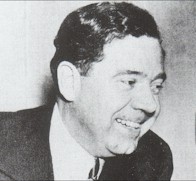
[ Huey
Long ]
Louisiana governor Senator Huey Long mesmerizes a crowd in
Magnolia, Arkansas, in 1932, while supporting the re-election of a
fellow senator. Long spoke eloquently of a society where wealth was
shared and rich people's incomes were strictly curtailed. |
|
|
Long owed his popular
appeal to his campaign against big business - the oil companies in
particular - and to his radical reform programme. Above all, he was
know for the creation of the 'Share Our Wealth Society' with its
slogan of 'Every Man a King'.
Many suspected it would be the cornerstone of his bid for higher
office.
Indeed in the spring of 1935, he had written a book, modestly entitled
My First Days in the White House, in which he mischievously expressed
his intention of appointing President Franklin Roosevelt as Secretary
of the Navy. As election year drew closer, there was apprehension in
some quarters that this was by no means an idle boast. |
|
|
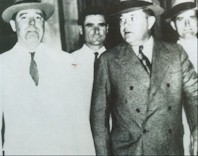
[ Fear
of Assault ]
Huey Long was aware that his forceful style of leadership might
result in threats of violence but, after his election as governor, his
fears turned into paranoia. He even tried to dissuade reporters from
riding with him, saying, 'Some crazy galoot's liable to be behind any
one of those telephone poles and take a shot at me.' This danger must
have seemed evident to him in 1933, following an assassination attempt
on President Roosevelt, which resulted in the death of Anton Cermak,
the Mayor of Chicago. Long now made increasing use of bodyguards.
Initially, he had just on minder, but towards the end of his career he
was regularly accompanied by a half a dozen security men. |
|
|
For many were critical
of Long's highly undemocratic practices. In Louisiana, he had taken
full control of the party machine, using this power to call special
sessions of the legislature and rush through new laws without proper
committee hearings or debates. Between August 1934 and September 1935,
no fewer than 226 bills had been enacted in this manner.
It came as no great surprise, therefore, when Long announced at 10am
on Saturday 7th September 1935, that he was convening another of his
special sessions that evening. In all, 42 bills were to be processed.
Most were routine, but one dealt with the transfer of the parish of St
Landry from the 13th to the 15th judicial district. St Landry, some
50km (33 miles) west of Baton Rouge, was opposition territory, and
Huey's idea was to reduce its influence by absorbing it into one of
his strongholds, while also enabling his followers to take power in
the 13th.
In addition, the transfer would unseat one of his oldest critics,
Judge Benjamin Pavy. This was such a blatant piece of gerrymandering
that even some Long supporters balked at the notion. Long himself had
driven from New Orleans to Baton Rouge, the capital of Louisiana, to
preside over this special session on Saturday 7th September. |
|
|
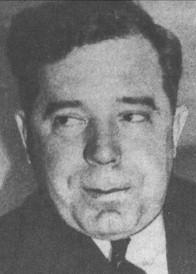
[ Huey Long ]
Huey Pierce Long was born on 30th August 1893, near Winnfield,
Louisiana. A qualified lawyer, he was elected governor at the early
age of thirty four, and became a US Senator two years later, holding
both posts concurrently. Long supported his fellow Democrat, Franklin
Delano Roosevelt, for the presidential nomination in 1932, but they
soon became political rivals. |
|
|
The following evening, after supper, he
entered the legislative chamber in the capitol, the statehouse of
Louisiana, to attend the final meeting. There, he chatted with some
colleagues before taking his place on the speaker's dais, and remained
there until the meeting adjourned just before 9.20pm.
Stepping out into the corridor, Long then headed towards the
governor's office. He was not alone. As usual, his bodyguards and some
of his supporters accompanied him. The group included on of his
bodyguards, Murphy Roden, who doubled as a chauffeur, and Justice John
Fournet of the Louisiana supreme court.
Long paused outside the office of the governor's secretary and then
turned back to face the throng. 'We have got to get all our men here
tomorrow,' he said to one of the legislators. At this moment, a figure
in a white suit emerged from behind a pillar and walked casually up to
the group. He raised his arm, as if about to shake the senator's hand.
Then too lat, somebody noticed that he was carrying a pistol. Fournet
managed to deflect his arm downwards, but the gun still went off.
According to Fournet, Long gave 'just one shout, a sort of hoot, ant
then he ran like a wild deer'.
Instantly, Murphy Roden leapt on the man, wrestling him to the floor.
A second shot rang out, tearing Roden's wristwatch from his arm. He
jerked loose and pulled out his own gun. Then a fusillade of shots
rained down on the assailant from all sides and he crumpled into a
heap by the wall. The guards continued to pump bullets into him, even
after he had stopped moving. |
|
|
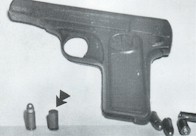
[ Murder Weapon ]
Long's assassin, Carl Austin Weiss, purchased his gun, a small,
Belgian, .32 calibre automatic pistol, during his three year stay in
Europe. According to Weiss's father, there was nothing remarkable
about the fact that he was carrying the weapon on the fatal evening of
8th September. Two months earlier, Weiss had surprised a couple of
intruders in the garage late one night and, ever since then, he had
taken the pistol with him when he went out on night calls. The gun
itself was faulty and jammed after the second shot had been fired.
Some commentators saw this as an indication that the assassination was
not planned in advance. |
|
|
Long, meanwhile, had staggered off into
the stairway leading to the basement.
He was found and taken to Our Lady of the Lake Sanitarium.
The doctor in charge, Dr Arthur Vidrine, instantly recognized the
severity of Long's condition. The bullet had entered his body under
the ribs and penetrated his colon. Dr Vidrine hoped to delay any major
treatment until a more experience surgeon arrived, but as the evening
wore on, it became clear that he would have to operate himself. The
patient's pulse rate kept rising, while his blood pressure was falling
- a sure sign that internal haemorrhaging was taking place. At around
11.20pm, Dr Vidrine decided to go ahead.
After the operation, Long seemed to be out of immediate danger. Only
later was it discovered that the bullet had damaged his kidney, and
the internal bleeding had not been stemmed. By then, Long was too weak
to withstand a second operation and his condition deteriorated
steadily.
Meanwhile, the investigation into the shooting got underway. The
gunman was found to be Dr Carl Austin Weiss, a twenty nine year old
physician. This news was passed on to Long in hospital some time
before he died on Tuesday 10th September. The name meant nothing to
him. 'Dr Weiss?' Long muttered. 'What did he want to shoot me for? I
don't even know him.'
As details about the identity of Long's attacker emerged, it became
clear that this was no ordinary assassination attempt.
The young Dr Weiss was a far cry from the embittered social outcasts
that are normally associated with this kind of crime. |
|
|
[ Murder Plot ]
In July 1935, anti-Longites held a large convention at a hotel in
New Orleans to decide on their candidates for the forthcoming state
elections. Behind the respectable facade, however, Huey Long claimed
that secret plans were hatched there for his eventual assassination.
Long's opponents naturally dismissed this allegation. Even if such a
plot existed, the claim that Carl Weiss had been present at the
meeting - as it was later claimed - proved to be unfounded. On the
date in question, Weiss was in Opelousas (the main town of St Landry
Parish) busy treating patients, one of them a cousin of Long's. The
men at the meeting also claimed they did not know who Weiss was. |
|
|
He was well established in his
profession as an ear, nose and throat specialist and he came from a
stable family background. There was no hint that he had any marital
problems, any mental defeats or held any extreme political views. He
had, it appeared, everything to live for.
Perhaps because Long was so universally distrusted, public reaction to
the shooting was unusual - there was no universal condemnation of the
act. Weiss's parents were treated sympathetically by the press and
there was little attempt to vilify the young man's name. Indeed, he
was given a hero's send off at his funeral.
The overriding emotion felt by Weiss's friends and colleagues was
disbelief. What could have possessed him? they wondered. In answering
this, pressmen immediately seized on the fact that Carl's wife was
Yvonne Pavy, daughter of the judge whom Long had been trying to
outcast. It was obvious, they claimed, that Weiss had taken it as a
personal slight against his family, and had sought revenge.
However, Carl's father, also a doctor, dismissed this suggestion
emphatically: 'Absolutely not! He had no reason to take that
seriously, because the judge himself did not take it seriously.' When
questioned, Pavy agreed, pointing out that he had been planning to
retire soon in any case. |
|
|
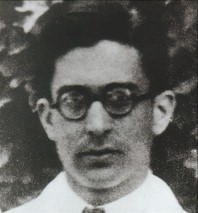
[ Dr Carl Weiss ]
Dr Carl Weiss, taken while at the American Hospital in Paris, where
he was doing postgraduate work. He returned to the USA in May 1930.
|
|
|
The mystery deepened as the grieving
father described the tranquil family get together that preceded the
killing. On the fatal Sunday, Carl had gone to Mass with his wife and
then dined at his parents' house. In the afternoon, the whole family
had enjoyed a picnic by the riverside.
At around 7.30pm, they had returned to the city and Carl took his wife
to their home, just a stone's throw away from the capitol. After
supper, e had phoned a colleague to confirm the arrangements for an
operation the following day. At about 9pm, he received a call and left
the house to visit a patient, although he must have headed almost
immediately towards the capitol. Despite this, nothing in either his
demeanour or his actions throughout the peaceful day had suggested
that the young doctor was contemplating murder.
The eventual inquest into Weiss's death in mid-September did little to
clarify the matter. Spectators may have been shocked by the savagery
of the onslaught against Weiss - the pathologist counted fifty nine
entry and exit wounds, and noted that part of the young man's face had
been shot away.
It was not until many years later, in the 1980's, that new evidence
was unearthed by a writer named Ed Reed.
Reed was puzzled by the many inconsistencies in the assassination
story. If Carl Weiss had planned on killing Huey Long, why did he seem
so normal that day? Why did he make an appointment with a patient for
the following morning? And how did he manage to walk into the capitol
carrying a gun, when the building was full of guards who were all on
the alert for a possible attack on Long? |
|
|
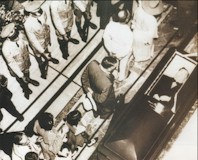
[ Huey Long's Funeral ]
Under the watchful eyes of guardsmen, mourners file past the body
of Huey Long as it lies in state in the Memorial Hall of the Louisiana
Capitol. Cameras were barred, but this photo was taken secretly. |
|
|
Reed learned one interesting fact from
Weiss's brother Tom. When the radio announced news of the shooting
soon after it happened, and mentioned Weiss's name, Tom and his cousin
Jim hurried to the capitol, and found Weiss's car parked outside. It
was locked, and they could see his closed medical bag inside. They
hurried back home to get the keys. By the time they returned, the car
had vanished. They found it behind the capitol, with the door now
unlocked. The medical bag was open, and its contents were in disorder.
And Weiss's gun was missing from its usual place in the glove
department.
One of the security guards who was in the capitol that night told Ed
Reed that the gun had been taken from the car by someone in the
building, and used as a 'throw down' gun - that is, thrown beside
Weiss's body.
In 1985, a reporter following up a story about Long's 'double
indemnity' insurance policy learned that an investigator for the
insurance company had looked into Long's death, and reported that it
was due to an accidental shooting by his own bodyguard. |
|
|
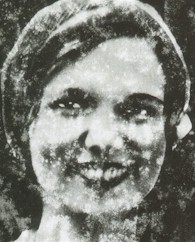
[ Yvonne Weiss ]
Yvonne Weiss - Carl Weiss's wife - came from an old French
Louisiana family. Her father, Judge Benjamin Pavy, was a fierce
opponent of Long and some theorised that Weiss had shot Long because
of this. In 1939, Yvonne Weiss took her son Carl and went to live in
Paris, but returned to the USA in 1941. She remarried in 1950 and died
in 1963. Carl Weiss Jnr also became a doctor, he had a cordial meeting
with Russell Long, Huey's son. |
|
|
What really happened that evening?
Almost certainly, Weiss decided to go and speak to Long on impulse
about his father-in-law (Judge Pavy). He stood in full view of many
people as he waited. Three times he tried to speak to Long, but was
brushed off and told to wait. If he had intended to kill Long, he had
several opportunities. The third time he tried to get Long's
attention, the governor was probably rude and impatient - he was that
kind of person. The mild Weiss finally lost his temper and hit Long;
another witness describes how, in the hospital, he asked Long how he
had cut his lip, and Long answered, 'That's where he hit me.'
The inexperienced and overexcited guards now emptied their guns into
Weiss, also hitting their own boss. Reed found evidence of two bullets
taken from Long's body were a .38 and a .45 - guns carried by the
guards - while Weiss's gun was a .32. To cover up Weiss's murder,
someone got the gun from his medical bag and threw it down beside him
in the corridor of the capitol. Then to cover up the killing, the
guards, naturally, made up the story about Weiss raising the pistol
and shooting Long. In retrospect, there is almost no doubt that Weiss
was an innocent man shot by trigger-happy incompetents. |
|
|
BACK TO TOP |
|
 Check out
the
latest
Crypt Polls!
|