|
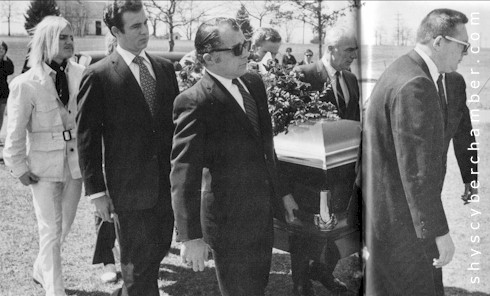
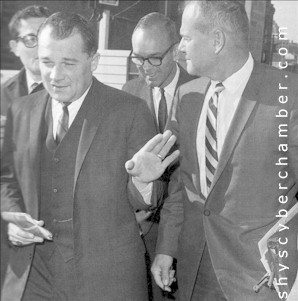
 SHEPPARD'S FUNERAL
:
Pallbearers - among them attorney F. Lee Bailey, brother
Richard Sheppard and father-in-law George Strickland - carry the coffin of Sam
Sheppard during his funeral on 8th April 1970 at Bay Village, Ohio. |
|
|
Everyone present knew that Dr Davis was referring to
the day almost 16 years earlier, 4th July 1954, when Sheppard's first
wife, Marilyn, had been found battered to death in their house in Bay
Village. Ever since, the question of Sam Sheppard's complicity
in the killing, if any, had been debated in newspaper columns and
living rooms across the country.
The burial took place shortly before noon in Forest Lawn Cemetery.
Bailey, Richard Sheppard and Strickland were among the pallbearers.
Sam Sheppard had once been among the most highly-paid surgeons in
Ohio. In the weeks after the funeral, it emerged that he had
died virtually penniless, unable to pay his professional bills or his
income tax, and facing a $300,000 legal claim by a former patient for
alleged medical malpractice.
The problems Sheppard left were not only financial. Soon after
the funeral, his third wife's family received a telephoned threat at
their ranch near the city of Columbus, Ohio's capital. 'You
killed Sam Sheppard,' the caller said. 'Beware!' |
|
|
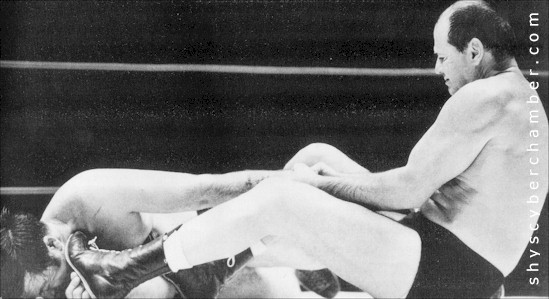
 THE WRESTLER
:
In times of trouble, Sam Sheppard
found release in physical activity. When he took up professional wrestling
at the age of 45 (pictured above right), with his life in ruins, he said:
'Wrestling is a good way to show that men over 40 can stay in good physical
condition... My father pushed me into medicine. Wrestling and other
athletics are more enjoyable.'
At his first professional bout in August 1969, crowds packed the stands at a
high school in Waverly, Ohio. Sheppard weighing just over 84kg (14 stone),
easily defeated the 21 stone 'Wild Bill' Scholl in seven minutes.
Nevertheless, he still drank large amounts of vodka. After his marriage in
October 1969 to 20 year old Colleen Strickland, he said publicly, 'I've never
been happier.' Privately, he told his few confidants that he wanted to
die. |
|
|
The ranch was immediately placed under strict police guard just as
Sheppard's lakeside home had been, 16 years before, on the night his
wife died.
Samuel Holmes Sheppard was born into a successful medical family in
Cleveland, Ohio, on 29th December 1923. A healthy, all-American
boy with a dimple, Sam loved all outdoor physical pursuits and set his
heart on becoming a professional athlete.
He was the youngest of three boys born to Richard Sheppard, a rising
force in the Ohio medical world, and his wife, Ethel. Sam
appeared to set great store by his parents' appearance. In his
autobiography Endure and Conquer, published in 1966, he
described his mother as 'a beautiful woman' and his father as very
handsome.
Sam's father was a general surgeon who specialised in osteopathy, a
method of treating physical injuries by manipulating the bones.
The family live in a modest red-brick house in the Cleveland Heights
district. |
|
|
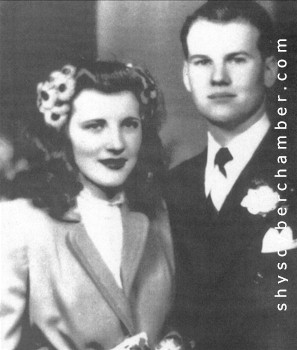
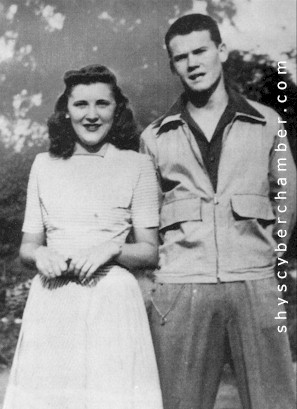
 SAM & MARILYN'S
WEDDING DAY :
Marilyn and Sam Sheppard on
their wedding day in November 1945. They were married at the First
Hollywood Methodist Church in Los Angeles, California. |
|
|
'There was nothing that happened during the first 30 years of my life
to indicate that some day my name would - unfortunately - become a
household word,' Sheppard wrote in Endure and Conquer.
Sam attended the local Roosevelt Junior High School. It was
during this period, when Sam was about ten, that his family took an
innovative step that was to help shape Sam's fate. His father
founded a small osteopathic clinic close to downtown Cleveland.
Sam went on to attend Cleveland Heights High School, where he was
elected president of his class in each of his three years. He
seemed to have been a fairly self-assured youth who recognised that
hard work was needed to succeed in life. He never seems to have
doubted that such success and its rewards would be his one day.
But he was always modest. |
|
|
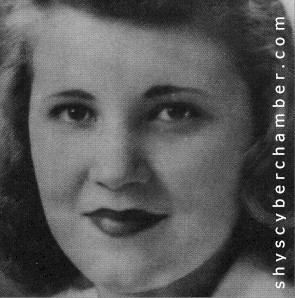
MARILYN REESE
:
Marilyn Reese, aged 19, with the clean-cut medical
student, Sam Sheppard who, 12 years later, was to be charged with her murder. |
|
|
Although he was competent at his studies, Sheppard seems to have derived little
satisfaction from them. He was a poor speller and his autobiography fails
to record any joy at passing examinations.
It was a competitive sports that captured the young Sam's imagination. 'I
was a regular on the track, basketball and football teams,' he later wrote, 'and
my performance earned me in the senior year an award as the school's most
outstanding athlete.'
Sheppard left high school in 1943, with a 'nagging feeling' that he should
enlist for service in the Second World War. His father convinced him he
'could do a lot more for my country as a doctor.' This was neither the
first time, nor the last, that Sheppard Snr had used charm and logic to nudge
all his three sons towards a medical career. Richard and Stephen were both
on their way to becoming osteopathic doctors, like their father. |
|
|
 SAMUEL REESE
:
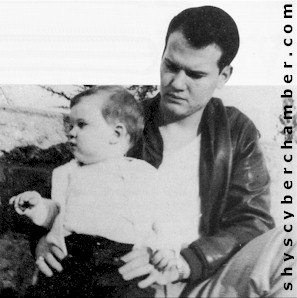
Dr Sam Sheppard is seen here with his son Samuel Reese ('Chip') who
was born in 1947. The boy was seven when his mother was murdered. |
|
|
Sam studied medicine at the Western Reserve University in Cleveland, Hanover
College in Indiana, and, finally, at the Osteopathic School of Physicians and
Surgeons in Los Angeles. By 1948, he had graduated, and begun to study
neurosurgery.
Sam had by now married Marilyn Reese, and their son Sam Reese Sheppard,
nicknamed 'Chip' had been born. They preferred to remain in California,
but Sheppard Snr had founded Bay View Hospital in Bay Village in 1948, and
wanted the family team under one roof.
His father won Sam round. 'I had a duty to return to Cleveland,' Sam wrote
in his autobiography, 'so without hesitation and a wish we could stay, we packed
our things.' |
|
|
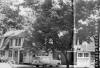 LAKE ROAD :
The murder of Marilyn Reese Sheppard took place at this expansive
timber-framed house in Bay Village,
Ohio. The front faced Lake Erie, while the back (seen here) faced the
street, confusingly called Lake Road. |
|
|
Late in the afternoon of Saturday 3rd July 1954, the eve of
Independence Day, Sam and Marilyn Sheppard were sipping cocktails at the home of
some neighbours in Bay Village, Don and Nancy Ahern. The mood was relaxed.
The couples knew each other quite well, and it surprised no one when the Aherns'
telephone rang with an urgent call for Sheppard.
The call was from Bay View Hospital. The 30 year old surgeon had already
spent several hours in surgery that day, fighting in vain to save a boy injured
in a road accident. Now he was needed to treat a boy with a broken thigh
bone. Chewing a clove, Sheppard drove the short distance to the hospital,
oversaw the repair of the boy's leg, and returned to his own comfortable,
wood-framed house at 28924 Lake Road. The Aherns were coming over for
dinner.
Casually dressed, the Sheppards and the Aherns had a few drinks on the front
porch, which overlooked the lake, away from the main rain. Their children
ate first. Later, while Don Ahern walked his two sons home, Marilyn put
seven year old Chip to bed. The adults then took a leisurely dinner on the
porch. |
|
|
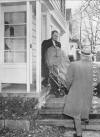 MARILYN SHEPPARD'S BODY
:
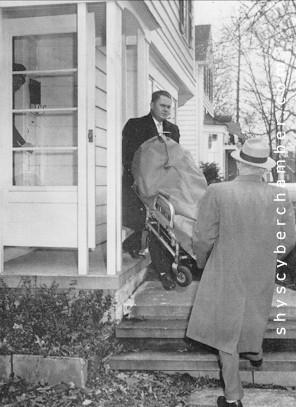
The body of Marilyn Sheppard
is taken from her house amid
speculation that her husband Sam was her killer. Her body had been found
in the early morning by Esther Houk, wife of the Bay Village mayor. |
|
|
After the meal, the couples settled in the living room. Don
Ahern listened to a baseball game on the radio, while the others watched the
1946 Claude Rains film Strange Holiday on television.
Marilyn Sheppard was four months pregnant. After some years of marital
strain, partly cause by Chip's difficult birth, she and Sam had once again
become a close, affectionate couple. When Marilyn went to sit on her
husband's lap, Nancy Ahern pretended to be jealous, settling herself by Don and
saying, 'You two aren't the only lovebirds.'
By the time the Aherns left after midnight, Sam was fast asleep on the sofa in
his white T-shirt, brown slacks and corduroy jacket. He was renowned for
his ability to doze off, even in company, and he was especially tired that
evening. The next day, 4th July, was Independence Day. The Sheppards
had invited over a dozen people to a picnic by the lake so neither wanted to
have a late night. |
|
|
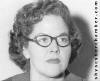
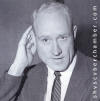 NANCY
& DON AHERN :
Nancy and Don Ahern visited the Sheppards on the night before the murder and
sensed nothing amiss. But Mrs Ahern's views on their marriage were used
against Sheppard. |
|
|
Though half-asleep, Marilyn managed to see the Aherns out.
They left by the door facing the main road, after Nancy Ahern had thoughtfully
locked the lakeside door for her drowsy friend. It was 12.30am, and Sam
was still snoring. There had not been a peep from Chip, asleep upstairs,
nor from the family dog, a part Irish setter called Kokie.
At 5.45am the telephone rang at a house 50m (100 yards) away from the Sheppards.
It was the home of Spencer Houk (pronounced 'HOW'k), 45, businessman and mayor
of Bay Village. Houk answered it and heard the voice of his friend Sam.
He sounded desperate: 'For God's sake, Spen, come quick! I think they've killed
Marilyn!'
Houk and his wife Esther dressed and drove over to the Sheppards' house,
arriving at 5.55am. They found the Sheppards' roadside door open.
The ground floor looked chaotic. A medical bag and equipment lay scattered
on the floor and a desk drawer had been pulled open. It appeared that the
house had been ransacked or burgled. |
|
|
 MARILYN SHEPPARD
:
Possessing hazel eyes and longish, dark blonde hair touching her shoulders in a
1940s style, Marilyn Sheppard was a charming woman. She laughed easily
and, according to Sheppard's brother Stephen, had a 'delightful little-girl
quality in the way she looked at you'.
Born Marilyn Reese, she was 31 years old when she
died. The couple met in high school in Ohio. Marilyn was a year
older than Sam. They were married in California, where Sam was studying in
late 1945.
Marilyn gave birth to a son, Sam, in 1947. It was a painful birth; she was
in labour for 16 hours. The ordeal had traumatized Marilyn, creating fears
of sexual intercourse and further pregnancy. Her own mother had died in
childbirth when she was six.
The Sheppards' marriage had been in danger for several years - Marilyn and Sam
discussed divorce, although it is unclear how recently they had done this before
Marilyn was killed. Their friends, however, reported that she had been
looking forward to having another child. |
|
|
Sam Sheppard was writhing in pain on a chair in his den.
His face was bruised and his trousers were wet. Mrs Houk went up to the
bedroom on the second floor. Marilyn Sheppard was lying in her pyjamas,
half-covered by a sheet, with extensive head injuries. 'Call the police,'
Mrs Houk screamed. 'Call an ambulance. Call everything!'
Just after 6am, patrolman Fred Drenkhan arrived, followed by Sam's oldest
brother Richard Niles Sheppard and his wife at 6.10am. Stephen Sheppard,
the middle brother, and the local Chief of Police, John Eaton, arrived in quick
succession soon afterwards. The house was soon full of police officers.
At 6.30am, Stephen drove Sam to Bay View Hospital, escorted by Eaton.
Hospital staff were to say that, on arrival, some of Sheppard's teeth were loose
and his lips were so cut that he could not open his mouth to drink water.
He was also mumbling remarks such as, 'Chip needs his mother more than me.
Why didn't they kill me?... I heard Marilyn scream, I tried to get to her.' |
|
|
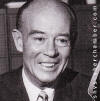 RABBLE-ROUSER :
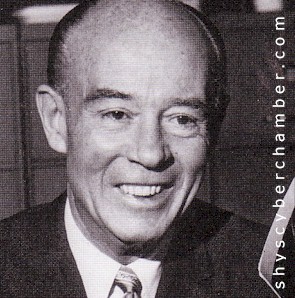
The driving force behind the press campaign for
Sheppard's arrest was Louis Benson Seltzer, editor of the Cleveland Press
newspaper for the previous 27 years. At the age of 56, Seltzer basked in
his influence over Ohio politicians, and relished any opportunity to hound the
police if he felt they were corrupt or lax in protecting the local citizenry.
The Cleveland Press had a large daily circulation of 380,000 copies. Among
its headlines in the days before Sheppard was charged were 'Getting Away With
Murder', 'Why Isn't Sam Sam Sheppard in Jail?' and 'Quit Stalling - Bring Him
In'.
In his autobiography, Seltzer said that he had written 'hard-hitting' editorials
to goad the police into arresting Sheppard, but his staff were divided on how
deeply Seltzer believed that Sheppard was guilty. |
|
|
At 9am, Sheppard, under heavy sedation and being treated
for neck injuries, was questioned by the Coroner of Cuyahoga County, Dr
Samuel Gerber, who had made a brief inspection of the house at Lake
Road. At 11am, Detectives Robert Schottke and Patrick Gareau from
Cleveland took over the questioning.
Police had found no signs of forcible entry into the Sheppards' house,
nor any fingerprints at all except for a thumb mark belonging to Chip.
Marilyn Sheppard appeared to have been the victim of a frenzied
attacker, not a burglar. The detectives were also disturbed that,
only half an hour after the Houks' call to the police, Sam's family
escorted him away to the protection of the Sheppard-family-run hospital
in Bay Village.
They had found no bloodstained weapon in the house, and Sheppard's
corduroy jacket - which he was wearing when he fell asleep in the living
room the evening before - was lying neatly folded on a cushion on the
sofa. |
|
|
 A DEADLY FURY
:
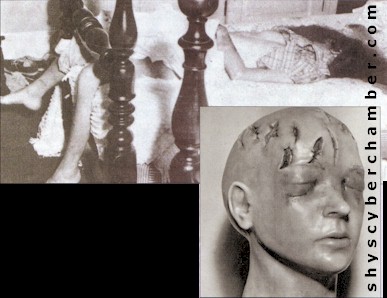
The horrific state of Marilyn Sheppard in death (pictured above)
fuelled local rage against her husband. When Sheppard found her, she was
lying half way down the down the bed, her battered head in a pool of blood, and
her legs dangling over the end of the bed. Her pyjama trousers had been
pulled down to reveal her genitals and the top was pushed above her breasts.
Blood was everywhere. A wax model (inset) was later made of Mrs Sheppard's
skull which showed the intensity that gripped her killer - massive gashes that,
it was suggested, might have been made by fire tongs or a crowbar-like
instrument. |
|
|
Sheppard told the police that he had been woken up on the living
room sofa by his wife's screams from upstairs. He refused to guess at the
time. 'I charged into our room and saw a form with a light garment...
grappling with something or someone,' he said in his formal statement on 10th
July.
He had wrestled with this person, until knocked out from behind. When he
regained his dazed senses, he saw on the floor his own police doctor's badge,
which he kept in his wallet. He took Marilyn's pulse 'and felt that she
was gone'. After fumbling his way into his son's room, and checking that
he was sage, Sheppard had heard a noise, ran downstairs and had seen 'a form
progressing rapidly somewhere'.
Sheppard said that he had chased the figure down the steps to the beach and
lunged at a large man with bushy hair. The man had caught his neck in a
grip and knocked him unconscious. The injury later required a neck brace.
He had woken up 'at the water's edge on my face' and staggered into the house. |
|
|
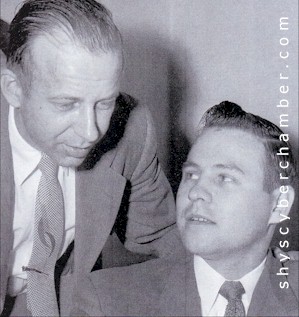
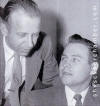 DETECTIVES GAREAU & SCHOTTKE
:
Detectives Patrick Gareau (pictured above right) and Robert Schottke
were among the first to enter the Sheppards' house on the morning of the
murder. They were to be, by turns, praised and criticized for the
manner in which they conducted the investigation. They believed in
Sheppard's guilt. |
|
|
The problem was that there was little proof for Sheppard's
account. 'The evidence points very strongly to you,' Schottke told him.
'I don't know what my partner thinks, but I think you killed your wife.'
The murder became sensational news. The wealthy, tight-knit Sheppard clan
was well known in and around Cleveland. It was held in some mistrust by
more conservative members of the medical fraternity, but Sam's charm and looks
made him popular, especially with women patients.
However, within a few days, newspapers and radio reports hinted that Sheppard
was not co-operating with the inquiry and that there were discrepancies in his
statements. |
|
|
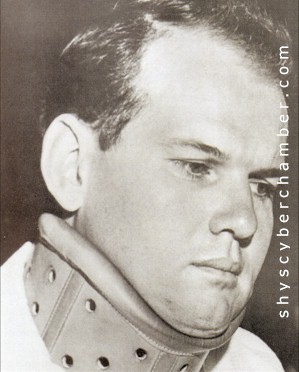
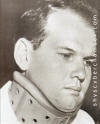 SAM SHEPPARD :
Dr Sam Sheppard in his neck brace, the result of an injury sustained while
tackling the real killer on the beach beside Lake Erie. Sheppard had been
taken to the Bay Village Hospital for treatment, and went to his wife's funeral
in the brace. |
|
|
On 7th July, Sheppard attended his wife's funeral in a
wheelchair, wearing an orthopaedic collar and dark glasses. Though not
under arrest, he was accompanied by a police officer. To many people, he
no longer looked like a benefactor of the community, but a man with much to
hide.
Sheppard's attorney, Anthony Corrigan, refused to let his client take a
lie-detector test, fearing the police would manipulate the results. 'The only
way to convict yourself, Sam,' he said, 'is by opening your mouth.'
However, Sheppard's silence deepened the suspicion towards him. On 28th
July, the influential Cleveland Press commented, 'You can bet your last dollar
that the Sheppard case would have been cleaned up long ago if it had involved
'average' people.' It described Sheppard as 'a liar, still free to go
about his business, shielded by his family, protected by a smart lawyer'.
At 10pm on 30th July, an angry crowd tried to storm the house of
Dr Richard Sheppard, where Sam was staying. Police arrived, handcuffed Sam
and led him through the mob to cries of 'murderer!' At Bay Village City Hall, a
murder warrant was read out. 'Not guilty,' Sheppard said. |
|
|
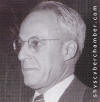 THE INQUEST :
On the morning of 21st July 1954, 17 days after Marilyn Sheppard was killed, the
Cleveland Press ran the headline 'Why No Inquest? So It Now, Dr Gerber'.
Dr Samuel Gerber (pictured), the 57 year old coroner for Cuyahoga County,
promptly announced that an inquest would begin the following day.
A large crowd, mainly hostile to Sam Sheppard, was packed
into a local school gymnasium for the hearing. Gerber refused to allow
witnesses to be represented by counsel and, to cheers from the public seats, had
Sheppard's lawyer, William Corrigan, thrown out for protesting. One person
shouted, 'What does Sheppard need a lawyer for if he's innocent?'
Waiving his right not to
give evidence, Sheppard submitted to eight hours of probing questions by Dr
Gerber. He denied allegations that he had committed adultery with a girl -
known only as Miss X - in California. He was arrested on 30th July, before
Gerber had recorded his verdict that Marilyn Sheppard had been murdered. |
|
|
The trial of Dr Sam Sheppard on the charge of first-degree, or premeditated ,
murder began in the Common Pleas Court in Cleveland, Ohio on Monday 18th October
1954. The case was heard before Judge Edward Blythin.
It was 28th October before a jury of seven men and five women was sworn in.
The long selection process was due to prospective jurors admitting they had
fixed opinions about the case, and the wish of the defence to keep divorced and
separated wives off the jury. The judge then listened to, and rejected,
motions by the defence to have the trial moved elsewhere, to avoid local bias.
The public gallery and press benches were packed for the prosecution's opening
address on 4th November. It immediately became clear that the prosecution
would portray Sheppard as a ruthless adulterer, intent on ridding himself of
Marilyn. |
|
|
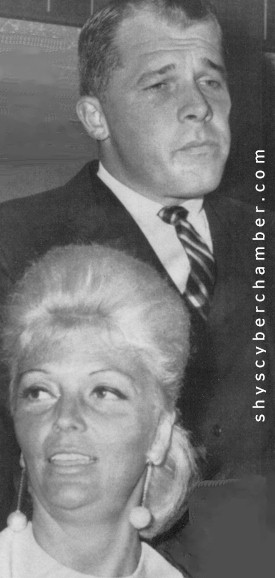
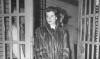 SUSAN HAYES
:
Susan Hayes, the 'other
woman' in the Sheppard case, leaves court after testifying that she had had an
affair with the defendant. The evidence that Sheppard was an adulterer was
devastating to his respectable image. |
|
|
'The state will prove that Sheppard and Miss X talked together
about divorce and marriage,' the chief prosecution counsel, John Mahon, a tall,
white haired man, said. 'No one was in the house that morning on July 4th
attempting to commit a burglary. No evidence has been found that any
burglar or marauder was there.'
Sheppard sat stiffly through Mahon's speech. Throughout the trial, the
defendant wore conservative grey suits with white shirts and dark ties.
Although pale, he retained his boyish look. He turned his back while Dr
Lester Adelson, who performed the autopsy on Marilyn, explained her injuries
with the help of a projection screen.
On 8th November, Don and Nancy Ahern, the Sheppards' guests on the evening
before the murder, gave evidence. Don Ahern said he had never seen Sam
loose his temper, but Nancy hesitated when questioned by Sheppard's counsel,
William Corrigan. 'Mrs Sheppard always seemed very much in love with her
husband, but I was never quite sure about Dr Sam,' she then said. |
|
|
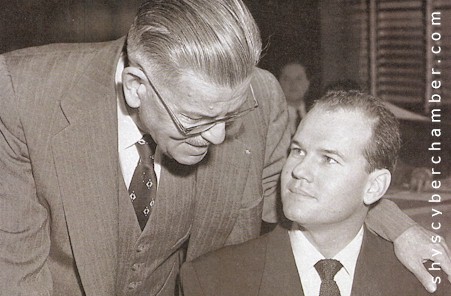
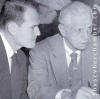 WILLIAM J. CORRIGAN
:
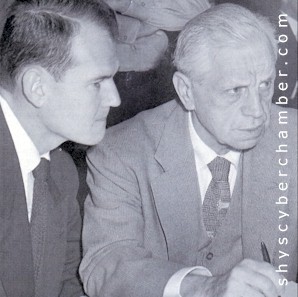
Dr Sam Sheppard (picture above left) sits with his defence counsel William J.
Corrigan during the trial. Criticisms of Corrigan's handling of the case
were offset by his strong objections to the behaviour of the press; he was also
unable to gain access to police and prosecution evidence at that time. |
|
|
Mrs Esther Houk testified that the Sheppards had had rows over
money, and that she remembered seeing their dog, Kokie leaving the house after
the Houks entered at dawn on 4th July. The prosecution were to argue that
Kokie would have barked if Sheppard's story of intruders was true.
The chief witness for the prosecution and the local coroner Dr Samuel Gerber
began his three days in the witness box on 16th November. He spoke of
finding a 'blood signature' on the yellow pillowcase beneath Marilyn Sheppard's
head. 'In this bloodstain I could make out the impression of a surgical
instrument,' he said.
Gerber produced slides of his imprint on the pillow, and offered his view that
the instrument had had two blades, each about 7.6cm (three inches) long with
serrated edges. The jury had already been told that no weapon was found at
the Sheppards' house. The defence lawyers vehemently protested that
Gerber's evidence was guesswork, and prejudicial to the defendant, a surgeon. |
|
|
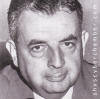 DISPUTED TESTIMONY
:
The jury at Sam
Sheppard's trial was almost certainly influenced by a deadly piece of testimony
from Mayor John Spencer Houk (pictured about), the friend telephoned by Sheppard
after the murder.
Houk testified that Sam's brother Richard had gone upstairs soon after arriving
to examine Marilyn. He then went into the den, where Sam was sitting and
clutching his neck, and said, 'She's gone, Sam.' According to Houk,
Richard then said, 'Did you do this?' or 'Did you have anything to do with
this?'
On the witness stand, Dr Richard Sheppard vehemently denied asking his brother
this question. 'I am positive I never said such a thing,' he said.
'I could not have because it never entered my mind that my brother could have
killed his wife.'
However, Houk's credibility as the local mayor, who was known to have been a
close friend of Sam Sheppard, may have splintered the defence's picture of a
loyal, honourable family. |
|
|
The judge allowed the evidence to stand, but asked Gerber if only
a surgical instrument could have caused the imprint. 'The impression could
only have been made by an instrument similar to the type of surgical instrument
I had in mind,' the coroner replied. He was not, however, asked what this
was.
Corrigan, Sheppard's counsel, was still seething at Gerber. When the
question of whether Sheppard intended to divorce Marilyn arose, Corrigan asked
Gerber angrily, 'You're a divorced man yourself, aren't you doctor?'
Mahon, for the prosecution, snapped, 'There's no comparison between the troubles
of Dr Gerber and those of Sam Sheppard. Dr Sheppard's wife is dead.'
A mysterious Miss X entered the witness box on 1st December. For dramatic
effect, Mahon had not named her in his opening speech, but the witness
identified herself as Susan Hayes, a 24 year old laboratory technician.
She said she had met Sam Sheppard on joining Bay View Hospital in 1951.
She hardly looked at Sheppard, and spoke in a flat, controlled voice about their
affair. |
|
|
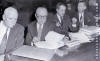 THE PROSECUTION
:
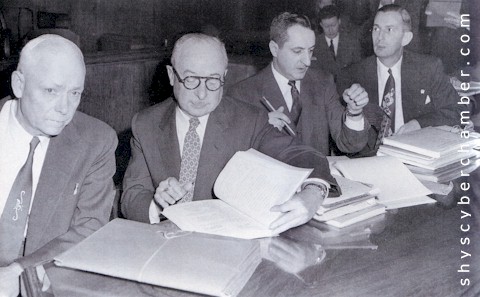
Facing Sheppard in the courtroom were
(pictured above
from left to right): the chief prosecuting attorney John Mahon, his assistant
prosecutors Saul S. Dancaceau and Thomas J. Parrino, and Chief Detective James
McArthur who represented the police. |
|
|
It had begun in California after she moved to Los Angeles early
in 1954.
'Did you occupy the same room,' she was asked.
'Yes.'
'The same bed?'
'Yes.'
This evidence, if true, made Sheppard guilt of adultery, which was then a crime
in Ohio, and a perjurer. At the inquest, he had denied having any affairs
during his marriage. Miss Hayes confirmed that he had spoken of leaving
Marilyn.
'He said that he loved his wife very much, but not as a wife, and was thinking
of getting a divorce,' she testified.
'Anything else?'
'He wasn't sure his father would approve,' she replied. |
|
|
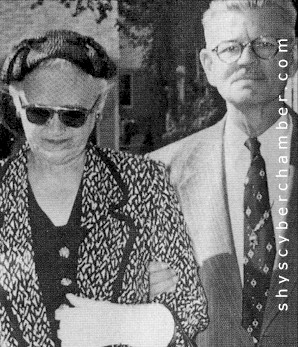
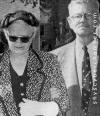 PARENTAL TRAGEDIES :
Before his arrest, Sam Sheppard
confessed in tears to his parents, Ethel and Richard (pictured above), that he
had been unfaithful to his wife, Marilyn. Deeply shocked, Ethel reminded
her youngest son of the Seventh Commandment. Later, she wrote to him in
jail appealing to Sam not to become 'a bitter, hateful, vengeful human being'.
On 19th November 1954, shortly after Dr Gerber had testified at the trial that
Marilyn had been killed with a surgical instrument, Mrs Sheppard took an
overdose of sleeping pulls. She was kept alive at the family's Bay Village
Hospital.
But on 17th January 1955, soon after her son was convicted of murder, Mrs
Sheppard wrote a brief note to her middle son, Stephen: 'I just can't go on...
I'm sorry.' She then shot herself dead with Stephen's revolver.
Eleven days later, Sam's 65 year old father, Dr Richard Sheppard, died of a
bleeding gastric ulcer. |
|
|
Sam Sheppard began his evidence on Thursday
9th December. It last four days and was detailed and thorough. But
Sheppard failed to impart warmth. One writer, who believed in his
innocence, recorded that Sheppard never gave the impression 'that he would come
out with unvarnished truth no matter how much it hurt'.
Mahon, cross examining Sheppard, passed quickly over Sheppard's version of the
night of the killing, and concentrated on his adultery.
Sheppard admitted perjury at the inquest, but said he had lied to protect Susan
Hayes, not himself. He said that he had never truly felt love for Miss
Hayes, and that he had never raised the subject of divorce either with her or
Marilyn. According to Sheppard, Susan had asked him, 'Other men divorce
their wives - why can't you?' |
|
|
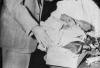 MISSING STAINS
:
Much of the physical evidence at
Sheppard's trial was unresolved by both the prosecution and the defence.
Although the four bedroom walls were heavily bloodstained, the only blood mark
found on Sheppard was on a trouser knee. 'If Sam had been the murderer, he
would have splattered blood all over his trousers,' his counsel, William
Corrigan, told the jury.
Sheppard had been wearing a white T-shirt when he had fallen asleep, but was
bare-chested when the Houks arrived after the murder. He said he could not
recall losing it. Two white T-shirts were eventually found on the beach.
Neither had bloodstains.
The Houks' son Larry found in the nearby underbrush a green bag usually kept by
Sheppard in his den. It contained some keys, and a key chain from his
trousers. |
|
|
Sheppard described how he had asked his brother Stephen for
advice when Marilyn's enthusiasm for sex waned after the birth of their son.
'I felt Marilyn needed reassurance and help,' he said. 'There was no
question in mind of divorce or separation.'
When he was closely questioned by Mahon, Sheppard admitted having committed
adultery with other women besides Miss Hayes, but he refused to name them.
'I always told my wife about my affairs with other women,' he said
unapologetically. 'I didn't want her to hear about them from other
people.' |
|
|
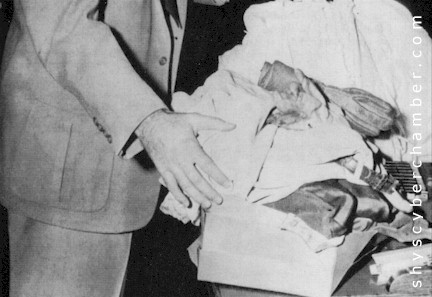
MYSTERY CLUES : THE MISSING WHITE T-SHIRT
:
A T-shirt found washed up on the pier of the Sheppards' neighbours. Dr Sam
could not explained what had happened to his T-shirt, but this one had no blood
on it and officials said it was not his. |
|
|
Summing up for the prosecution, Mahon's assistant, Thomas Parrino,
asked, 'If the defendant would lie under oath to protect a lady, how many lies
would he utter to protect his own life?'
An interesting element to the case was introduced by Sam's brother Dr Stephen
Sheppard. Before the trial he had suggested to the police that perhaps
some men in Bay Village had been 'interested' in Marilyn with perhaps not the
most honourable intentions.
At the trial during his time in the witness box, Stephen Sheppard testified that
Marilyn had told him that Mayor Houk had been pestering her with his attentions
for over two years. Later, during the trial, Detective Schottke said that
Sam had told him that his wife had at least three potential lovers. |
|
|
 MYSTERY CLUES : THE BLOODSTAINED PILLOW
:
On the bloodstained pillow from the
Sheppards' bed, the prosecution claimed to have found the imprint (circled
above) of a surgical instrument. But no one could identify what sort it
was. |
|
|
The suggestion that other men may have been attracted by Marilyn
infuriated Houk, who had threatened to punch Stephen Sheppard on the nose.
When Houk eventually testified himself he said, 'Marilyn was the purest girl I
ever knew.' But further suspicions were cast when Sheppards' maid told the
court that Houk used to visit Marilyn in her bedroom when she was ill and alone
in the house.
However, nothing really came of these vague suggestions that perhaps Marilyn
Sheppard had been murdered by a lover, frustrated or otherwise, or by a jealous
lover's wife.
Mahon and Parrino were relentless in their pursuance of the conviction of Sam
Sheppard, despite the lack of logic - and especially evidence - in their
argument. |
|
|
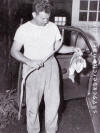 MYSTERY CLUES : PIPE AND RAG
:
This pipe and rag were found on the beach in front of the Sheppards'
home, but failed to yield any clues to support the doctor's story of
being attacked by 'a large man' and left unconscious. |
|
|
They claimed Sheppard's trousers were wet
because he had tried to wash away the blood after killing his wife. They
also suggested that he had inflicted the injuries on himself, either to support
his alibi or possibly to kill himself.
Perhaps their most potent tactic was the way in which they drummed unanswered
and unanswerable questions into the juror's heads. Why did Sam not go to
his wife's aid more quickly? How was it possible for him to sleep through
the commotion? How was this athletic man knocked to the ground so easily?
Why did the Sheppard family dog not bark when an intruder entered the house?
These and other questions were fired at the jury one after another.
Corrigan, for the defence, made little or no mention of the scraps of evidence
that the prosecution had failed to explain. There was a fragment of tooth
in the bedroom (other than the two belonging to Marilyn), which did not come
from either Marilyn or Sam. There was the mysterious 'surgical instrument'
which was never identified. |
|
|
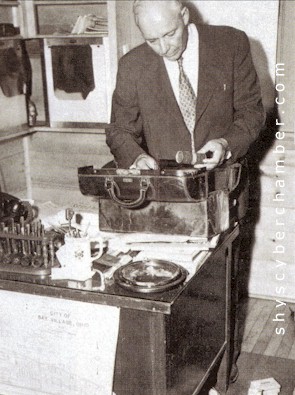
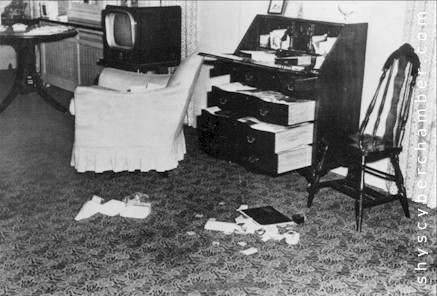
 MYSTERY CLUES : SHEPPARDS' MEDICAL BAG
:
Sam Sheppard's
medical bag is examined for clues. It is unknown whether he had upset the
bag himself or whether an intruder had turned it out on the living room floor,
looking for drugs. |
|
|
Other pieces of evidence that were not scrutinized properly were
a small piece of red leather, a chip of a woman's nail polish of a type
different to that used by Marilyn Sheppard, and wool threads found in
microscopic scrapings under the victim's fingernails. Nor did Corrigan
follow up on the footprints of a woman which were found on the beach.
Following the prosecution's lead, Corrigan concentrated on the Sheppard
marriage. 'Is sex the only thing in a marriage?' he asked. 'Sheppard
wandered from the path of rectitude. That didn't prove he didn't love his
wife, his home, or his family.'
Judge Blythin began his address to the jury at 9am on Friday 17th December.
He did not analyse the evidence in detail, but instructed the jury in the laws
governing circumstantial evidence, and the difference between first-degree and
the less premeditated second-degree murder. |
|
|
THE DAY BED
:
Three people involved in the murder case pose beside the
daybed in the Sheppards' living room where Sam Sheppard fell asleep
prior to his wife's murder: they are from
left to right, coroner Samuel Gerber, chief prosecutor John Mahon and
assistant Thomas Parrino. |
|
|
The jury retired at 10am. Its deliberations were to prove
among the longest in any American trial of the century. It was 4pm on
Tuesday 21st December before they returned.
Judge Edward Blythin read out their findings. Sheppard was acquitted of
first-degree murder. Then the judge read, 'But we find him guilty of
murder in the second-degree.'
Sheppard was told to step forward. 'I'd like to say, sir' he told Judge
Blythin quietly and without anger, 'that I am not guilty. I feel there
have been facts presented to this court that definitely prove that I could not
have committed this crime.'
Without making a comment, Judge
Blythin thereupon sentenced Dr Sam Sheppard to life imprisonment. |
|
|
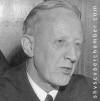 JOHN EDWARD BLYTHIN :
Judge Edward Blythin presided over Sheppard's 1954 trial. He was
eventually to receive one of the most stinging rebukes ever handed down by the
US Supreme Court, accused of pre-trial prejudice against the defendant. In
1955, he was to deny a motion for a new trial. |
|
|
Two days after Sam Sheppard became Prisoner 98860 at Cuyahoga County Jail, the
keys to his house in Lake Road were returned to his family. This was their
first opportunity since the murder to conduct their own scientific tests on the
evidence.
Sheppard's attorney, William Corrigan, promptly hired one of the country's
leading criminalists, Dr Paul Leland Kirk of the University of California, to
study the house. (Kirk called himself a 'criminalist' - one concerned with
facts about the crime - rather than a criminologist, who deals with broad
sociological and behavioural theories about crime and punishment.)
Kirk began work on 22nd January 1955 in Cleveland and, after exhaustive research
inside his laboratories in California, produced a 10,000 word report published
in April 1955. |
|
|
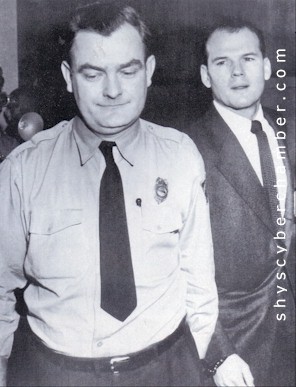
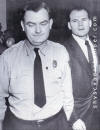 SAM SHEPPARD :
Sam Sheppard is led from the
court by a guard at the end of the trial. The strain had taken its toll,
but he still had to wait several days before the jury reached a verdict - one of
the longest deliberations in US history. |
|
|
Kirk reported that a fourth person - someone other than Sam, Marilyn or 'Chip'
Sheppard - had been inside the bedroom on the night of 3rd July 1954.
Kirk found blood on the wardrobe door that did not match that of the Sheppards.
Fragments of Marilyn's teeth had been found by the police on the carpet.
According to Kirk, they could not have been placed where they were as a result
of the blows to Marilyn. He concluded that Marilyn, struggling for her
life, had bitten her attacker. This person would certainly, he said, have
carried marks from such strong bites, but none had been found on Sheppard after
the murder.
Kirk was convinced that, if Sheppard was the killer, his trousers would have
been soaked with blood. But only one small spot had been found on them.
The pattern of the bloodstains on the walls showed that the killer had struck
with left-handed blows, he said. Sheppard was right handed. |
|
|
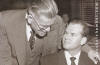 THE SHEPPARD FAMILY
:
Sam Sheppard (seated) gains some comfort from his father, Richard during the
1954 trial. The Sheppard family crisis brought out the worst in many of
their fellow citizens. |
|
|
'No actual proof of a technical nature was ever offered
indicating the guilt of the defendant,' Kirk concluded. He ridiculed
Coroner Gerber's view that Marilyn Sheppard was killed by a surgical instrument.
On 10th May 1955, Judge Blythin refused to grant a retrial on the basis of
Kirk's findings. On 20th July, the Ohio Court of Appeals upheld Sheppard's
conviction, though it conceded that much of the newspaper coverage before the
trial 'was intended to spur on the investigation'. Five days later, the
same court rejected an appeal for a new trial. It praised the 'originality
and imagination' of Dr Kirk, but described his report as 'speculation'.
The following summer, on 31st May 1956, the Ohio Supreme Court upheld Sheppard's
conviction, by a vote of 5 - 2. But the two dissenting judges said there
had been scant evidence to prove Sheppard guilty. They also voiced their
opinion that the trial judge had accepted gossip as evidence, and allowed jurors
to discuss the case with their families. |
|
|
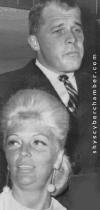 ANNE MARIE :
If Ohio and the Sheppard case lacked glamour and fizz, that void was filled by
the arrival of the Boston attorney, F. Lee Bailey and the rich German socialite
Ariane Tebbenjohanns, both pictured above. |
|
|
On 19th December, the country's highest judicial body, the US
Supreme Court, hinted at similar doubts. For technical reasons, it refused
to review the case but one of its seven members, Mr Justice Frankfurter, wrote
that this 'in no way implies that this court approves of the decision' in Ohio
not to re-try the Sheppard case.
Sam Sheppard had spent most of the $100,000 inheritance from his father on legal
fees. But Corrigan, who originally doubted Sheppard's innocence, told him:
'I don't care you don't have any money. I'll fight this thing through as
long as I live.'
The family turned next not to a set of judges, but to America's most famous
detective story writer, Erle Stanley Gardner, creator of the fictional
detective, Perry Mason. Gardner ran a respected non-profit organisation
known as the Court of Last Resort, using criminologists to look into alleged
miscarriages of justice. |
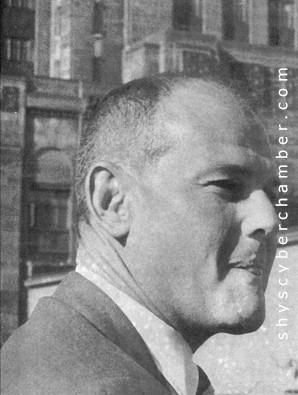
|
|
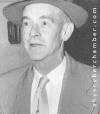 THE 'CRIMINALIST' :
Dr Paul Leland Kirk, who claimed after the trial that Sheppard could not
have killed his wife, described himself as a criminalist - one concerned with
the facts of crime, not theories, like a criminologist. He graduated in
chemistry at Ohio State University in 1924 and held scientific degrees from the
Universities of Pittsburgh and California.
He was among the pioneers of scientific detection in the USA. His book
Crime Investigation: Physical Evidence and the Police Laboratory, has been
standard reference work for police forces around the world. Kirk also
established 'crime labs' in Chicago, St Louis and California.
During the Second World War, he worked on the programme for developing
plutonium, the fuel used for the atomic bomb.
Kirk's research convinced him that the killing of Marilyn Sheppard began as a
sexual attack and that Sam Sheppard was innocent.
Unfairly convicted due to lack of investigation into the available evidence and
scientific ignorance. |
|
|
'We agree to take lie-detector tests,' Stephen Sheppard wrote in
his letter to Gardner. The detective writer had great faith in such tests
and knew that, if Stephen or Richard Sheppard, or their wives Dorothy and Betty,
failed the tests, they could be prosecuted as accessories to the murder.
The Sheppard family took the lie-detector tests on 4th May 1957 in Chicago.
The tests were applied by four internationally-known criminologists. The
four Sheppard family members were given complete, unanimous passes. On
19th July 1957, the Governor of Ohio, C. William O'Neill, agreed to allow a
lie-detector test on Sam Sheppard.
The test never took place. In the same month, Donald Wedler, a 23 year old
serving a ten year sentence in Florida for attempted armed robbery, made a
confession to the murder of Marilyn Sheppard. Coroner Gerber and two
detectives from Ohio interviewed Wedler and decided the confession was 'a
complete hoax'. The Court of Last Resort sent a lie-detector expert, Alex
Gregory, who announced that 'Wedler is telling the truth or what he believes to
be the truth'. |
|
|
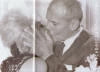 SAM SHEPPARD & ARIANE
:
On 18th July
1964, only two days after leaving prison, Sam Sheppard kisses his new bride
Ariane, after a civil ceremony at a Chicago hotel. The glitz sickened even
his supporters. The US Supreme Court said he had been denied a fair trial. |
|
|
In the confusion, Governor O'Neill revoked his permission for Sam
Sheppard to take the lie-detector test. Erle Gardner was deeply
disappointed, and withdrew the Court of Last Resort from the Sheppard case.
William Corrigan, Sheppard's loyal attorney, tried on last legal opening.
In the summer of 1958, he appealed to the US Supreme Court to rule that the
prosecution at the trial had withheld vital evidence. The case was
dismissed in May 1960.
Sam Sheppard had by this time found some unexpected moral support. In
March 1959, his brother Stephen received a letter on crimson stationery from a
woman in West Germany. It was only one of scores from women around the
world who wanted to console Sam. But the simple signature, 'Ariane', in
white letters caught Stephen's eye. He showed the letter to his brother on
his next visit to Ohio State Penitentiary, where Sam had spent the previous five
years. |
|
|
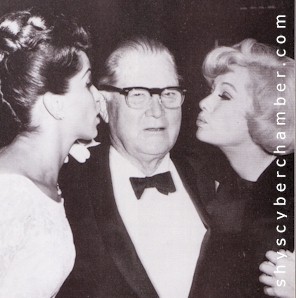
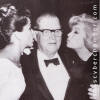 FACT MEETS FICTION :
IN 1936, Erle
Stanley Gardner - pictured above with actresses from the TV series based on his
Perry Mason books - resigned from the California bar to take up writing crime
fiction full time. He had been a successful lawyer since 1911, when he was
just 22 years old.
Gardner had discovered that he had a talent for
writing, scoring his first success in 1932 with his book The Case of the
Velvet Claws. The main character was his now-famous creation, attorney
Perry Mason, who has appeared in countless subsequent books.
Gardner's considerable legal experience enabled him to imbue his books with
authenticity, and he was always scrupulous in ensuring that the details of his
intricate plots were correct. His stories usually hinge on a point
of law, forensic medicine or matters of science. They invariably end with
a courtroom climax.
Mason was not Gardner's only creation. Later, he added the DA series which
dealt with a county district attorney, the Bertha Cool and Donald Lam books
written under the name of A.A. Fair. When he died in 1969, aged 80,
Gardner had over 120 titles to his credit. |
|
|
'Ask her to send a picture,' Sam said. The writer was a
wealthy 29 year old woman named Ariane Tebbenjohanns, who had followed reports
of the trial in 1954 and felt outraged by the verdict against the handsome young
surgeon.
A busy correspondence developed. To get around prison regulations, Stephen
delivered Ariane's letters by hands on his visits, and wrote Sam's replies down
on a scrap of paper which he would forward to Ariane without comment.
'She sent me a little lock of her hair,' Sheppard later recorded. 'To me,
she was Sophia Loren, Doris Day, Marilyn Monroe and Liz Taylor all wrapped up in
one.' |
|
|
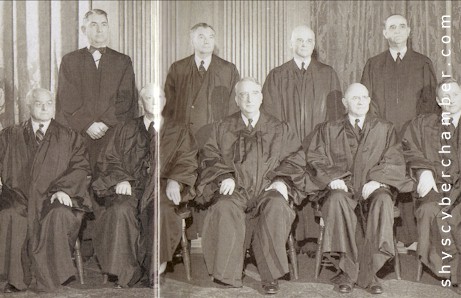
THE US SUPREME COURT :
In 1956, the
US Supreme Court - the highest federal court in the land - rejected William
Corrigan's appeal that vital evidence had been withheld. Ten years later,
it overturned Sheppard's conviction. |
|
|
Then, in August 1961, two event transformed Sheppard's fortunes.
First, his dogged, but exhausted, attorney William Corrigan died at the age of
75. Soon after, a fast talking young lawyer from Boston named F. Lee
Bailey arrived in another Midwestern city, Chicago, to lecture on the virtues of
the lie-detector tests.
The 29 year old Bailey had been practicing law for only nine months and needed a
big case. In Chicago, he was approached by Paul Holmes, a journalist whose
book, The Sheppard Murder Case, Bailey had already read.
By November 1961, Bailey had agreed with Stephen Sheppard to represent Sam.
At his first meeting with his new client, in January 1962, Bailey told him,
'I'll charge you a whopping fee but I'll help you earn the money to pay for
it... don't pack your suitcase yet, but keep your clothes clean.' |
|
|
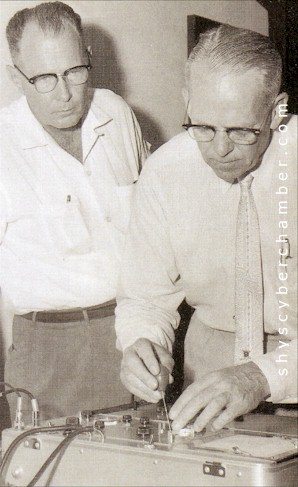
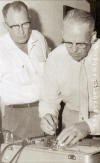 RODNEY THURSBY & ALEX GREGORY
:
In the town
of De Land, Florida, Sheriff Rodney Thursby (pictured above left) watches
polygraph expert Alex Gregory prepare to check the confession of Donald Welder
who, in July 1957, claimed to have killed Mrs Sheppard. |
|
|
Bailey threw himself into securing Sheppard's freedom. He
began by lobbying the Ohio authorities for Sam Sheppard to be allowed a
lie-detector test. He also gave a succession of lectures and news
interviews, keeping interest in the case alive with his abrasive charm.
The brash young attorney also went to see Louis Seltzer, still the editor of the
Cleveland Press. Seltzer refused to support Bailey's campaign for a lie-detector
test.
'You're an old man,' Bailey retorted. 'You've got the money and the
influence but someday, somehow, I'm going to hold you up to scorn and ridicule.'
Seltzer threw him out. |
|
|
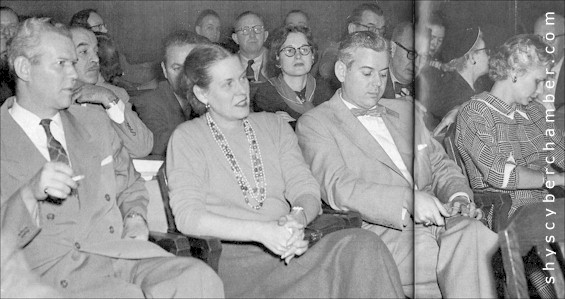
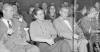 THE SHEPPARD BROTHERS :
Sam
Sheppard's brothers, Richard (above left) and Stephen (centre)_, together with
their wives Dorothy and Betty, also saw their lives transformed by the court's
miscarriage of justice. |
|
|
The judicial process moved slowly. It was December 1962
before the Ohio Supreme Court rejected Bailey's petition. The following
month, the Sheppard case became more lively than ever with the arrival in the
USA of Ariane Tebbenjohanns.
Sheppard had been transferred to Marion Correctional Institute as a model
prisoner. On the morning of 24th January 1963, a guard told him that 'a
blonde stunner in a mink coat' was there to see him. Stephen Sheppard had
pleaded with Ariane not to raise his brother's legal or romantic hopes.
But at the end of the four-hour visit, Sam asked her to marry him. She
accepted. 'It was love at first sight,' Sheppard wrote later. 'It
was love before first sight.'
Over the next few days, Ariane's German background and her relatives' links to
the Nazis were dug up by the Cleveland Press. This, and her public
statements criticizing the American justice, tarnished Sheppard's reputation as
a model prisoner.
On 31st January, the state's Pardon and Parole Commission refused to
release Sheppard. After that, Bailey and Stephen Sheppard ensured that
Ariane said as little in public as possible. Two weeks later, Marilyn
Sheppard's father, Thomas Reese, who had refused to support the Sheppard family,
shot himself. He left a note saying: 'I am sick of everything.
Goodbye.' |
|
|
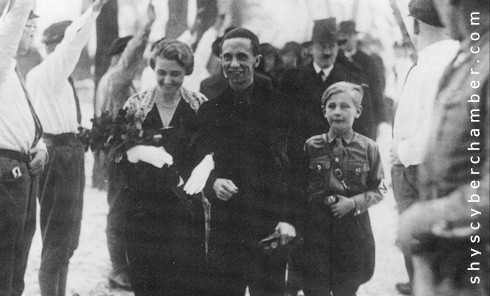
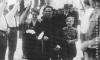 ARIANE & THE NAZIS :
Ariane
Tebbenjohanns was born in 1929, the daughter of German businessman, Oskar
Ritschel, who, she claimed, was fervently anti-Nazi. Brought up in
D�sseldorf, Ariane had a half-sister, Magda, by her father's first marriage.
In 1930, Magda had married Josef Goebbels, a leading Nazi. The best man at
their wedding (pictured) was Adolf Hitler. Goebbels went on to become
Minister for Propaganda after the Nazis took power, leading the persecution of
anti-Nazi intellectuals.
According to Ariane, Goebbels once shouted at her father, 'If you weren't my
father-in-law, I would have you thrown into a concentration camp.'
Goebbels and Magda killed their six children and committed suicide in 1945 as
Soviet troops entered Berlin.
Ariane said that she had joined a Hitler Youth organisation, but never the Nazi
Party. However, the American people remained suspicious of her. She
married Olaf Tebbenjohanns in 1952, but they were divorced six years later. |
|
|
In April 1963, Bailey petitioned the US District Court - a federal, not a state,
body - to reopen the case. The judicial process again moved with painful
slowness. Then, over a year later, on 15th July 1964, Judge Carl Weinman
caused a fresh sensation.
Judge Weinman described the original trial as 'a mockery of justice'. He
singled out Judge Blythin and the Cleveland Press for stinging criticism: 'If
ever there was a trial by newspaper, this was it.' He ordered that
Sheppard be released and granted a retrial.
Sheppard was freed after ten years in prison. He married Ariane
Tebbenjohanns three days later in Chicago. Then more legal difficulties
set in. The US Sixth Court of Appeals, another federal body, overturned
Judge Weinman's ruling. But it allowed Sheppard to remain free while
Bailey appealed to the US Supreme Court.
Over a year and a half passed before Bailey, thumbs up in his waistcoat pocket,
appealed to the most venerable judges in the USA to allow Sheppard to be
retried. On 6th June 1966, Bailey was defending a man on a bank robbery
charge in Massachusetts when the judge was handed a message. 'I want Mr Bailey
to know that he's won,' the judge said. It was almost 12 years since the
murder. |
|
|
 AN INSIDE JOB? :
Whoever
killed Marilyn Sheppard made a clumsy attempt to stage a burglary of the living
room at Lake Road. However, some things had been stolen, such as Mrs
Sheppard's watch and money from a wallet. |
|
|
Everyone linked to the investigation into Marilyn Sheppard's
death agreed that the murderer was someone she knew.
If Sam Sheppard's story of at least one nocturnal intruder on 4th July 1954 was
true, then the murderer or murderers knew where to find a small side door
leading to steps down to the beach, a far safer escape route to the dark than
the front entrance on to the main road.
The Sheppards' lives were almost entirely bound up with Bay Village.
Marilyn took part in church work, played bowls and golf and learnt how to
water-ski on the lake. Sam Sheppard, besides his hospital work, was the
unpaid police surgeon for the district, on 24 hour call. To relax, he
played outdoor sports with local youngsters.
'The answer to the Sheppard case riddle lies in Bay Village,' wrote Harold
Bretnall, a private detective from New York. Bretnall was hired by
Sheppard's family in 1955, after the first trial. He was preoccupied with
Sam's phrase, while still groggy, when telephoning John Spencer Houk for help.
'I think they've killed Marilyn,' Sheppard said. |
|
|
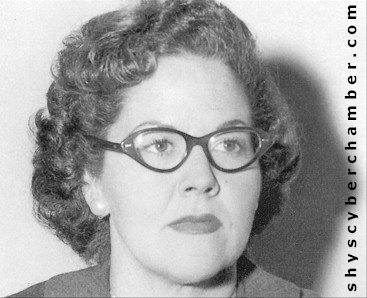
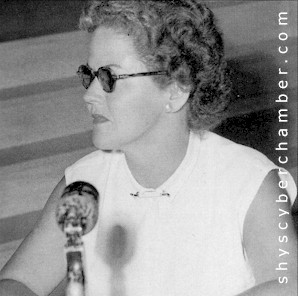
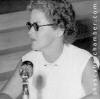 NANCY AHERN :
Neighbours
in Bay Village, the home of the Sheppards, believed that Mrs Sheppard's close
friend, Nancy Ahern (pictured above), knew more than she ever told. This
was typical of village gossip and baseless innuendo. |
|
|
Bretnall died in 1963 while writing a book about the case.
Although he had warned the Sheppard family that his conclusions would be
independent, he quickly became convinced that Sam Sheppard was innocent.
Some of his unpublished findings were described in John Harrison Pollack's book,
Dr Sam : An American Tragedy (1972).
The private sleuth had looked into Marilyn's private life closely, and examined
evidence ignored by the authorities. It had been taken for granted in 1954
that because she had had a difficult pregnancy, and suffered years of sexual
inhibition, Marilyn had to have been murdered by Sam.
However, at the first trial, the jury heard part of Sam Sheppard's statement to
police in which he said that Marilyn had 'spurned lovers - potential lovers...
three that I know of and I am pretty sure more'. In his statement,
Sheppard did not name the men, but stated that he had identified them as
detectives.
Bretnall claimed that a pair of Marilyn's bedroom slippers disclosed evidence
that she had left the house during the night of 4th July 1954 while wearing
them.
'Marilyn Sheppard was murdered by someone who was a frequent visitor to
the Sheppard home,' he wrote. |
|
|
 A CONFESSION :
So deep was the
belief that Marilyn Sheppard was killed by someone who lived in Bay Village that
the confession by a convict in Florida, Donald Wedler (picture above right), was
never taken very seriously.
Wedler, 23 years old at the time he confessed to the killing in July 1957, said
he had been driving a stolen car around the Lake Road area three years earlier.
He claimed to have entered the white house on the lakefront with the view to
robbery, beaten a woman with an iron pipe, struck her husband on the stairs and
fled in the car.
Wedler was a thin, blonde-haired man and did not resemble the well-built
attacker described by Sam Sheppard, although his hair was unruly. While
the details he provided impressed many, the Ohio authorities dismissed the
confession as a hoax.
Sheppard's attorney, William Corrigan, used the confession purely to emphasize
doubts about the case. Wedler passed a lie-detector test, but the expert
who gave it dismissed the results. |
|
|
Don and Nancy Ahern, the Sheppard's guests for dinner on 3rd July
1954, were the last people to leave the house before the mysterious hours from
12.30am to 5.55am when the Houks arrived. 'I can't account for it,' Nancy
said later, 'but everyone in the village had an idea I was holding something
back. I began to get telephone calls accusing me of being evasive.'
Mrs Ahern said this led her to provide testimony based on tittle-tattle about
Sam Sheppard's mistress. It was this evidence that drove Sheppard, a man
who never lost his temper, to fury. It is possible that Sheppard knew far
more about his wife's private friendships than he said, and was embittered to
find gossip working against only him.
John Harrison Pollack, who reported Bretnall's research, suggested that a couple
were the intruders at 28924 Lake Road. 'Could it be,' he asked, 'that the
man was having an affair with Marilyn, that his wife found out about it and
tried to kill her, only to be interrupted by her husband who, out of guilt,
rushed to her aid?'
Paul Holmes, whose book The Sheppard Murder Case
was published in 1961, before the second trial, also believed a couple were in
the house that night. Holmes imagined the husband reaching Marilyn first
for a tryst, only to be followed by a jealous wife who killed Mrs Sheppard.
This, Holmes argued, would explain the fury of the attack, the relatively mild
injuries to Sam, and the unconvincing disarray left by the couple as they
simulated a burglary and left false clues. The couple would have been well
known to the Sheppards, he wrote. That was why the dog did not bark. |