|
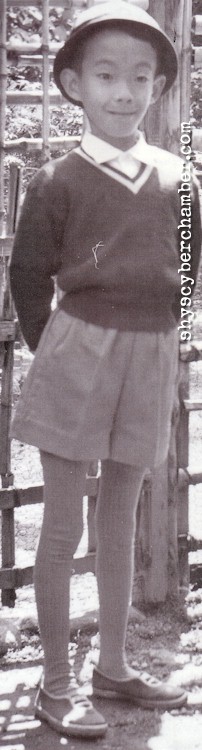
[ Teen Years ]
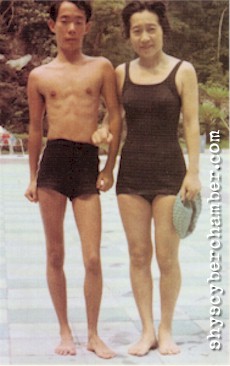
As a teenager, Sagawa pictured here with his mother at a swimming
pool, was always painfully conscious of his slight build and short
stature, which reinforced his isolation and loneliness. |
|
|
It was at this stage in Sagawa's
development that his diminutive physical size began to bother him.
He felt that he needed to absorb the healthy plumpness of those Renoir
women into his own pitiful body. Sagawa's fantasies also
included Western women, especially American actresses such as Grace
Kelly and Jean Seberg, whose marble-white flesh fascinated and excited
him. Much later Sagawa was to say: 'I was a premature and
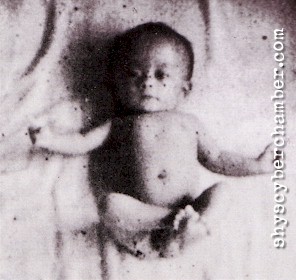
unhealthy baby, I am ugly and small, but I indulge in fantasies about
strong, healthy bodies.'
These fantasies began to dominate his life and became increasingly
powerful, and Sagawa began to recognize that the realisation of his
fantasies would have to involve an act of violence against another
human being. 'I saw a Western woman in the street,' he wrote.
'My fantasies started to act with their own force, sneaking in through
the window. She's showing her back. I should take a belt
and strangle her.'
Sagawa became so concerned about his fantasies that, at the age of 15,
he telephone a psychiatrist for advice. But the psychiatrist
refused to talk to Issei on the phone, telling him that he would have
to visit him in person, and Issei found the idea too shameful.
He tried telling his brother about his fantasies but he seemed to
think it was a joke. In hindsight, Issei's actions appear to be
a cry for help - an attempt to escape from these fantasies, which were
beginning to get out of control. But being denied help by both
the psychiatrist and his brother pushed Issei into an even lonelier
world, where his fantasies took on a more powerful life of their own. |
|
|
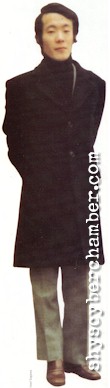
[ Sagawa - The Student ]
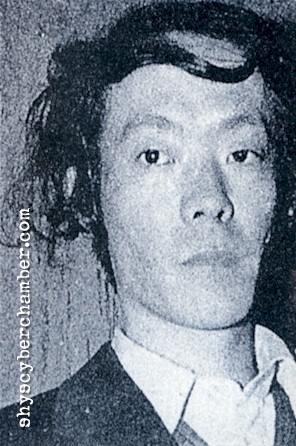
Issei Sagawa photographed in Paris during his years as a student
there. The city made him feel lonely and alienated, intensifying
his cannibalistic fantasies. |
|
|
While carrying out his investigation of
the murder, the Examining Magistrate, Judge Jean-Louis Bruguieres, was
painstakingly thorough. In his attempt to build up a clear
picture of the crime, the judge talked to everyone in Paris who had
known either the dead student, Renee Hartevelt, or her killer, Issei
Sagawa.
Bruguieres soon learned that 25 year old Renee usually spent the
weekends with an Arab boyfriend of whom her Jewish parents
disapproved. This, said one friend, had caused a rift between
Renee and her family, and was the reason why she was receiving no
financial help from them. As a result, Renee was short of money
and had eagerly accepted an offer from Sagawa that she teach him
German.
Those who knew Sagawa did not believe there was any kind of romantic
attachment between him and Renee. Their assessment was that she
must have agreed to go to his apartment in the first place strictly
out of pity for the diminutive Japanese student, who was seen as a sad
loner by all the other students.
But none of the people to whom Bruguieres spoke could shed any light
on the most extraordinary aspect of the crime, the one that all the
newspapers were full of, and the one which its perpetrator said was
his chief motivation - cannibalism. Only Sagawa himself could
explain that.
Bruguieres began an extended series of interviews with the killer in
which he was able to build up a detailed account of the lead-up to the
horrific killing of Renee Hartevelt. Sagawa seemed just as
anxious as his interrogator to understand how he had ended up
committing such an extraordinary crime. Slowly, as the Japanese
student talked and talked, and the pieces of the jigsaw fitted into
place, a nightmare picture of the darkest recesses of the human mind
began to take shape. |
|
|

[ Examining Magistrate -
Jean-Louis Bruguieres ]
Jean-Louis
Bruguieres, the Examining Magistrate in the Sagawa case, undertook to
find out all he could about the murderer. Before long, his
detailed investigation began to reveal the deeply complex fantasies of
the killer's mind. |
|
|
Issei Sagawa had arrived in Paris in
1977, when he was 28 years old. A quietly spoken, shy young man
from a highly cultured background, he had already had an MA degree in
Shakespearean literature following his studies at Wako University in
Tokyo. Now he was joining the Sorbonne's School of Oriental
Studies to specialise in modern avant garde literature.
But while on the outside he lived the ordinary life of an overseas
student in a foreign city, seeing the sights and enjoying the
excitement of Paris, he was also living in a terrifying fantasy world
which had obsessed him for some 25 years.
His fantasies focused on attractive, well-formed Western women and
American screen actresses in particular. The low-cut dresses
they wore on screen, exposing large areas of white skin, filled him
with overwhelming and terrifying urges. he said that he had
wanted to bite into those soft, white shoulders, to taste that
cream-coloured flesh. The masterpieces of Western art with their
rose-coloured naked models also served to fuel his wild imagination.
Coming to Paris therefore only helped to exacerbate the abnormal
fantasy of life which was growing ever harder to control.
Sagawa's homeland of Japan was still in many ways a traditional
society. Even into the 1990's one third of Japanese marriages
were still arranged by the old matchmaking system, in which a relative
or friend of the family introduces eligible singles to each other.
In spite of the well known blind eye which the authorities turn to the
so-called 'love-hotels', where rooms can be rented by the hour,
respectable women still tend to dress modestly.
In any case, Sagawa's sadistic fantasies revolved around Western
women. Yet despite Japan's growing global status as an economic
superpower, there were relatively few of these to be seen in the
country.
There had been one incident in 1970 in which he had climbed through
the window of a German woman's apartment at night, hoping to act out
his cannibalistic obsession. Fortunately for her, she woke up
and her screams frightened him off. As a result of the incident,
Sagawa went to see a psychiatrist, who declared that Sagawa was
'extremely dangerous'. The incident was hushed up, however, and
it seems that for the remainder of his time in Japan, Sagawa managed
to keep his urges under control, allowing his fantasies to revolve
primarily - and safely - around film stars and paintings.
But in Paris, a city that has always claimed to have the most
attractive women in the world, he was surrounded by real life versions
of the kind of women who had occupied his feverish thoughts for so
long. These women were not afraid to wear revealing and sexually
provocative summer fashions. As they sat outside pavement cafe's
with bare shoulders and exposed legs, Sagawa felt like a starving man
looking through the window of an expensive restaurant. Perhaps,
he thought, if only he acted out his terrible fantasy just once, the
obsession would leave him, and he could continue his life in peace.
It was now, uprooted from the familiar ways of Japan and transported
into what literally seemed like another world, that Sagawa crossed
that line between imagination and action.
With the alluring Parisiennes driving him into a fever of longing, his
fantasy became ever more powerful to the point where it became his
dominate reality. He finally reached a point where he made a
conscious decision to carry out his desire and he laid plains
accordingly.
His first thought as to act out his cannibalistic fantasies on a
prostitute - a common recourse for sex criminals from Jack the Ripper
to Peter Sutcliffe, the 'Yorkshire Ripper'. No doubt, Sagawa
believed that a prostitute would be less likely to be missed. On
at least seven separate occasions, therefore, he invited prostitutes
back to his apartment, but each time found himself unable to go
through with his plans.
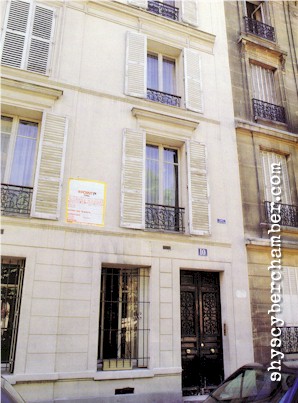
Sagawa was living in an apartment on rue de Longchamp - in the same
fashionable district where he was staying at the time of his arrest -
when he picked up one particularly beautiful blonde prostitute and
took her back to his room. She went to his bathroom to use the
bidet, and he got as far as following her with a knife. But at
the last minute, he could not bring himself to stab her. He had
sex with the woman instead and to his relief the fantasies for
cannibalism subsided, but only for a while.
The relief was only temporary. Soon the urge was back, stronger
than ever. At this point he decided that if he could not bring
himself to stab a woman, perhaps it would be easier to kill her with a
gun. |
|
|
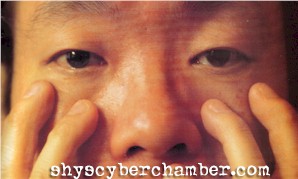
[ Issei Sagawa ]
Was Sagawa the victim of a bizarre and terrifying sexual obsession
or, as some psychiatrists who examined him believed, simply a
dangerous sexual criminal, who should have been locked away behind
bars? |
|
|
Sagawa was surprised at how straightforward obtaining a gun proved to
be. Without bothering to apply for a permit, he walked into a
gun shop and brought a .22 carbine, a small rifle usually used for
hunting. He put the weapon in a cupboard in his room and went
out searching for another potential victim. Once again a
prostitute seemed like the easiest target.
He took another girl back to his room,
but once more could not bring himself to kill her. This one was
young, almost like a school girl. 'I enjoyed talking to her,'
he told Judge Bruguieres.
Instead of murdering and eating her, as he had planned, he made
friends with the young prostitute. She returned to his room on
several occasions, even cooking meals for him. He raised the
subject of cannibalism in as casual a way as he could. She
listened, and even went as far to bring him a book on the subject.
When the authorities finally tracked the girl down, she told them that
she remembered Sagawa, but that it had never crossed her mind that
this apparently harmless young man had a genuine longing to taste the
flesh of a human being.
In October 1980, Sagawa went home to Japan for an extended visit.
None of his friends or family reported seeing any change in the young
man whose fantasies were now running so terrifyingly out of control.
But during his four month stay Sagawa was forcibly struck by the
absence of those beautiful Western women he had got so used to on the
streets of Paris. 'For Japanese I haven't any sexual desire,' he
later told Peter McGill, a reporter for the Observer newspaper, 'I am
feeling as if she is my own daughter - no, sister, so it would be
incestuous.'
Sagawa returned to the French capital in February 1981. His
studies at the Sorbonne were now near complete. Soon he would be
returning to Japan permanently, and the chance to live out his fantasy
of eating a white woman might be gone forever. Later, Sagawa
claimed that the thought of leaving Paris without having tasted female
flesh caused him extreme mental anguish - as this might be his only
opportunity of fulfilling his dream. It was at this point that
his path crossed that of 25 year old Renee Hartevelt from Holland.
Sagawa had come back to the Sorbonne to put the finishing touches to
her doctoral thesis about his favourite Shakespearean play, The
Tempest. But he was a hard worker and he also found time to
continue attending classes in modern literature. Renee had
arrived at the Sorbonne only recently. She was in Paris to do
post-graduate work for her doctorate at the Censier Institute, another
arm of the University of Paris. One day in May she stood up in
class to read her paper about Dadaist poetry.
Sagawa, who was attending the same class, was immediately captivated.
Renee, a typically fair-skinned Dutch girl, had the classic white
shoulders that had so obsessed the young Japanese man. Renee
also had a sweet, gentle smile, clear grey eyes and a sensual figure.
Sagawa later recalled in his autobiographical book In The Fog
how he was completely mesmerized by his first impression of her: 'I
couldn't keep my eyes off her. Out of her short t-shirt I could
see her white arms.'
There and then, Sagawa - now deep in the grips of his dark fantasy -
decided that this was the woman he was destined to eat. He went
on to explain to Judge Bruguieres that he had not been in love with
Renee - it had been a sexual obsession. For Sagawa, however,
this meant not ordinary sex, but rather cannibalism. Within a
month, he would have turned this terrible fantasy into a still more
terrible reality. |
|
|
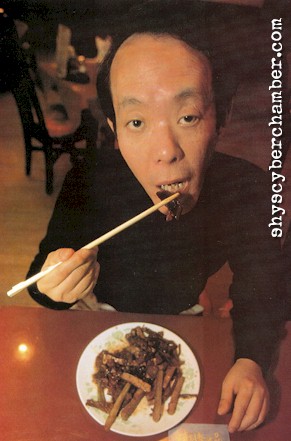
[ Issei Sagawa ]
Back in Japan, Issei Sagawa has been feted for his crime. His
attitudes towards sex and eating have been heavily exploited by
popular press and television. This picture, showing Sagawa
eating barbecued food in a restaurant, appeared as part of a feature
on the gourmet page of a magazine. |
|
|
Issei Sagawa claims that his sexual
violation of Renee Hartevelt was almost an afterthought, altogether
less important that the pleasure of eating her flesh. But should
we trust his own account of his actions if we are to make sense of
this most bizarre of murders?
Was it, as Judge Bruguieres decided, the act of someone who had
completely lost his grip on reality and was suffering from psychosis -
the deluded belief that eating human 'meat' would bring him sexual
satisfaction?
In many ways, Sagawa showed the classic symptoms of a sexual murderer.
Unlike other murderers, this type of killer does not strike out of
revenge or in a spontaneous outburst of rage. He kills to
satisfy an overwhelming inner compulsion, which, if repeated, turns
him into a serial killer.
By his own admission, Sagawa's compulsion was to possess women to the
extent of consuming their flesh. It was a fantasy that had taken
root in childhood and had haunted him for 20 years before he finally
yielded to it. |
|
|
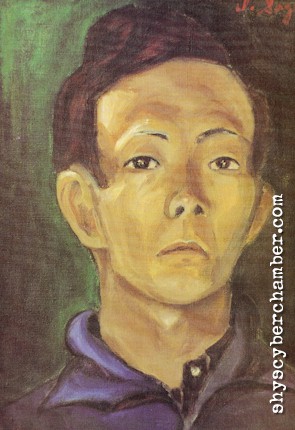
[ Issei Sagawa ]
This self-portrait by Issei Sagawa reveals the face of an aloof and
rather suspicious man. The acting out of his fantasies turned
him into a psychiatric puzzle . But the tragedy of the case is
that if he had believed he could build a relationship with Renee,
based on a 'normal' sexual relationship, his flesh-eating obsession
might have retreated permanently. |
|
|
There were aspects about the crime that
puzzled Jean-Louis Bruguieres. On one hand, Sagawa appears to
have had no desire to see his victim in pain or for her to know she
was about to die. This showed a concern completely alien to the
typical sexual killer who is by nature a sadist. Another oddity
is that Sagawa did not find the act of killing a peak sexual
experience. Instead, fulfillment came with undressing Renee's
body and eating her flesh.
However, in other aspects Sagawa's behaviour showed the marks of a
serial killer. He chose one of the buttocks - a very sensual
part of the body - as the area to eat first and then kept some of the
victims parts so that he could savour the sensation again.
He also maintained a facade of normal behaviour, showing not the
slightest trace of guilt.
When the full impact of what he had done began to register, he
experienced a deep sense of anti-climax and sank into a black
depression.
According to Sagawa, he found the murder and its aftermath such a
brutal awakening that it cured him permanently of the temptation to be
violent (although, significantly, he has never claimed to have lost
his desire for eating human flesh).
Judging by the hopelessly inept way he tried to dispose of the body,
his actions were indicative of a man who wanted to be caught.
It is fortunate that Sagawa was caught early, for there was enough
evidence to suggest that, after his initial revulsion at what he had
done had gradually been overtaken by the urge to do it again, he could
quite easily have developed into a fully fledged serial killer.
Sagawa later claimed that - after the murder and his stay in La Sante
Prison and the Henri Colin Asylum - his delusional world burst like a
bubble. He believes that his compulsion made him temporarily
sick, but that he has now made a full recovery.
However, others disagree. Some French and Japanese psychiatrists
still think he deceived the authorities into believing he was insane
to disguise the fact that he was a dangerous sexual criminal. |
|
|

[ Crime Scene ]
Sagawa chopped
up Renee's body in the cramped bathroom of his Paris flat to let the
blood drain away. Many sexual killers derive pleasure from
cutting up their victims' bodies but Sagawa claimed to find the whole
process of dismemberment extremely distasteful. |
|
|
According to the account given by Sagawa
to Judge Bruguieres, the first moment he saw Renee Hartevelt in a
literature class at the Sorbonne, Sagawa started to lay plans to lure
the unsuspecting girl into his fantasy world of murder and
cannibalism. Pure chance and the Dutch girl's easy-going,
friendly disposition combined to make this far easier than he had
imagined.
Sagawa was on his way home on the Metro after that very first class,
when he bumped into the girl again by sheer accident. They fell
into easy conversation about their research work. It was just
the opening Sagawa had been hoping for. he made sure he did not
miss the next class. Sure enough, Renee was there too.
When the class ended, someone came up with a plan for an outing to a
Greek restaurant - Renee and Sagawa formed part of the group.
Sagawa was the only Japanese among the group of students, and one of
them suggested they should try a Japanese restaurant next time in his
honour. Sagawa instantly took the opportunity to invite them all
to his apartment to eat the traditional Japanese meat, vegetable and
noodle dish called sukiyaki.
It may be that most of the students did not take Sagawa
seriously. Or it may be that they did not want to visit the
Japanese mans room. Bruguieres found no one among the student
body who considered himself Sagawa's close friend, and the killer
regarded himself as being entirely friendless in Paris. So, on
the appointed day, only one of the students actually turned up for the
meal. Much to his surprise, it was Renee Hartevelt.
The two students talked about music, while Sagawa played recordings of
his favourite composers, Handel and Beethoven. Sagawa later
described the conversation as 'pleasant'. Renee let slip that
she could speak English, French and German fluently. She also
made no secret of the fact that she was short of money. Sagawa
saw his opportunity. He suggested she should return to his
apartment on a regular basis to give him German lessons for which he
would pay her well. Renee was delighted at the prospect of an
extra source of income and agreed readily.
Renee asked Sagawa why he was so anxious to learn German. The
explanation he offered was that he wanted to be able to read German
Romantic poetry in the original. The truth was that he had not
been prepared for Renee arriving that day, so he had not laid
his plans for murder. Now he needed an excuse to invite the girl
back to his apartment again alone, when she would be totally at his
mercy.
By the day of the first German lesson, Sagawa had his plan worked out.
He would wait until Renee was occupied with a book. Then he
would go to the could while she read, take out his gun, step behind
her and shoot her through the neck just above the shoulders.
Once she was dead, he would undress her. Then he would eat her.
But after his experiences with the prostitutes, Sagawa was not at all
sure if he would be able to go through with the killing when the time
came. And anyway, would Renee turn up?
Sagawa need not have worried about her reliability. She was not
the kind of girl to break appointments, and anyway she needed the
money. She arrived on time. In the room which served as
both bedroom and study, she sat on the floor with her book. The
gun was ready in the cupboard. But once again, when it came to
the point, just as he had suspected Sagawa found himself unable to
carry out his plan. The gun stayed safely in its cupboard and
Renee got up and left when the lesson was over, totally unaware of the
danger she had been in.
When she was gone, Sagawa was full of self-loathing. He called
himself a hopeless dreamer - too weak to live out the fantasy that had
haunted him for so long. He told himself that if he did not go
through with it the next time he would never be able to respect
himself again.
The day before his next German lesson with Renee, Sagawa was not
feeling well. He had a bad cold and was running a slight fever.
But then a man from his father's firm, Kurita Water Industries, a
water treatment company in Osaka, arrived, bringing with him some
choice items of Japanese food with him from home. Sagawa felt it
his duty to show him the bright lights of Paris. They spent the
day sight-seeing and that evening ended up in a Japanese restaurant.
Looking at the raw fish laid out in the Japanese style on the counter
for the customers to see, Sagawa was suddenly filled with a new and
terrible determination. He had dreamed for so long of biting
into the soft white flesh of a woman. How stupid it would be if
the mere fact of not feeling well should prevent him from finally
fulfilling his ultimate fantasy the next day. |
|
|
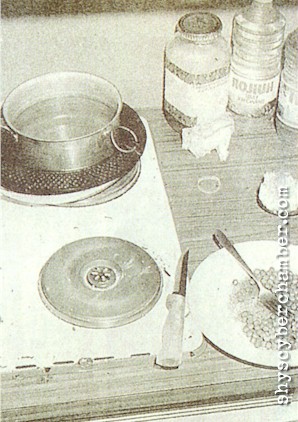
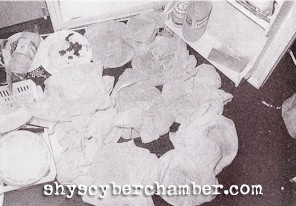
[ Crime Scene ]
Sagawa
prepared the flesh from his victim on the cramped work surface of his
tiny kitchenette and cooked it on this two ring cooker. The
whole procedure was carried out with almost ritualistic precision. |
|
|
Renee arrived on time once more for the German lesson the following
day. By now, it seems it was not just the money she was
interested in. Her parents gave the police access to letters she
had written home during her time in Paris. In one of the last
she wrote of a new friend she had made. She described her new
friend as being 'kind and sympathetic', and she said that she hoped to
be able to introduce him to the family. There seems no doubt
that she was referring to Sagawa himself - behind the shy, diffident
manner there was a charming, sociable and entertaining man.
Sagawa made sure that Renee sat with her back to the cupboard where
the gun was kept. He waited until she was totally occupied
reading German poetry aloud, then he made his way quietly over to the
cupboard, drew back the curtain and gripped his .22 rifle.
This time his nerve did not fail him. With Renee quite oblivious
to her danger, he aimed the weapon at the back of her neck at
point-blank range and pulled the trigger. There was a click and
nothing else. Inexplicably, the rifle had jammed. Renee
did not seem to have heard the faint sound, so Sagawa simply put the
rifle quietly back in the cupboard, and went on with his German
lesson.
Still without the slightest inkling of the danger this quiet man
posed, Renee returned to his apartment once more. It was
Thursday 11th June 1981. They sat once again on cushions on the
floor in the Japanese manner, he gave her a concoction of tea and
whiskey, 'to deaden the pain' as he explained later, she with her back
to the cupboard and its fatal contents, while she began reading him a
poem by the German poet Becher called 'Evening'.
Saying he was going to switch on the tape recorder, Sagawa got up and
went to the cupboard. He took out the .22 and stood behind the
girl. Again, he held the muzzle of the rifle to the nape of her
neck, almost touching the white skin. Renee stopped reading.
Sagawa fired. Unlike the last time, the rifle operated normally.
Death was instantaneous.
According to his own account, Sagawa fainted when he saw what he had
done. When he came to, and saw Renee lying dead in a growing
pool of blood on the apartment floor, he could not believe this was
really happening. A part of him was horrified at his own actions
and afraid of the dead body, the first he had ever seen. Another
part of him slipped into the fantasy he had imagined so many times.
In this dream world the horrific reality of what he was doing could
not reach him.
He undressed the dead girl, and placed her carefully face down on the
floor. Sagawa had planned exactly what he would do next.
Believing that the left buttock might contain more blood because it
was closer to the heart, and not liking the sight of blood, he bent
down and bit into her right buttock, but failed to break the flesh.
Sagawa went to the kitchen drawer for a knife. Using a sharp
carving knife, he cut deeply into the white flesh of which he had
dreamed so much. He remembered seeing a thick layer of fat which
he described as 'as yellow as a corncob'. Then his knife reached
red meat. He cut a piece, put it in his mouth and chewed in a state of
extreme sexual excitement.
The flesh reminded him of raw tuna fish. It was as delicious as
he had hoped. He turned the body over and cut more flesh from
the thigh, which he also ate raw. Then, he admitted to Judge
Bruguieres, he raped the dead woman. But he insisted that the
sexual violation was more or less an afterthought. The main
pleasure and satisfaction he derived from the killing was from eating
Renee's flesh.
The dead woman had bled profusely all over the carpet, and Sagawa
realised he could not leave the body where it was. He dragged
the corpse into the bathroom and heaved it into the bath. Then
he set about the task of dismembering it, leaving the tap running so
the dead girl's blood would wash down the drain. He told Judge
Bruguieres and the other investigating officers this had nothing to do
with his lurid fantasy, it was purely a practical consideration - he
knew he had to get rid of the body, and he wanted it in smaller, more
manageable pieces. |
|
|
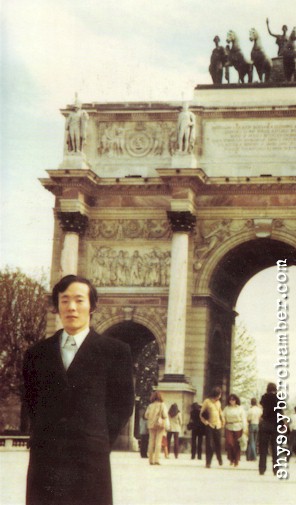
[ Issei Sagawa ]
Sagawa as a sightseer, photographed in front of the Arc de Triomphe
de Carrousel near the Louvre Museum. After he killed Renee he
disposed of most of her clothing by dumping it in dustbins along the
Champs-Elysees. |
|
|
Parts of the thighs and buttocks he
wrapped in plastic and kept in the refrigerator, planning to eat them
later. But he claimed that cutting up the body gave him no
pleasure, and in fact made him feel ill. He had severed a
breast, planning to eat it, but it reminded him of animal offal which
he had never been able to stand. He was nauseated by the sight,
calling the breasts, 'revolting lumps of fat'.
Over the next two days - Friday and Saturday - Sagawa left his flat
several times. He dumped the dead woman's clothing in dustbins
along the Champs-Elysees, keeping only her pants. he brought two
large suitcases. He also met some fellow students for a trip to
the cinema. Questioned later, the students who went with Sagawa
to the movies seemed to recall nothing out of the ordinary about the
Japanese man's behaviour.
In between these excursions, during which he seemed completely normal,
Sagawa would come back to the apartment, take more flesh from the
refrigerator and cook himself a meal. He added salt, pepper and
mustard to his gruesome cooking to give flavour to the meat which, he
said, reminded him of rather tough veal, once cooked. Despite
these culinary objects, he went on to say that eating the human flesh
each time took him to another peak of sexual excitement.
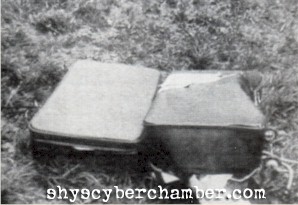
On Saturday night, he put the dismembered parts into the suitcases he
had bought and called a taxi. The cab arrived at about 11.30pm.
Sagawa loaded his suitcases into the boot and told the driver to take
him to the Bois de Boulogne. |
|
|

[ Issei Sagawa's Prison ]
Huge walls encircle the prison of La Sante in the 14th
arrondissement of Paris, where Sagawa was held while it was decided
whether he would face trial. |
|
|
The cab headed north through the Bois,
past the Hippodrome D'Auteuil, where the steeplechases are run, and
past the Lac Superieur. Opposite an island on the Lac Inferieur,
the driver stopped. Sagawa remembered the middle-aged French
couple staring at him as he dragged his suitcases towards the waters
edge. He recalled the sudden panic at being spotted. He
had dumped the cases under a bush and run straight back to his
apartment as fast as he could.
This was the lucid account of his horrific crime that Issei Sagawa
gave to Judge Bruguieres. it left the examining magistrate in a
quandary, for it was he who had to decide whether Sagawa was fit to
stand trial for the crime of murder, or whether he was insane - in
which case he could not stand trial but might have to be confined to a
mental institution for an indefinite period.
From the police point of view the killing looked like a case of
premeditated murder. It had been carefully planned and executed.
Nothing about Sagawa's demeanour suggested that he was obviously mad.
Nut surely the very bizarreness of his crime, and his admitted
life-long obsession with cannibalism, cast doubts over the balance of
his mind. And, if his account was to be believed, this obsession
had started when he was just three years old. The questions was:
could he be held responsible for his childhood fantasies?
An intelligent and sensitive man, Bruguieres deliberated long and hard
about what to do. An endless series of tests was carried out on
Sagawa, looking for signs of abnormality in his brain. A team of
psychiatrists offered their expert opinion. But it was solely up
to the judge to determine whether a trial would take place or not.
In the end, his decision would cause a world wide sensation. |
|
|
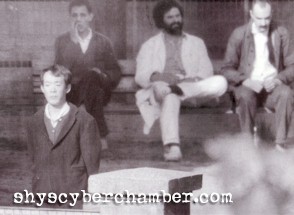
[ Issei Sagawa's Prison ]
Sagawa, in the foreground, gazes out from the grounds of the Henri
Colin Asylum in Villejuif, south of Paris. Confined initially
for 'an indefinate period', his stay here would span little more than
two years. |
|
|
The Examining Magistrate, Jean-Louis
Bruguieres, was a heavily built man with the brusque manner of someone
accustomed to wielding authority. This facade disguised a
genuine desire to understand the workings of the criminal mind and a
tenacity which took him to extreme lengths in this baffling case.
With his dossier more or less complete on how, where and when the
killing of Renee Hartevelt had been carried out, Bruguieres was free
to concentrate on the aspect of the crime that still remained in doubt
- why had Renee Hartevelt been killed in the first place?
He decided he might have more chance of getting at what lay behind the
crime which remained incomprehensible to all its investigators by
visiting Japan, and conducting a probe into the background of Issei
Sagawa. Perhaps in Sagawa's home country he would discover
secrets that could help him decide if the killer was sane or insane -
and therefore whether he should stand trial for murder or not.
Bruguieres boarded a plane for Tokyo.
In Japan, the judge talked to Sagawa's family. He talked to
doctors. He talked to the psychiatrist who had examined Sagawa
after he broke into the German woman's apartment back in 1970 - the
first indication that one day he might go on to commit a violent
attack. But Sagawa's actions were just as puzzling to Japanese
experts as they had been to the French.
Sagawa himself had told Bruguieres about the childhood New Year game
which he believed started his obsession with cannibalism, but
interviews with his eminently normal family offered the judge no
further explanation for the adult Sagawa's perverse fantasies.
Meanwhile Akira Sagawa, father of the man the press called "The
Japanese Cannibal", travelled in the opposite direction.
Arriving in Paris, he immediately hired one of France's top lawyers,
Philippe Lemaire, to defend his son. Legal and hospital expenses
would ultimately cost the Sagawa family a small fortune, but the money
was never begrudged. The family stood by Issei Sagawa
throughout.
Mr Sagawa took some of his son's fellow students out to dinner, trying
to find out from them how this nightmare had been visited on his
family. One of the students told the press afterwards that
Sagawa's father had asked for their help, saying, 'He didn't do it.'
But following the sensational newspaper coverage in his own country,
he had resigned from his position as head of Kurita Water Industries,
feeling he had no alternative. For Issei's mother, Tomi Sagawa,
the experience of having her eldest son arrested for murder and
cannibalism was too much. She suffered a nervous breakdown.
With Akira Sagawa in Paris organising his son's defence, Bruguieres
returned to the French capital, apparently without having made up his
mind about how to proceed. For a time the case went quiet.
The newspapers moved on to other things. Then finally, in 1982 -
nearly two years after the killing of Renee Hartevelt - came the
sensational decision.
After all due deliberation, Judge Jean-Louis Bruguieres accepted
Sagawa's explanation that he had killed Renee Hartevelt because of his
obsession with cannibalism. Further, Bruguieres did not believe
it was possible for a man who killed a woman in order to eat her to be
sane. He concluded that Sagawa had been suffering from
'dementia' at the time of the killing (a degenerative disease of the
brain that is thought to be linked to psychosis), and could not be
held responsible for his actions. Bruguieres' decision was that
Sagawa should be detained for an indefinite period at the Henri Colin
Asylum for the criminally insane, a secure hospital in Villejuif, a
southern suburb of Paris. There was to be no trial.
The newspapers went wild. In fact, there was almost as much
coverage of the fact that Sagawa would not stand trial for murder as
when the killing took place. Most of the coverage was strongly
against the decision. Led by the press, popular opinion still
maintained that this was a straightforward case of a scorned lover
turning to vengeful murder, and that the cannibalism was simply a
gruesome distraction. All the same, the papers took every
opportunity to remind their readers of every gory detail of the
killing. |
|
|
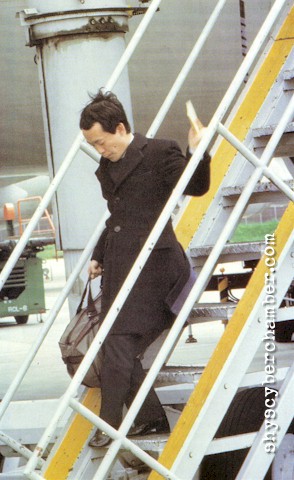
[ Issei Sagawa's
Deportation ]
In 1985, Sagawa was deported back to Japan. As he stepped off
the plane at Tokyo Airport, he was met by a mob of journalists and
photographers. |
|
|
In April 1983, Sagawa was finally moved
from prison in La Sante to the Henri Colin Asylum. He was a
celebrity among both staff and inmates at the asylum, but he was
plunged into total despair at the thought of spending the rest of his
life with people who were so clearly mad.
Nevertheless, in a continued attempt to understand for himself just
what had driven him to kill Renee Hartevelt, he pressed on with the
writing he had begun while awaiting for the court's decision in La
Sante. Before long, he received a visit from a well known
Japanese writer and translator Inihiko Yomota. When Yomota
learned about Sagawa's attempts to write a book about the terrible
fantasy life which had ended in murder and cannibalism, he was
fascinated.
Shortly after the visit, Yomota wrote to Sagawa, asking if he could
see the manuscript. Flattered, Sagawa sent off his unfinished
writings, but it came as a complete surprise when a few months later,
in September 1983, he discovered he was a published author.
Under the title In the Fog, his unfinished manuscript had
appeared in book form in Japan, and was rapidly moving up the best
seller list.
Sagawa had already had the experience of seeing letters he had written
from prison to Japanese playwright Juro Kara appear in print as part
of a novel called Letters from Sagawa-kun. The new book
In the Fog was therefore the second time his writings had been
used without his permission. Sagawa had mixed feelings.
On the one hand he felt he had been betrayed by these two literary
figures who had seemed to take a sympathetic interest in him. On
the other hand, the idea that so many people in Japan wanted to read
about the inner workings of his mind was flattering and exciting.
This further demonstration of the public fascination with Sagawa's
crime was a sign of things to come. In the spring of 1985, the
popular magazine Paris Match managed to get hold of the
official coroner's photographs of the dismembered body of Renee
Hartevelt, taken on the slab in the Paris morgue.
The police moved swiftly to block this outrageous and criminal
intrusion into the privacy of the dead girl's family. One
journalist was arrested, and 250,000 copies of the magazine were
seized to prevent publication. It was becoming clear to the
French authorities that Sagawa remained an expensive public liability
who might spend the rest of his days in a French asylum. But
what could they do?
Just two years after Sagawa had been committed to the Henri Colin
Asylum apparently for the rest of his life, the French authorities
made up their minds that there was something they could do. In
the case's most bizarre twist of all, in May 1985 Issei Sagawa was
suddenly released. The 'Japanese Cannibal' was a free man.
Not sure of what sort of reception to expect in his home country,
Sagawa would have been glad enough to stay in France. He feared
that once back in Japan he would never be allowed out of the country
again. But an absolute condition of his release was that he
board a plane to Japan and never return.
A team of French doctors accompanied the newly free Sagawa on his
flight back to Japan. They kept reporters at bay as best they
could while the plane was in flight but once the aircraft touched down
in Japan their job was over and the feeding frenzy in the Japanese
press began. |
|
|
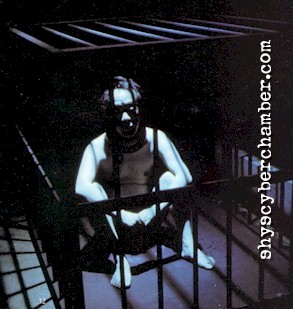
[ Issei Sagawa's
Deportation ]
Sagawa sits in a cage as part of a publicity stunt in 1995.
In the decade since he left the hospital, he had found himself being
drawn more and more into the spotlight. |
|
|
At Tokyo Airport, press men and
photographers surged around. After all, this was not just a best
selling author returning home to Japan. This was a man who had
killed and eaten a woman, and to all intents and purposes got away
with it. True, Sagawa was taken immediately from the airport by
ambulance to the Matsuzawa Hospital, but this was a plan concocted by
his family specifically to avoid a public outcry.
It was felt that if Sagawa simply walked off the plane and back into
Japanese life as a free man, the press would be up in arms. On
the other hand, if he entered the Matsuzawa as a voluntary patient,
then that would show that in spite of the French authorities' decision
to set him free, he himself had not forgotten what he had done, and
was still trying to atone for his crime. Of course, it was
little more than a token gesture, because, as a voluntary patient,
Sagawa was free to leave the hospital at any time.
The staff of the Matsuzawa put him into a secluded wing of the
building, where the windows were covered at all times to keep their
charge away from intruding camera lenses. Sagawa himself was
shocked by the hostility and distaste which characterized every
newspaper account of his home-coming. He was also to be shocked
by the treated he received in the Matsuzawa, because the psychiatrists
there were soon to come to a radically different conclusion from their
French counterparts.
No one on the staff at the Matsuzawa was pleased at having to deal
with their notorious patient. For one thing, the hospital was
under a state of virtual siege from the media. One psychiatrist
told Sagawa he was 'one too many; and that he wished he would simply
go away.
The Japanese psychiatrists believed that Sagawa was an ordinary sex
criminal who had deceived the French into believing he was a psychotic
who could not be held responsible for his actions. 'I think he
is sane and guilty,' declared hospital superintendent Tsuguo Kanego
unequivocally. 'He should be in prison.'
The Japanese applied to Bruguieres in Paris for his file on Sagawa
with a view to bringing him to justice in Japan. But Bruguieres
refused to hand over a single document. In due course, the
Japanese came to the same conclusion as the French.
They washed their hands of Sagawa. On 12th August 1986, the
Matsuzawa Hospital's most notorious patient was discharged into the
community to begin his life over again as an ordinary, private
citizen. |
|
|

[ Media Frenzy ]
In his small flat, Sagawa paints while his model reclines on the
couch. This sort of 'photo opportunity' for the press began to
turn Sagawa into something of a media performer pandering to the
sensational tastes of the public. |
|
|
In the summer of 1986, Issei Sagawa
emerged from five years of confinement in prison and hospital, hoping
to disappear anonymously into Japanese society. He changed his
name to Shin Nakamoto, and moved into a small apartment, spending
evenings with his family who had remained supportive throughout the
whole affair. But in the circumstances, anonymity was to prove
an impossible dream.
The main problem was the attention of the press, whose interest in
Sagawa was revived by his release from the Matsuzawa Hospital.
Typical of the kind of sensationalised reporting which appeared was
one newspaper's headline about the killer's release 'Attention! Sagawa
is walking the streets.'
But it was not just the tabloids who got in on the act. A highly
respected Japanese literary magazine called Hanashi no Tokushu
ran an extended interview with him, accompanied by many photographs.
In the interview, Sagawa declared the urge to eat human flesh to be
perfectly normal and natural. The magazine's editor commented
with the kind of sensationalism which accompanied every story about
the cannibal killer, 'The ultimate taboo can be overcome, and Sagawa
is the only man who can do it.'
Of course every story carried a picture and that was Sagawa's biggest
problem when it came to establishing a new identity - his face was
simply too well known. This proved a particular difficulty when
he began looking for a job. One school initially offered him a
teaching post, but when his true identity emerged, the entire school
staff came out in protest against their proposed new colleague.
The principal of the school was obliged to withdraw his job offer.
No matter where Sagawa went, his new name was no disguise. He
even found himself rejected when he applied for menial work such as
washing dishes. The only way he could find to support himself
was writing articles for magazines catering to sado-masochists and
other sexual minorities - hardly appropriate work for a man ostensibly
trying to put his past behind him. |
|
|

[ Media Frenzy ]
Issei Sagawa wears a devil's mask during the making of the British
TV documentary Excuse Me For Living. |
|
|
With several more books and films in the
pipeline. Sagawa remained as busy as ever. His more recent
project is a film which carries his story into the future. Based
on a book by Ieda Shoko, the script finds Sagawa living as a respected
70 year old. Then someone finds out about his terrible past and
kills him. |
|
|
BACK TO TOP |