shyscyberchamber.com  
SERIAL KILLERS

Date Added

Dennis Nilsen September 2003
 
Bio
  Full Name Dennis Andrew Nilsen
  Date of  Birth 23rd November 1945
  Known Also As ?
  Hit Count 16
Information & Pictures
  Tuesday 8th February was just a day like any other to Mike Cattran, and employee of the Dyno Rod plumbing firm. He'd been called out to unblock sinks, clear pipes and dislodge soft toys which had been stuffed down the toilet by a 2 year old. All in a day's work. But the last call of the day, in the evening just as he was preparing to go home, was something else again. It was a call out he'd never forget.


The call came in to send a plumber to 23 Cranley Gardens, Muswell Hill, in North London.

All the tenants of the house, which was divided into flats, had been complaining that since the preceding Saturday they had been unable to flush their toilets. There was some kind of blockage which effected the whole system that served the flats.


The tenant of the ground floor flat showed Cattran the location of the man hole cover that led down to the sewage system. When the plumber lifted the cover, he was almost knocked off his feet by a nauseating stench. It was patently obvious that rotting meat was the source of the smell. Someone had, it seemed, attempted to dispose of some rotting meat by trying to flush it down the toilet instead of putting it out in the dustbin wrapped in plenty of newspaper.


Cattran tied a wet towel (provided by the ground floor tenant) over his nose and mouth and proceeded to descend the iron steps into the black depths, torch in hand. The tenant meanwhile made a hasty retreat, understandably enough.


Flashing his torch around, Cattran soon discovered the source of the smell. Rotting white meat - chicken or perhaps pork. But it looked rather odd. There were some strange shapes among this meat - shapes that looked suspiciously like fingers. Chicken or pork didn't have fingers. Cattran decided to ring his supervisor for instructions, and was told that the supervisor would come first thing in the morning next day, as he had already gone home. So the plumber climbed back to terra firma and told the ground floor tenant that help would be arriving at 8am the next day to deal with matters.


The supervisor arrived duly at eight o'clock and prepared to go down into the system to check the obstruction. To his astonishment, he found that most of it had been cleared, but the odour was still in evidence - slightly lessened in intensity, though not much. The Dyno Rod supervisor decided to question the tenants of the flats to see if they could throw any light on the cause of the blockage and also how it managed to clear itself during the night.


One tenant told him that she had been kept awake most of the night by the noise of footsteps going up and down the stairs to and from the flat on the uppermost floor, which was known as the 'top-flat'. No one else had heard anything. Maybe they were not such light sleepers as the lady in question. In the meantime, plumbing engineers were re-examining the sewer below ground, and they found that the pipe was not completely cleared but still partly blocked. The obstruction looked like no kind of chicken or pork the men had ever seen. They both thought it looked like human flesh, including fingers and bones. This was a case for calling the police, said the supervisor - and he did.

   CRANLEY GARDENS, NORTH LONDON:


Situated in a quiet, leafy suburb, the house at 23 Cranley Gardens, North London, housed Britain's most notorious serial killer in the attic.
Detective Chief Inspector, Peter Jay, of Hornsey CID came to inspect the sewer. This time it was his turn to borrow a wet towel. He also interviewed the lady who had reported hearing the ascending and descending footsteps that had kept her awake all night She told him, in answer to his question, that the tenant of the 'top-flat' was a civil servant named Dennis Nilsen, who was out all day at work but usually arrived home in the evenings around six o'clock. When Nilsen arrived home that night, he found DCI Peter Jay waiting for him in the ground floor hall.


Dennis Nilsen was a 37 year old office worker at the Jobcentre in Denmark street, in Soho, London. DCI Jay came straight to the point and told Nilsen that he wanted to talk to him about the problem with the sewer. Nilsen invited the detective up to his flat, and as soon as he entered it the policeman knew that Nilsen held the key to the mystery of how human remains had become wedged in the sewer pipe, for the same odour permeated the flat that he had been subjected to in the sewer, overlaid by disinfectant which had obviously been sprayed around in an attempt to mask the odour, not very successfully. He had no wet towel with him this time ...
  CRANLEY GARDENS, NORTH LONDON
'I believe you know how those human remains came to be in the sewage system,' DCI Jay told Nilsen. 'What happened to the rest of the body?'


Nilsen looked at the detective without batting an eyelid. He pointed to the wardrobe. 'It's in there,' he said in a matter of fact voice. 'In two black plastic rubbish bags.'


Nilsen was taken to Hornsey Police Station for questioning. On the way, DCI Jay asked him if the remains in the bags and in the drains were those of one body or two. Nilsen immediately replied, 'There have been fifteen or sixteen altogether.' His remark was made in a completely detached manner, quite devoid of any sign of emotion.


Once in the police station, Nilsen spilled his guts. He talked and he talked, and he talked. Hardened policemen could not believe what they were hearing, and not a few experience detectives thought at first that Nilsen was one of those compulsive confessors who turn up from time to time. Although he had obviously killed a man, or men, they thought he was embroidering his account to 'look big', as such murderers often do, or maybe to shock - all part of the psychopath's psychological make-up.


Nilsen told the detectives that he had killer three men in his Cranley Gardens flat, and that he had killer another twelve or thirteen - he couldn't remember which - in the house he had lived in at 195 Melrose Avenue, Cricklewood, over a 5 year period.
    MELROSE AVENUE, CRICKLEWOOD:


During the winter of 1975, Nilsen moved to 195 Melrose Avenue, Cricklewood, in North London.  Inset:  The back garden, where Nilsen burnt the bodies and then scattered the remains.
'I'm not absolutely sure of the number,' he said. 'I didn't keep a body count.'


In the meantime, police searching Nilsen's Cranley Gardens flat discovered three severed heads in plastic bags in the wardrobe and dismembered parts of three bodies in a tea chest in the flat. Forensic examination revealed that two of the three heads had had much of the flesh stripped off and that they had in fact been boiled. In addition to the three heads and the material in the tea chest, searches also found the entire lower half of a torso in the bathroom. This was found to match up to body parts found in the chest. After all this evidence had been removed and the drainage system completely cleared, men were detailed to cleanse and disinfect both the flat and the drains, and to assure tenants that they could now flush their toilets with impunity. Not all the tenants stayed to do so, however - one moved out lock, stock and barrel the very next day to stay with relatives, while another gave notice to the landlord that he would be going as soon as he could find another flat. At the other extreme, crowds of morbid sightseers flocked to see the house, and were moved on by police. It was some considerable time before Cranley Gardens returned to semblance of normality. Eventually all the tenants moved out and the house was put up for sale in 1983. There were a few prospective purchases and it was more than a year before the house was eventually sold at a price well below its market value.


Nilsen had moved in the autumn of 1981 to the Cranley Garden flat, and the job which had so shocked Mike Cattran the plumber was carried out on 8 February 1983. Thus, Nilsen's last three victims were all killed over about a year and a half. The police now turned their attention to the house at 195 Melrose Avenue in Cricklewood, where Nilsen said he had killed 'twelve or thirteen' other victims. The house was searched and the garden dug up. No evidence was found in the house itself, but the garden yielded plenty. Teams of police diggers took almost a fortnight to complete the job, and unearthed quantities of human remains. Bones from numerous bodies were dug up in the garden, while suitcases containing human remains had been stowed in a garden shed which still stood, locked and padlocked but not used by the subsequent tenants, whose tenancy had obviously obliterated all traces of blood or other evidence from the interior of the house itself, since over an approximately seventeen month period floors and other surfaces would have been scrubbed many times.
   ARMY CATERING CORPS:


Nilsen enlisted in the army at the age of 15, and his first three years, from 1961 to 1964, at Aldershot as a trainee boy soldier. He later described this period as the happiest in his life. After passing exams, he joined the Catering Corps, and was posted first to Osnabruck in Germany, where he was introduced to alcohol. After a short spell in Norway, he was posted to Aden in the Middle East where the British were involved in an anti-terrorist war. By 1969, he was in Berlin with teh Argyll and Sutherland Highlanders, in charge of catering for the officers' mess. A year later, Nilsen found himself responsible for the N.C.O. kitchen for the Queen's Royal Guard at Balmoral in Scotland. In 1971, he joined the 242 Signals in the Shetland Islands. After more than 11 years in the service with the army, Nilsen decided to leave. By now he was a trainee butcher, and knew how to dissect carcasses - a skill he was later to put to sinister use. He finished his military career aged 27 with the rank of Corporal.
 

Scots-born Nilsen started life on 23rd November 1945. After leaving high school he joined the army, from which he was discharged in 1972. During his twelve years service he had been a cook in the catering corps and had seen action in Aden, Sharjah on the Gulf, Cyprus and finally West Germany. After his discharge he joined the Metropolitan Police, but found the life not to his liking and resigned after only eleven months. He took a job as a security guard, working for the Department of the Environment, but that, too, did not appeal to him: he never met anybody and felt very lonely and isolated. The fact that he was homosexual did not help matters; he was on duty at times when he could have cruised the gay bars. So finally he took a clerical position at the Jobcentre in which he was working at the time of his arrest. There he had plenty of opportunity to meet the disadvantaged, the drop outs and the unemployed who felt rejected and carried a chip on their shoulder. After working hours and would go home, change and cook himself a meal, then head for the West End bars in search of the young male company he craved.


Up to 1975 Nilsen had been living in Teignmouth Road, Willesden, in North west London, and it was in that year that he met an Irishman ten years his junior named David Gallichan, and eventually decided to share a flat. Although the flat-mates started their sharing relationship at the Teignmouth Road address, they soon realised that the flat was far too small for two, and looked for a larger abode. This they found at 195 Melrose Avenue, Cricklewood, to which they moved in November 1975. Nilsen found the round of cosy domesticity to be just what he needed, offering security, companionship and warmth. Nilsen did the cooking, David tended the garden and they acquired a dog and a cat. David worked as a railway porter, and Nilsen enjoyed his clerical job, and it seems unlikely that if this state of affairs had continued, Nilsen would ever have become a serial killer.


But the idyll was not to last. In May 1977 David Gallichan was offered a job in the country working for an antique dealer, which he quickly accepted, explaining that he had always had a yearning to live in a rural setting. When he left, Nilsen was devastated - his secure world had collapsed like a burst balloon. On the face of it, it would seem that Gallichan's feelings for his flatmate were less intense than the other way round. Nilsen took refuge in drink.


Nilsen's initial shock soon turned to anger, but it was a controlled kind of rage, an inner fury that manifested itself in taciturnity and cold aloofness. Only when well loaded with hard liquor did he mellow sufficiently to allow his normally talkative, expansive self to surface.


In the Cricklewood Arms Nilsen was garrulous in his cups and had little difficulty in talking a young Irishman whose identity has never been ascertained, into coming home with him on the night of 30 December 1978. The intention was to keep his companion with him over the New Year period, but the Irishman had other ideas. However, he was perfectly amenable to staying the night with Nilsen and indulging in homosexual behaviour, although he had made it clear that he would be leaving the following morning. Nilsen, however, had no intention of letting him do so. He strangled him with his tie at some time during that night. In his later confession, he averred that he 'had no recollection' of the act and had awakened in the early hours 'to discover that he had strangled  him in his sleep'. Few believed him. Afterwards, he said, he carefully washed the body in the bath, put it back in bed and sexually abused it. 'I now had a new flatmate,' he later said. 'I had the company I needed.' After re-dressing the corpse and masturbating over it, he prised up the floorboards, wrapped the clothed body in two black plastic rubbish bags, and laid it under the floorboards, where it remained for an incredible seven and a half months after which time Nilsen removed it from its makeshift grave and burned it on a bonfire in the garden, heaping a number of rubber car tyres on top so that the smell of burning rubber would mask the odour of burning flesh.


Nilsen's reaction to the realisation that he had actually killed a fellow human being was a severe attack of nerves. He later told police that he 'shook uncontrollably' for several hours, and debated in his mind whether or not to commit suicide. He then considered giving himself up to the police. Eventually he decided that if he took either course there would be no one to look after his dog, of which he was very fond. He said that he was amazed that no one came to see him or question him about the matter.


Nilsen did, however, have a brief run in with the law on 31 October 1979. He had picked up a young Chinese student, Andrew Ho, in a pub near Trafalgar Square called the Salisbury. After a few drinks at the flat, Nilsen attempted to strangle him with a tie, but the student managed to break free and grabbed a brass candlestick with which he managed to knock Nilsen out before making good his escape. He feared that he might have killed his assailant and went to the police. On investigation Nilsen said that he had been drunk and did not remember anything, and no charges were made. 'That was cutting things a bit close,' Nilsen said in his later statement. But it did not stop him from continuing to lure victims to his flat with deadly intentions...

   THE CRICKLEWOOD MURDERS:


Before he moved from Melrose Avenue in September 1981, Nilsen killed a total of twelve men. Eight of them have never been identified, having lost all connection with their place of origin. Kenneth Ockerden was a Canadian tourist visiting relatives. He was untypical of the other victims who met Nilsen in a West End pub, and was due to return to Canada the following day. He was the only victim whose absence attracted any real attention.
  Nilsen's second victim was a 23 year old Canadian student named Kenneth Ockenden. He was not gay, but was pleased to meet Nilsen and accept drinks from him, this time in the Princess Louise pub in High Holborn. This was but the prelude to a heavy drinking session at the flat, interspersed with a main meal of ham, eggs and chips cooked by Nilsen. Nilsen played a number of rock-n-roll tapes, to which he persuaded his companion to listen to on headphones. Moving behind him on the pretext of fetching more booze from the kitchen, Nilsen strangled him with the headphone cord. For some reason, Nilsen said, they did not engage in any activities beyond touching and caressing. Nilsen propped the body up in an armchair in front of the TV and talked to it as if it were alive. Finally he washed the body, as he did with all his victims, and made up the dead face with cosmetics and shampooed its hair. After a day or two the corpse was laid to rest under the floorboards, but Nilsen took it out again no fewer than four times over the ensuing fourteen days, each time have intercrural sex (ie. between the thighs) with his dead companion.


In the course of undressing the body, Nilsen discovered that Kenneth Ockenden had a large quantity of money in Canadian dollars, secreted in a money belt. Nilsen tore the bills in pieces and burned them. Stealing was not his scene at all. Later, when he was found to be wearing a gold watch which had belonged to one of his victims, he told police, 'Its owner had not really gone away, so it was not theft.' Indeed it was true in a sense, for that victim was still under the floorboards at the time.


After this, his second murder, Nilsen stated that he still felt 'bewildered and frightened by his own actions' and again considered the same two options that he had addressed previously, but soon afterwards found that he was becoming what he termed 'less emotional' about the whole thing. He was beginning to think that he could kill with impunity.


Martyn Duffy, a Liverpool-Irish youth of sixteen already heavily into alcohol and drugs, was Nilsen's next victim. He also had a record for petty theft. It was May of 1980 when Nilsen took the boy to his flat, strangled him, washed the body in the bath, masturbated over it and laid him under the floorboards by the side of the unfortunate Kenneth Ockenden. The odours of decomposition soon began to seep through to the interior of the flat, and by midsummer Nilsen was spraying air fresheners and disinfectants about the place. These, however, did little to ameliorate the situation and Nilsen was forced to exhume the bodies. He dissected them, putting the heads into plastic rubbish bags and the torsos into two suitcases which he stored in a shed at the bottom of the garden to which he had a key. Arms and hands were buried in the garden and viscera were dumped in plastic bags by the dustbins for refuse collectors to remove. A passerby found one of these, however, before the dustmen arrived. He took it to the police, saying it looked suspiciously like human internal organs. The police dismissed the idea and said it was simply butcher's refuse.
   THE CRICKLEWOOD MURDERS:


William Sutherland, a heavy drinker from Edinberg, had a record of petty crime. He met Nilsen in a pub near Piccadilly Circus and followed him back to his home.
  In the late summer of that same year - probably between July and September - Nilsen went on a pub-crawl in the West End with a 26 year old Scot named Billy Sutherland. Predictably, they ended up in Nilsen's flat, where the Scot was strangled with a tie. Nilsen left him sitting in an armchair for two days before the usual ritual of washing in the bath, changing underwear and fondling the body. Sutherland's last resting place was where the bodies of his two predecessors had lain prior to their dismemberment - beneath the floorboards.


Victim number five, picked up in the Salisbury at the end of the year, could have been either Filipino or Latin American, according to Nilsen, but his origin was never ascertained. The sixth victim was an Irish builder's labourer, inveigled to the death flat from the Cricklewood Arms. The seventh was an emaciated, ill-nourished young dosser whom Nilsen had found huddled in a shop doorway at the end of Oxford Street where it adjoins Charing Cross Road. Nilsen took him home and gave him a meal, and they drank a bottle of rum between them. When the young man was in a drunken stupor, Nilsen strangled him with a tie. He was so thin and wasted - 'he looked just like a Belsen victim' - that Nilsen could not bear to look at his naked body but bundled him unceremoniously into a plastic bag and burned him in the garden as soon as he could.


Nilsen could remember little about the eighth victim, beyond saying that he had put the body under the floor, taken it out and dismembered it into three sections, and then replaced it under the floorboards. Victim nine and ten were both Scots. Bother were eighteen, and both had been picked up in the Golden Lion in Dean Street. They eventually joined their comrades in death beneath the by now overcrowded space under the floor of the flat.


By the end of the year Nilsen though it was high time, to coin a phrase, to get rid of the plethora of bodies - 'wall to wall bodies' - as he later described them. He built another bonfire in the garden - a huge one which attracted a number of neighbourhood children - and set to dismembering the remains and burning them in a usual black plastic refuse bag shroud, heaping car tyres on top. A vast quantity of tyres went up in acrid smoke, keeping the bonfire burning all day. When the funeral pyre had burned itself out, Nilsen got busy with a lawn roller and crushed the remaining bone fragments to powder. Then he raked over the site. Neighbours may well have thought he was a keen gardener as he went about his grisly task, but non of them had the slightest inkling of the grim reality that they behind his apparent industry.


Having disposed of his 'problem', as he dubbed it, Nilsen had no intention of halting his murderous spree. To celebrate his relief at having at last rid himself of the incriminating and malodorous bodies, he went out the same night to a pub and bringing a young man home for sex decided on a whim to let him live. He left the next morning unharmed.


Reverting to his true form, Nilsen picked up his eleventh victim in Leicester Square. This was a Cockney skinhead who had a row of dots tattooed around his neck superimposed by the inscription 'Cut along dotted line'. When Nilsen dissected the body, he did just that. He became the first of the next group to occupy the under floor space.


Malcolm Barlow, aged twenty four, was in the wrong place at the wrong time. Nilsen found him literally on his doorstep, sitting slumped against a wall in Melrose Avenue, only yards from the death flat. He was an epileptic and had suffered from a fit in the street, after which someone had propped him up. Nilsen, however, did not immediately seize the unemployed vagrant from Yorkshire and take him into his flat; instead he called an ambulance, which took Barlow to hospital.


The following day he discharged himself from hospital against medical advice, and went to look for the Good Samaritan who had helped him. He found the house in which Nilsen lived and sat on the front steps to wait for him to come home from work at about six o'clock. He invited himself in, and asked Nilsen for a drink. Nilsen had misgivings about this because he knew that the young chap took medication for his epilepsy. He warned Barlow that alcohol and his tablets might not mix. Barlow said that he was willing to risk it. Nilsen cooked him a meal and they drank a quantity of rum; Barlow quickly became unconscious. Nilsen strangled him, and he was laid to rest beside the Cockney skinhead with the grotesque tattoo.


Barlow was the last man to die in Melrose Avenue charnel house. Nilsen's landlord had been offered a very substantial sum for the house by property developers, one of the conditions being that it was to be purchased with vacant possession. The landlord then set about offering all the tenants cash settlements to induce them to leave. He offered Nilsen one thousand pounds, which he accepted, and started looking for a larger flat to move into. Finding one to his liking, he took tenancy, but there was one snag, it had no garden. There would be no bonfires to burn his victims, and he would have to devise some other method of disposal of the bodies. Before moving, of course, he would also have to have one final funeral pyre to dispose of the bodies he had under the floor and also, dismembered in plastic bags, in the garden shed.
   BLEEP:


Dennis Nilsen's one companion was a black and white mongrel bitch with a bad eye, called Bleep. She paid no attention to the dead bodies in the flat, and retreated into the garden when Nilsen dismembered one. But she could sense when a body still had life in it. It was she who saved Carl Stotter by licking him and alerting Nilsen, who subsequently revived him. On Nilsen's arrest she was taken to Hornsey Police Station where Nilsen could hear her whining from his cell. 'I am so ashamed that her last days should be so painful,' he wrote. 'She had always forgiven me everything.' Bleep was ill and died under anaesthetic a week later. Some of the tabloid newspapers reported that she was pining for her master and had died of a broken heart.
  This he did, and on 5th October 1981 he moved to his new flat at 21 Cranley Gardens, Muswell Hill, with his little dog named Bleep. For a time, he busied himself with decorating his new flat and arranging his furniture and belongings to his liking, as well as stocking up the house with booze. He would certainly be inviting young men to his new abode, though he would have nowhere to cremate them. That was the problem that led to his undoing.


In March 1982, Nilsen met John Howlett, know to all and sundry as 'John the Guardsman', although actually he had never been in the Guards but was a 23 year old unemployed drifter from High Wycombe in Buckinghamshire. Although Nilsen has willingly invites him back to the flat for drinks, he became annoyed when Howlett made himself, to use Nilsen's words, 'too much at home'. 'I didn't know you were moving in,' said Nilsen sarcastically. 'I think its time you went, so you better go.' Howlett had become so drunk that he was practically comatose, and while in this state Nilsen throttled him with his bare hands until he lost consciousness completely, then drowned him in the bath.


The floorboards in Nilsen's new flat were impossible to lift unless he had been prepared to use tools and make a considerable amount of noise, which would have attracted the attention of other tenants. So he dissected the body, boiled the head in a large cooking pot, put the largest of the bones out with the rubbish for the dustmen, and the flesh of the torso, arms and legs into a tea chest which stood in his rooms. He then flushed the internal organs and some portions of the flesh down the toilet.


Nilsen's fourteenth victim was Graham Allan, a Glaswegian of twenty eight years who was a drug addict and alcoholic. Nilsen cooked him a meal, during which Allan fell asleep, since he was already drunk when Nilsen took him home. In his later statement Nilsen says that he has no recollection of killing the man, but that he 'found him to be dead'. He removed his clothes and washed his body in the bath, where he was left for two days. Then he was subjected to the same treatment as the previous victim.
   DENNIS NILSEN IN JAIL
  Nilsen's last victim was another drug addict whom he found in The George public house in Goslett's Yard on 1 February 1983. He did not know it, but eight days later he would be arrested. The man Stephen Sinclair, twenty, had a prison record and suffered hepatitis. They spent the evening watching TV and listening to rock music, drinking whiskey and beer; Sinclair also injected himself with drugs.


Once again Nilsen, according to his statement, had no memory of killing Sinclair; he said that he was so drunk that he could not remember anything of what happened. The body was left in the bedroom for a couple of days, covered by a blanket. When Nilsen had sobered up sufficiently, he cut off the head and set it to boil in the large pot, which he went out to the pub with Bleep, his small dog. He cut up the body and bagged it, but subsequently decided that he would have to get rid of it, so he put the largest portions out with the rubbish and flushed smaller parts down the toilet. Nemesis was creeping nearer and nearer.


The tea chest with its grisly contents was becoming more and more odoriferous. The boiled heads of the last two victims were bagged and put into the wardrobe along with other bagged remains that had already been placed there, and Nilsen shut the door on them. He then considered what he should do to get rid of the remains in the tea chest.
   DENNIS NILSEN'S BATHROOM
  To this end, he removed the complete lower half of a torso and left it in the bathroom in preparation for a dissection job which would enable him to bag the remains in smaller portions and take them out the the dustbins; he had no compunction about using other people's dustbins when his own became full.


Spraying more disinfectant and air freshener around the flat, he finally flushed the last of the smaller remains - hands, fingers, internal organs - down the toilet. And it was not long after this that the other tenants started complaining to the landlord about the blocked drains, saying their toilets were clogged up and unflushable. As we have seen, things came to a head the following Tuesday, 8 February - the day that Nilsen finally met his Waterloo.


The day before his arrest, Nilsen had appeared perfectly normal at the Jobcentre where he worked. Nobody noticed the slightest trace of nervous tension or other unusual behaviour. It was the same calm, emotionless facade that was to see him right through all his interrogations and his subsequent trial.


The pathologist who examined the remains found in his flat discovered that the two large black plastic bin liners contained a series of smaller plastic carrier bags. One contained a male left thoracic segment including the arm still attached; in another was a torso with all limbs removed. A third contained lungs, heart, spleen, liver, gall bladder, kidneys and intestines. The dissection had been carried out with some degree of skill, the doctor was able to say. Nilsen evidently had a good knowledge of the human anatomy. The pathologist was able to match up the lower torso that had been found in the bathroom to upper body parts found in the tea chest. The three victims from the Cranleigh Garden flat were identified variously from dental records, fingerprints, blood grouping and, in one case, the distinctive fracture of the jaw the man had sustained in a fight, which showed up on a skull x-ray. If DNA printing had been in use at the time the pathologist's task would have been made immeasurably easier.


The questioning lasted a week, during which Nilsen gave police officers a precise and detailed account of all the murders, bar the two he could not remember killing owing to his drunken state at the time. He told DCI Peter Jay, 'It's a good job you've arrested me now. If you'd waited till I was sixty-five, there'd have been thousands of bodies to look through.' The interviewing officers could barely conceal their revulsion.


Nilsen had a bizarre sense of humour. During his interrogation he asked for an ashtray to stub out his cigarette he'd smoked, and when a young constable told him to flush it down the toilet, Nilsen replied, 'The last time I flushed something down the toilet I got into real trouble.'


Asked whether the murders had been premeditated, Nilsen told his interrogators that he did not go out looking for victims with the intent of killing them once he had lured them back to his flat. 'The killings just happened,' Nilsen said. He added that a far greater number of young men had left his flat alive than had been killed. But he said that he felt no remorse, and could not feel anything at all for his victims. 'Inside me,' he said, 'I was just completely cold and devoid of feeling.'


Later Nilsen's solicitor asked him to try to explain to him why he had killed the men. He said he had no explanation. 'Maybe someone else may be able to tell me why I did what I did,' he said, quizzically.
   A CUT-UP CORPSE FOUND IN DRAIN
  Nilsen was remanded to Brixton Prison where he saw the tabloid headlines such as 'The House of Horrors' and became very conscious of media interest in his case. At last he had become a 'somebody' - at last he had won the recognition he craved, albeit via the notoriety of crime of the most heinous and repellent nature.


The trial began on Monday 24th October 1983, at the Old Bailey before Mr Justice Croom-Johnson. Prosecuting was Mr Alan Green, QC and Mr Ivan Lawrence, QC, defended the accused, who was charged with six murders and two attempted murders. He had actually confessed to fifteen murders and seven attempted murders. He pleaded not guilty to murder but guilty of manslaughter on the grounds of diminished responsibility.


The prosecution outlined the facts of the case to the eight man, four woman jury. He said that seven of the victims had been positively identified, although only six were named in the indictment. Mr Green pointed out the pattern of the murders: all the victims were young men, all but one had been picked up in pubs, and all were complete strangers to the accused. With one exception, all were drifters or vagrants of no fixed abode. Some of them, though not all, were homosexuals, as was Nilsen himself. It had been forensically proved that Nilsen had sexual relations with six of the bodies.
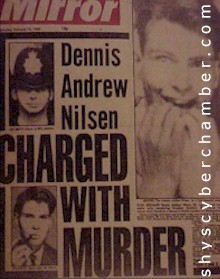
   DENNIS NILSEN CHARGED WITH MURDER
  Mr Green read Nilsen's confession to the shocked and horror stricken court. When the police had asked him how many bodies he had in his flat at any one time, Mr Green said, Nilsen replied, 'I'm not sure. I did not do a stock check.'


The first witnesses called by the prosecution were various men who had escaped with their lives (some barely) after Nilsen's murderous attacks. The police had been aware of these attacks only after Nilsen had confessed to them in his long and detailed statement. The survivors came forward to testify only at the request of the police; originally they had not wished to press charges as they did not wish to be publicly branded as homosexuals.


Detective Inspector Chambers gave evidence that he had been able to trave fourteen young men who had visited Nilsen's flat and come to no harm.


On the third day of the trial Mr Lawrence, for the defence, told the jury that he was not attempting to prove that Nilsen was insane, but that at the time of the murders he had been suffering from an abnormality of mind. He called Dr James McKeith, a psychiatrist, as his first witness.


The doctor averred that Nilsen suffered from a severe personality defect and that at the times of the killings he was suffering from a condition know as 'disassociation', which could be most easily described as a person feeling that he was actually watching someone else perform the action in question. Under cross-examination by the prosecution the doctor had to admit that a psychiatrist's knowledge of a person's mental state was limited to what he could evaluate from the person's own statements. Mr Green was at pains to point out that if Nilsen could desist from killing in some cases, then that showed that he had the power of choice, which was proof of rational thinking and ruled out 'temporary insanity'.


Nilsen was quoted as having said that he was a 'creative psychopath' who became a 'destructive psychopath' under the influence of alcohol. There was certainly no doubt that he was an alcoholic, but it was a controlled kind of alcoholism, in that he managed to abstain during the day in order to be sober enough to carry out his duties at work, his alcoholism was allowed to take over and distort his entire personality, with the results that caused him to end up in the dock on a multiple murder charge. Proof enough, if such were needed, the psychiatrist continued, that Nilsen's responsibility was indeed diminished and that he was a victim like the men he had killed, though in a different sense.


The prosecution disagreed, pointing out that the decision to remain sober by day to avoid losing his job, but to give rein to his craving for alcohol after working hours, was, again, a matter which proved free choice and thus, ipso facto, that he was capable of rational thinking.
  THE CRICKLEWOOD MURDERS:


Malcolm Barlow was an orphan who had spent most of his life in care or special hospitals. He was discovered by chance, slumped on the pavement in Melrose Avenue near Nilsen's house.
  Another psychiatrist put up as a witness stated that Nilsen could not have had 'malice forethought' to commit the murders if as he had himself stated he had no feelings. At this point the judge rebuked the witness and told him not to trespass in the realms of the law but to confine himself to medical opinions.  The prosecution insisted that free choice formed an integral part of Nilsen's behaviour; he chose to invite men to his flat, he chose to go out looking for them. He chose to murder Malcolm Barlow because, according to his own confession, the had 'become a nuisance'. In his closing speech Mr Green said, 'When all is said and done, you are dealing here with a man who enjoyed killing people and derived satisfaction from the act of killing. The defence says that this man was simply out of his mind and couldn't help it. The Crown says, oh yes, he could!'


The judge's summing up took four hours, and some people felt that he was somewhat biased against the defendant and sceptical of the claims of psychiatrists. 'There are evil people who do evil things,' he declared, 'and committing repeated acts of murder is one of them.'


The jury retired to consider their verdict on the morning of Thursday 3 November, and at 4.30pm the judge asked them whether they had been able to reach a decision. They had not, and the judge ordered them to be sequestered in a hotel overnight. At ten o'clock the next morning they returned to the jury room to resume their deliberations. The judge informed them that he would be prepared to accept a majority verdict, and at 4.25pm they returned to the courtroom ready to announce their decision.


The foreman of the jury announced that there was a majority verdict of ten to two of guilty of murder on all counts. And on all counts of attempted murder, they voted ten to two for guilty except for one of the indictments under this heading, when their verdict had been unanimous.


On Friday 4 November 1983, after the ten day trial with all its sensational revelations of horror, Dennis Nilsen was sentenced to life imprisonment, with the proviso that he should serve a minimum of twenty five years.

BACK TO TOP


Check out
the latest
Crypt Polls!


-���-

F o u n d   a   b r  o k e n   l  i n k ?   L e t   u  s   k n o w