|
[ Milat's Eagle Vale Home ]
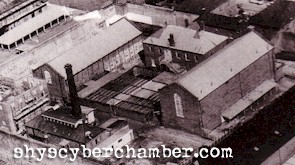
Ivan Milat's home at 22 Cinnabar Street, Eagle Vale, a Sydney
suburb, was kept obsessively tidy - a legacy from his father's love of order. |
|
|
There was a committal hearing, but Milat, who also
faced two armed robbery charges, including one at a bank, jumped bail and fled
to New Zealand, where he stayed until 1974. On his return he was
re-arrested.
He was acquitted of the robbery charges and in a one day trial beat the rape
charge after one of the victims changed her story. There was evidence that
Milat, then aged 26, had tied up both women and threatened them with a knife,
but, incredibly, the police task force investigating the backpacker murders
never learned about the chilling similarities of the crimes until late in the
day.
Years later, Milat confided to a friend that he was in fact guilty of pulling
the bank job but a brother, who was also involved, took the rap.
By 1975, Milat was apparently respectable. He still lived with his
parents, didn't drink or smoke, and was a workaholic interstate truck driver.
Ivan now met his future wife Karen, then 17, and pregnant to his cousin Mark.
Soon, the couple were living together in a caravan in a garden and saving a
deposit for a house. Ivan treated Karen's son Jason as if he was his own,
and married Karen in the mid 1980's.
The family were not asked to the wedding, as they were in the midst of a feud.
Milat's father had died of bowel cancer in the early 1980's and there was more
tragedy when Ivan's brother David was permanently brain-damaged in a motorcycle
accident.
By then, Ivan was working for the Department of Main Roads and was away for days
at a time. The marriage under further pressure mainly due to Ivan's
frugality. |
|
|
[ Milat's Family ]
Ivan Milat's mother Margaret pictured with her second youngest son
David John. She recalls all her family as never being any trouble. |
|
|
It was alleged during the murder trial that it was at this time he had
an affair with Maureen, the first wife of his brother Walter. There was
also a violent side to the marriage, well hidden behind the obsessive neatness
of the house-proud Milat. In his wife's words, he was becoming 'gun crazy'
and often took to beating her.
Then, on St Valentine's Day in 1987, while Ivan
was away at work, Karen packed up the house with the help of her mother and
fled, taking all the furniture. He didn't see her again for seven years
until Karen, then on a witness protection scheme, gave evidence against him at
his committal hearing.
In 1989, Milat quit his regular job. He took to working under an alias to
avoid tax and stop Karen claiming any of his income. The divorce went
through and by the end of the year the two young hitchhikers, Deborah Everist
and James Gibson, had gone missing. |
|
|
[ Milat's Eagle Vale Home ]
Known by the alias 'Diane', and pictured at the time of Milat's
murder trial, his probable first victim was subjected to rape in 1971.
Milat was not convicted of the crime. |
|
|
The Belanglo State Forest is barely a two hour
drive from the heart of Sydney. It is announced by a small sign and turn
off alongside the Australia's busiest trunk road, the Hume Highway.
Towards the end of 1993, it became the focus of the largest homicide inquiry in
the nation's history.
Raw police recruits, state emergency workers and others were drafted in to comb
wide swathes of the forest, often on hands and knees, for anything that could
provide a clue. They were supported by nine analysts from the State
Intelligence Group who cross-checked every shred of information and every
possible lead.
The nation was horrified as police revealed the brutal nature of the murders.
There was evidence that the killer, or killers, had become increasingly
confident with every murder and had spent longer at each successive crime scene.
The commander of Task Force Air, Clive Small, by now a Chief Superintendent,
revealed that the first three victims had been killed comparatively swiftly.
But by the time Gabor Neugebauer was shot, and his girlfriend Anja Habschied
beheaded, the killer had begun playing his own perverted games. 'The
victims had been bound... and at some stage had been unbound and moved several
hundred metres,' Chief Supt. Small would later tell Milat's committal hearing.
'Further, there were quite a number of spent shells, I believe about one
hundred, which suggested there was a good deal of time firing weapons.'
Worse still, it appeared the killer had set up beer bottles on a tree stump to
show off his marksmanship to the victims. It even seemed that Caroline
Clarke and Joanne Walters had been made to undress and then dress again in a
hurry. Caroline was then shot repeatedly in the head through her maroon
sweatshirt. Joanne was stabbed 20 times through her top, which was later
to become a significant exhibit in Ivan Milat's murder trial. |
|
|
[ Paul Onion ]
Englishman Paul Onion began to brood on what happened to him as a
backpacker. But it would be some months before police took notice of his
story. |
|
|
But at this stage, all that the police knew for
certain was that the killer probably drove a four wheel drive vehicle to access
the remote bush tracks, and had some knowledge of the forest. Meanwhile,
ballistics experts found that the same gun was used to kill Gabor and Caroline -
a US-made Ruger 10/22 rifle which was comparatively rare in Australia.
The investigation team also knew that the danger periods were during the
holidays. All the backpackers vanished through Australia's long summer,
the Christmas break and around Easter. They also though the use of rifles
and knives suggested the killer was a hunter.
Because the travellers died in the same clothing they had worn on their fateful
trips down the Hume Highway, it seemed they were probably killed the same day
they went missing. This suggested the killer was living in or around the
south-western region of Sydney.
There were plenty of theories but few hard facts. Psychologists helped
draft a profile of the killer. 'It is fair to say that almost without
exception people involved in this type of crime from unskilled or semi-skilled
occupations,' said Supt. Small. 'I'm not trying to put a class thing on
it, but I think they are the facts of the matter.'
On 5th November 1993, the New South Wales Government offered a reward of
A$500,000 (about £240,000) for information leading to the killer's conviction -
the largest bounty ever offered in the country. A free pardon was also
offered to any accomplice not involved in the murders who would give the killer
up.
Information lines were set up and within the first 24 hours, 5,100 calls were
logged. The public response was enormous.
Eventually more than one million tip offs were received, of which police
followed up 10,000 leads. |
|
|
[ Milat Arouses Suspicion ]
The scrutiny of Ivan Milat was intensive. As discreetly as
possible, detectives contacted anyone who might have know or worked with him.
Among them was Anthony Sara, a former colleague at the Department of Main Roads,
who spoke to police in April 1994. Sara said he had become friends with
Milat and that they frequently discussed firearms. He said that in early
1992 he was driving with Milat in an official vehicle past the Belanglo State
Forest when Ivan said out of the blue, 'You'd be surprised what's in there.'
'What, snakes and kangaroos?' asked Sara. But Milat changed the subject
and started talking about work. This was at least 6 months before the
British girls' bodies were recovered.
Milat's distaste for authority
was revealed by his drivers license, issued in a false name, like all his papers
since 1971. |
|
|
Investigators used a computer system called
Netmap to chart the connections between the fragments of information about
names, addresses, gun ownership, vehicles and times. The clues to catch
the killer were there but it was not just a matter of finding them, they had to
be matched together. Even satellite photographs were used to see how wet
conditions had been on the days the backpackers vanished.
But in far away Birmingham, England, the trap was beginning to close. Paul
Onion, aged 27, was beginning to brood about tabloid newspaper reports about the
'Forest of Death'. And details of his own brush with an armed robber on
the same road three years earlier seemed more than just coincidence. |
|
|
[ Milat's Eagle Vale Home ]
Ivan Milat displayed many personal fantasies, which included
signing himself to friends in the guise of the TV 'Saint'. |
|
|
Onions contacted the Australian High Commission in
London and, on 13th November 1993, was put in touch with Task Force Air, to whom
he gave details of his attack and a full description of he assailant.
However, it was to be five months before he heard from them again.
Meanwhile, the Milat name started to crop up in investigations. Police
discovered a statement in their files from Ivan's brother Alex, who had
contacted detectives in October 1993 with a strange story.
Eighteen months earlier, he claimed he had seen two women tied up in the back of
two cars with a group of men near the Belanglo State Forest. But the
details and dates did not match and the man Alex said he was with failed to
corroborate the story fully. Police discounted Milat's statement.
Investigators also found a report from the wife of a worker at a building
materials plant, detailing her suspicions about her husband's workmate.
The tip off made in early October just after the second set of bodies was found,
referred to a worker called Paul Miller. Police already knew he was
actually Richard Milat, Ivan's younger brother.
During the murder trial it was alleged that after the British girls' bodies were
discovered, Richard had told workmates, 'There's more out there. They
haven't found them all yet.' On other occasions he allegedly went on 'They
haven't found the Germans out there yet', and 'I know who killed the Germans.'
This was months before any of the three German victims were discovered.
In a phrase which would come back to haunt him, Richard, although he denied
making all the statements, was also quoted as saying 'Stabbing a woman is like
cutting a loaf of bread.' |
|
|
[ The Sister's In Milat's Life ]
Several of Ivan's female relatives were to play a major part in his
trial. They included two sisters-in-law and his sister Shirley Soire
(pictured left) who,
to the chagrin of the prosecution, failed to appear to answer questions, despite
driving Milat family members to court on most days.
Following her divorce, Shirley
Soire had moved in to share Ivan's house at 22 Cinnabar Street and became one of
his staunchest supporters. After his arrest in 1994, Shirley asked her
brother Walter to get rid of a pistol buried in the backyard which the police
had not found in their search. She was criticized by the crown for failing
to give evidence at the trial as to how so much of the backpackers property came
to be found at the home she shared with Ivan.
Carolynne (pictured left), the wife of Ivan's brother William Milat, was questioned about
suggestions that she changed a date on a photograph to give Ivan an alibi for
two murders that happened in Easter 1992. She admitted she had altered the
dates from March 1991 to March 1992, but denied she had done it to back up
Ivan's story that he was on the family camping trip when the two British girls
disappeared.
Ivan was suspected of having an affair in 1990 and 1991 with another
sister-in-law, Maureen Murray, the former wife of Walter Milat. The
defence tried to suggest that as a result, Walter's ill-will towards his brother
could have been a motive for him planting evidence of the murders on him.
But Walter denied any grievance, saying that if the alleged affair had happened,
his love for his brother was so great he would not have held any grudge against
him. |
|
|
On 16th November, the 400 police in the Belanglo
State Forest paused for on minute's silence out of respect for the dead.
Their six week search of the area was now officially over.
By the end of the year police were making discreet inquiries about Ivan Milat at
the NSW Road and Traffic Authority depot in Granville, Sydney. They found
out the dates of his holidays and days off. They also approached Ivan's
brother Walter at his home while checking gun licenses. But Ivan had got
wind of the investigation and, unknown to detectives, began to stash his
firearms in a secret alcove in Walter's home.
In January 1994 Senior Constable Paul Gordon followed up his theory that the
backpackers were all hitchhiking when they met their murderer. He checked
the records for attacks on travellers who had left the Liverpool area and came
across Ivan Milat's acquittal in 1971 for the rape of two hitchhikers.
The noose was beginning to tighten. Milat was their number one suspect,
but the task force still needed stronger evidence before they dared move.
They mounted a major surveillance operation shadowing Milat's every move.
Tradesmen's vans began to appear regularly near his home in Cinnabar Street, on
a housing estate in Eagle Vale, in Sydney's south west district.
Milat was seen staring back at police through binoculars from his front window.
Then in April came the breakthrough. Paul Onions told police by telephone
from England the full details of what happened while he was hitching south on
the Hume Highway in January 1990. His attacker drove a white four wheel
drive, called himself Bill and had a moustache like Australian cricketer Merv
Hughes. He was also from a Yugoslav background, was divorced and worked on
the roads. The description fitted Ivan Milat like a glove. |
|
|
[ Milat's
Four Wheel Drive ]
Ivan Milat's four wheel drive vehicle conformed to the general description that
the police had been given by Paul Onions, although many people in the Sydney
area owned cars of this type. |
|
|
Onions was secretly flown to Australia on 2nd May
and took police to the spot, near the Belanglo turnoff, where the man attempted
to rob and abduct him at gun point. He was shown 13 photographs on a video
of men matching his description and identified Ivan Milat. 'I remember the
moustache,' he said. Milat's ex-wife Karen confirmed that Milat had made
trips into the forest as far back as the early 1980's. At last the police
were ready to move, and planned to raid seven properties owned by the Milat
family.
On 21st May, three detectives from Task Force Air flew to Queensland to
re-interview Alex Milat about his claimed sighting of two women in the forest in
1992. There his wife Joan handed them a backpack she said Ivan had given
them saying it belonged to a friend who had returned to New Zealand and did not
need it anymore. Subsequent tests showed it had once belonged to Simone
Schmidl. Police were also alerted when Joan made some unsolicited comments
about serial killers keeping 'trophies' from their victims.
That night Ivan was called by a relative in the nearby town of Bargo telling him
police had been round asking about a silver Nissan four wheel drive he once
owned. At 2am his brother William rang to say he too had been questioned
about the car and his involvement in an armed robbery.
At 6.36am on Sunday, 22nd May, police called Ivan Milat's home and told him to
come out with his arms outstretched. Milat claims he thought the call was
a prank and ignored the order.
After a third call, he and his girlfriend, Chalinder Hughes, a public servant,
came out to find 50 heavily armed police surrounding them. The
investigators were confident they had their man at last. Now they just had
to prove it. |
|
|
[ Milat's Arrest ]
Early in the morning of 22nd May 1994, armed police surrounded Milat's home and
moved in to arrest him. |
|
|
Soon after his arrest, Ivan Milat was interrogated
by detectives for three hours at his home. He was asked if he had ever
used the name Bill; if he owned any firearms, and if he'd ever used a Ruger
10/22 rifle. He said no to each question.
The next day he appeared in Campbelltown Local Court charged with armed robbery
and using a revolver with intent to commit an indictable offence in relation to
Paul Onions. It wasn't until 31st May that he was formally charged with
the murder of the seven backpackers, the attempted abduction of Paul Onions and
several firearm offences.
From day one, Milat denied all the charges, but behind the scenes investigators
were seizing a wealth of ballistics, scientific and physical evidence. The
irony was that most of came from the ordinary brick suburban building worth
around £100,000 that Ivan called home, and appeared to be macabre trophies of
his exploits. Milat had had ample time to dispose of the evidence.
So why didn't he?
The evidence found at 22 Cinnabar Street was startling in anyone's language.
In Milat's bedroom they found 38 .22 cartridges in a tin and electrical tape
similar to that found at the murder scenes. In a spare room was a manual
for a Ruger 10/22, more ammunition and a Bowie knife, and in the laundry was a
.32 Browning pistol with its ammunition.
Then, in a wall cavity were found parts of a Ruger trigger assembly, which tests
showed was used in the murders. In a cupboard were more parts of the gun
Milat denied that he ever owned, together with a map showing the Belanglo State
Forest.
Police who had spent months getting nowhere on the investigation could not
believe their luck. Soon they turned up a water bottle that had belonged
to German victim Simone Schmidl and an Olympus camera that had belonged to
Caroline Clarke. They also found small amounts of foreign coins from all
the countries that the backpackers had visited en route to Australia. |
|
|
[ Milat's Armoury ]
Ivan Milat's home at 22 Cinnabar Street, Eagle Vale, a Sydney suburb, was
kept obsessively tidy - a legacy from his father's love of order. |
|
|
More disturbingly, in the garage was a pillowcase
containing five sash cords. One had bloodstains that DNA tests showed were
consistent with blood belonging to a child born to Ian and Jacqueline Clarke.
There was also a tent belonging to Simone and a home made silencer for a rifle.
Milat shared the house with his sister Shirley Soire. In her bedroom were
found sleeping bags belonging to Deborah Everist and Simone Schmidl. In
court it was alleged that Milat asked her dispose of a Colt .45 pistol which he
had buried in the garden. It was claimed Ivan's brother Walter sold the
weapon to a stranger and passed on the A$800 to Shirley.
Another key piece of evidence was a photograph of Milat's girlfriend Chalinder
Hughes in a green and white Benetton top exactly the same as one that Caroline
Clarke brought with her to Australia.
And there was more to come at the various homes of the Milat clan, whom
anonymous callers to the police hotline had called a 'hillbilly family'.
The family had remained close-knit over the years - especially the five
brothers, Ivan, Wally, Bill, Alex and Richard, who shared a love of hunting,
shooting and cars.
In Walter's home was an Anschutz .22 rifle and bolt of the type used at the
murder scene of Anja Habschied and her boyfriend, as well as a pack that had
been Simone's.
At Richard's property were Caroline Clarke's tent and bed roll. At Alex
Milat's home in West Woombye, Queensland police were handed Simone's backpack.
And at the Milat's mother's home in the Sydney suburb of Guildford (where Milat
was living at the time of the murders) were found a T-shirt belonging to Simone
and a Next brand T-shirt that Paul Onions formally identified as his.
It seemed as though the police had an open and shut case. But in fact, all
the mounting evidence was still circumstantial. There was nothing which
put Ivan Milat in the forest at the time of any of the deaths. And
although there were a number of strong leads, some of the best would never be
heard in a court of law. |
|
|
[ Milat's Armoury ]
Many of the weapons were concealed, like this .32 Browning automatic pistol
discovered hidden together in a suede pouch under Milat's washing machine. |
|
|
Among such leads was the bizarre story that Alex
Milat had told police as the second group of bodies was being discovered.
He'd claimed that in Easter 1992, as he drove past the Belanglo State Forest on
a dirt road, he had seen two girls tied up and gagged in the back seats of two
passing four wheel drives.
Police were incredulous as Alex gave detailed descriptions of the men and the
guns he said they were carrying, despite the fact that both vehicles were being
driven at speed in the opposite direction. The friend Milat said he was
with could only partly verify the story.
But later investigators discovered that the registration numbers Alex had gave
them matched part of the registration of a car which his brother Ivan had once
owned. Was it a round about tip off? Or was Alex trying to confuse
police? He has since maintained he told the complete truth about what he
saw in the forest.
Police were also intrigued by a 'confession' that Milat allegedly made to a
former prisoner called Noel Manning, with whom he had shared a cell while
awaiting his rape trial in 1974. Manning told police officers Milat had
explained how he had raped a girl after stabbing her spine to paralyse her, so
the victim could see the crime but couldn't stop it.
Although this was years earlier than the backpacker murders, three of the seven
victims had been stabbed in the spine. And there was evidence all had been
sexually assaulted. Manning told his story before the details of Milat's
attacks were made public but was never able to repeat them in court. He
died, in an apparent suicide, weeks before the trial began.
More incriminating evidence against Ivan Milat would also be kept from the jury,
this time for legal reasons. This was the story of the 1971 rape case. |
|
|
[ Milat's 'Trophies' ]
Among the evidence found by the police were large amounts of property
belonging to the murder victims. Prominent among the items belonging to
several of the girls. |
|
|
On Friday, 9th April 1971, the 26 year old Milat hit the road in his
beloved 250 horse power Falcon V8. He was hunting for hitchhikers.
At Liverpool he picked up two 18 year old girls wanted a lift to Melbourne.
Bother were undergoing psychiatric treatment and were on Valium.
The girls dozed off and
awoke on a dirt road where Milat produced knives and told them he was going to
have sex with both of them. He brazenly promised, 'You know what I'm going
to do? I'm going to kill you. You won't scream when I cut your
throats, will you?' Milat then bound their hands and feet with nylon cord
and raped one girl in the front seat. Later, they both escaped when he
pulled into a gas station to buy them a fizzy drink.
Perhaps the episode was a
twisted dress-rehearsal for what would follow years later. Or perhaps it
was the regular but unreported pastime of a man who since the age of 17 had
spent five years behind bars.
In any case, Milat was
caught on the road after a police chase. He always claimed that the women
consented to sex and in 1974, after a poor performance from the victim, a NSW
Supreme Court jury believed him. Milat was a free man and didn't appear in
court again until 1994 when he stood charged with the backpacker murders.
A seasoned detective on Task Force Air who put Milat through intense
interrogation said, 'Ivan is the coolest man I have ever interviewed.'
It now appeared there was a
pattern emerging in Milat's attacks. Although Ivan seemed to have had
several girlfriends, there were just two major relationships in his life and the
timings of bother were crucial to the commission of his crimes.
Ivan was introduced to his
future wife Karen in October 1975. It was a time of apparent stability in
his life. He had five jobs in 18 years and all his bosses described him as
the ideal employee. Although their relationship was turbulent, Ivan and
Karen appeared happy together and they were married in 1984. |
|
|
[ The Moustache ]
Paul Onions' identification of Milat was crucial to the police case and much
of it hinged on Ivan's moustache. Onions said he had been held up by a man
with a long moustache like Australian cricketer Merv Hughes (pictured).
Milat denied he had such whiskers at the time of the attack. But official
photographs of a road accident in the same month showed him fixing the road
surface, wearing a moustache.
In court, Milat, who was then
clean-shaven, was forced to admit the pictures were of him. His defence
contended that Milat's moustache was more in the 'drooping Mexican style' than
like that of Merv Hughes. Counsel also argued that in 1990 his brother
Richard Milat had a moustache similar to that of the cricketer's. |
|
|
But then, in 1987, Karen walked out on her
husband. On 13th July 1989 they were divorced. Six months the first
two backpackers went missing. For a period of two and a half years,
between January 1990 and April 1992, Milat became a ruthless, cold blooded and
sadistic killer who scoured the Hume Highway looking for victims. Then the
murders stopped just as suddenly as they begun.
Perhaps it was the unlikely relationship that Ivan Milat struck up with 43 year
old divorcee Chalinder Hughes, the Indian born and English educated registrar at
the Federal Human Rights and Equal Opportunities Commission. Two years
later, after there had been no more attacks, she was in his bed when the armed
police raided Milat's house in Cinnabar Street.
There was one more coincidence that pointed to a link between the murders and
Milat's emotional state. After Milat's arrest, police checked all
unresolved rapes to see if he was involved. There was just one case in
1984 when two Asian girls hitching down the Hume Highway were picked up and
taken to the Belanglo Forest. A man they later identified as Milat
demanded, 'Okay girls, which one of you wants to go first?' The young
women managed to escape and hid in the Forest while Milat prowled around looking
for them. Police found that the date coincided with one of Milat's
temporary break-ups from Karen.
The evidence mounting against Milat was certainly sensational, but his trial
proved to be even more dramatic than anyone could have expected. |
|
|
[ Milat's Trial ]
Following initial committal proceedings, the long-running trial
lasted for some four months. The prosecution solicitors took
three months to deliver their detailed case, including two key witness
statements.
Milat's trial was one of the longest in Australian legal history.
Its complication turned mainly on the lack of hard facts among a
wealth of circumstantial evidence. |
|
|
Justice David Hunt warned the jury of eight men
and four women, who had been whittled down from the 1000 originally sent notices
to appear, that the case would be emotional - he might also have added
confusing, confounding and contradictory.
Seventeen weeks later, when he came to his summing up, Justice Hunt said that in
17 years as a judge he had never known a case when the prosecution and defence
cases had varied so much. 'Indeed, you may have wondered at times whether
the barristers were each talking about the same case,' he commented.
The committal of Ivan Milat at Campbelltown Local Court in Sydney's south west
district, that began in October 1994, had revealed the prosecution's huge weight
of evidence against the road worker. Now, after 15 months of delays caused
by legal aid arguments, it would soon be time for the defence to play their
surprise trump card - which left some believing Ivan could after all be an
innocent party.
The trial of Regina Vs Ivan Robert Marko Milat began on Tuesday 26th March 1996
at the historic St James Road Court in the heart of Sydney, with more than a
hint of the horror which was to come. Crown Prosecutor Mark Tedeschi QC
started by outlining the attempted abduction of Paul Onions who, he said, Milat
intended killing purely for psychological gratification.
He then graphically explained the injuries that were suffered by the seven
victims of the killer. 'The backpackers were killed in ferocious and
sustained attacks during which vastly more force was used than necessary to kill
them. These killings were for killing's sake.'
Though it was bogged down in essential detail the Crown case was simple.
The physical evidence found at 22 Cinnabar Street linked Milat with all four
groups of bodies found in the forest, and the modus operandi of the killer
showed that whoever did on murder did them all. |
|
|
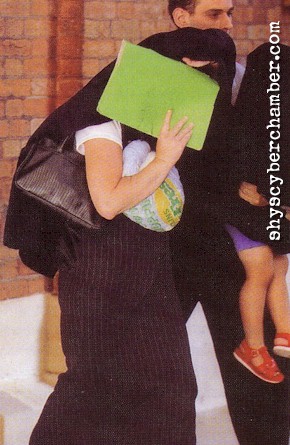 [ Milat's Ex-Wife ]
Ivan Milat's ex-wife Karen was a key prosecution witness. Her testimony
was given under witness protection and she rarely look at him as she recounted
the story of their life together. |
|
|
The jurors had the chance to see for themselves
the sites where the bodies of the seven backpackers were discovered. On
18th April the Belanglo State Forest was closed to the public to protect the
anonymity of the jury and the court adjourned to examine the area.
The prosecution took three months to make their case. But among all their
damning ballistics and forensic evidence it was the testimony of two very
different witnesses that probably convinced the jury there could be no
reasonable doubt.
The first was Karen Milat, aged 37, who rarely looked at her ex-husband as she
recalled four different trips to the Belanglo State Forest with Ivan in 1983.
On two occasions he had gone to shoot kangaroos and finished one off by cutting
its throat. The other two times they just drove around and had a picnic.
Despite Milat's claims he had never been to the forest, Karen told the court how
he seemed to know his way and never used a map. 'Ivan jut liked guns,' the
woman now under witness protection explained. 'Ivan knew how to handle
them and was confident about handling guns.' She also confirmed that Ivan
was known by many aliases, including Bargo Bill.
The second key witness was Paul Onions, who had escaped from Milat in 1990 and
whose identification of him in 1994 from police photographs helped lead to his
arrest. Mr Onions, now aged 30, told the terrifying story of how Milat had
pulled a revolver on him while he was hitching south along the Hume Highway.
Milat said it was a robbery but Onions saw some rope sticking out of his bag.
'It was just a bag with dirty coloured rope. I saw the rope and that
scared me more than the gun... I undid my seat belt and jumped straight out of
the vehicle.' he told the court. Onions tried to flag down passing cars as
Milat chased him and fired a shot at him. 'I heard the gun go off. I
just froze and then I started dodging and weaving as best I could.'
When no cars stopped, Onions said he was about to give up when he felt Milat's
hand on his shirt. He struggled and managed to get away. 'Once I broke
free, I thought the next vehicle that comes over the hill I'm just going to
stand in front of it, even if it runs me over, that's it.'
But the young engineer was lucky. He stopped a passing van, jumped
inside and locked the door. 'The people inside were saying "Get out, get
out" and I said "This man has got a gun, I'm not going anywhere."' Onions,
who had left all of his belonging in Milat's vehicle, said the last thing he
remembered seeing was a 'stupid grin' on the face of the man who'd just tried to
gun him down. |
|
|
 [ Milat's Trial ]
During Milat's committal hearing, court officials visited the Belanglo State
Forest to inspect the scene for themselves. Some 18 months later, in April
1996, the forest was closed so that jurors could do the same. |
|
|
It was the 13th week of his trial that Milat
climbed into the witness box and swore to tell 'the truth, the whole truth and
nothing but the truth'. He could have made an un-sworn statement from the
dock but to the surprise of many choose to give evidence and, more importantly,
to face cross-examination.
Dressed in a navy blue suit, Milat coolly answered the questions of his counsel
Mr Terry Martin. He denied having any knowledge of or involvement in any
of the deaths or the abduction of Paul Onions. He admitted having up to
30,000 rounds of ammunition for Chinese made rifles at his home but had no idea
how the vital Ruger rifle parts came to be hidden there. He claimed the
had never been to the Belanglo State Forest, contradicting the sworn evidence of
his former wife. And he had no explanation as to how any of the victims'
property came to be in his and his brothers 'homes.
It was soon after this that what many regard as the turning point came under
cross-examination from Crown Prosecutor Mark Tedeschi, to whom the ever-cool
Milat just kept up his denials."
'So,' the Queens Council began, 'you ask the jury to accept that someone broke
into your locked house, despite the burglar alarm, planted a Ruger rifle bolt in
the ceiling of your garage, dropped the weapon's receiver in one of your boots
in the hall cupboard - making sure both gun parts were painted in the same
camouflage colours you use on your firearms - then left a single fired
cartridge, linked to the murder of Ms Caroline Clarke, in a plastic bag on the
bed in a spare room?'
The usually cocky Milat could only answer, 'They must have.' It was a low
point for the defence case from which they never fully recovered.
There were only a half dozen witnesses for the defence in the entire trial and
conspicuous by their absence were Milat's sister Shirley Soire, with whom he
shared the Eagle Vale home, and his mother, Margaret Milat. The witnesses
that Milat's side did call presented him as a good neighbour who was always
willing to help, but the damage had already been done to his reputation. |
|
|
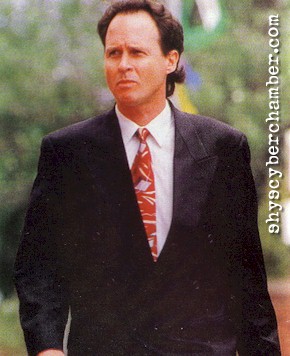 [ Milat's Counsel ]
Milat's counsel was the
Queensland barrister Terry Martin, under whose questioning he denied all
charges. |
|
|
In his final address, Crown Prosecutor Mark
Tedeschi said it was Milat's 'incredible arrogance and unbelievable self
confidence' which led him to keep his victims' camping gear and parts of a
murder weapon at his home. He said Milat not only fitted the physical
description given by Onions but that his four wheel drive and a revolver with
copper-tipped bullets also matched the traveller's testimony. Milat also
often visited Lombardo's shops at Casula where Onions was offered his fateful
ride.
'It is my submission there is only one person in the whole of Australia who
matches all of those descriptions - the man, the car, the equipment, and the
place - and that is the accused.' He concluded, 'It's almost as though the
accused left a fingerprint in the forest because of the incredible coincidence
of all the items being linked to him.'
Then Milat's counsel made a strategic concession and raised a terrifying theory
which has continued to haunt the case. Terry Martin said there was a
reasonable possibility that one, or both, of Ivan's younger brothers could have
committed the murders and then planted the evidence on their sibling. Ivan
himself had testified that he had no knowledge of whether his brothers were
involved in the offences.
Both Richard Milat, a labourer, aged 40, and Walter Milat, a self-employed
builder aged 44, had featured prominently in the trial. But both had
denied having anything to do with, or any knowledge of the backpacker crimes -
despite the victims' property being found at their homes.
'There can be absolutely no doubt that whoever committed all eight offences must
be within the Milat family, or very, very closely associated with it.
Blind Freddy can see that,' Mr Martin said in his final address. He said
if there was any doubt that Ivan was the guilty party he should be given the
benefit of that doubt. |
|
|
[ Witnesses ]
Among the many witnesses
called for the prosecution was the woman driver who had picked up Paul Onions,
saving him from Milat's attack. |
|
|
But in closing, the defence left the jury with a
tantalizing question. 'Do you think that a person capable of those most
brutal crimes would give two hoots about planting gear on a brother? Do
you not think a person guilty of that behaviour would do anything to avoid
conviction?'
Mrs. Milat was not called by the defence to give evidence, but shortly before
the end of the trial, she told a newspaper reporter that her whole family was
not guilty of any crime. 'But if Ivan is innocent, then they'll go and
arrest Richard,' she said. 'They are both innocent. They were living
here when those murders were meant to happen. I did all their washing.
There was no blood. They're good boys.'
Then Justice Hunt began to sum up the evidence which had taken 62 days, involved
145 Crown and nine defence witnesses and concerned 420 exhibits. The sheer
weight of minute detail had filled more than 3,500 pages of transcript. He
asked the jury to put aside any sympathy they might have for the victims or
their families, many of whom were present throughout the grueling days of
testimony. And, he reminded them, 'suspicion is not a substitute for proof
beyond a reasonable doubt'.
There was still no definite evidence that placed Milat at the murder scene.
But the judge told the jury, 'Circumstantial evidence may be compared to rope,
a thick piece of cord made up of a number of strands of fibre. Not one of
those strands alone may have very much strength, but when those strands are
taken together the strength of the rope may be very great. |
|
|
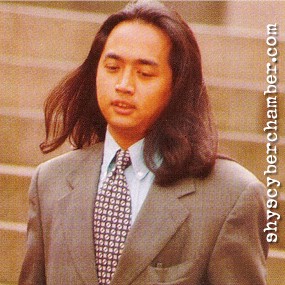
 [ Ivan Milat ]
Milat had remained cool
and calm throughout the trial. As he arrived to hear the verdict, he
smiled and looked confident. |
|
|
The image was appropriate, as the jury evidently considered they had
enough rope to hang Milat. On Saturday, 27th July 1996, after a four month
trial and 20 hours of deliberation spanning four days, the jury returned.
As the foreman stood to read out guilty verdicts to all charges, Mrs. Gillian
Walters, the mother of the murdered Welsh backpacker Joanne Walters, gasped from
the public gallery.
Milat did not react as he was immediately
sentenced to jail for the term of his natural life. The whole nightmare
seemed over for the grieving families and an outraged Australia - but there were
more disturbing surprises to come.
In passing sentence, Justice Hunt stated that Milat's 'callous indifference to
the suffering' of his victims was almost beyond belief. And he suggested
the only motive ever raised in the court for Milat's reign of terror, that the
backpackers had been savagely and cruelly attacked for 'psychological
gratification of the prisoner'. The judge then stated what police
investigators, the families of the deceased and public feared most. 'It is
inevitable that the prisoner was not alone in that criminal enterprise,' he
said. |
|
|
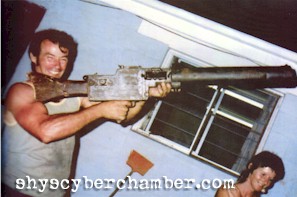 [ Milat's Guns ]
Ivan Milat's obsession
with weapons extended to this World War I vintage heavy machine gun. His
ex-wife Karen referred to him as 'gun-crazy'. |
|
|
Manfred Neugebauer, the father of one of the German victims, remains
convinced that Milat was not alone: 'Gabor was 1.86m (6 foot 1 inches) tall and
very strong. When we sometimes went into the forest to cut firewood he
would cut huge logs and carry whole stumps. It would have taken two men to
kill him.'
'I think we've got the awful prospect that there is someone out there on the
streets who shouldn't be on the streets,' said Caroline's father Ian, soon after
the verdict was handed down.
Dr Peter Bradhurst, the forensic pathologist who conducted all seven autopsies,
said throughout that he thought it likely there was more than one person
involved. The theory of multiple killers was supported by evidence that
two rifles had been used at one death scene and shots had been fired from
different directions. Evidence was also given that the branches used to
cover the bodies were too heavy for one man to lift.
Different methods were used to kill two pairs of victims. Caroline
Clarke had been shot ten times in the head while Joanne Walters had been stabbed
14 times. Gabor Neugebauer was shot six times in the head and strangled,
but his girlfriend Anja Habschied had been decapitated.
Police also considered it unlikely with six victims travelling in pairs, Milat
could have restrained them alone during the bumpy drive into the Belanglo State
Forest. They also could not explain why cigarette butts and liquor bottles
were found at the grave sites when Milat neither smoked nor drank. |
|
|
 [ The Milat Brothers ]
Pictures of the Milat
brothers together reveal many striking similarities which were commented on at
Ivan's trial. Here Ivan and Richard (left) enjoy a karaoke night in 1993. |
|
|
After the trial the chief suspects were Ivan's
brothers Richard and Wally, who had been named in court by Milat's own counsel.
In a remarkable television interview shortly after the trial, Richard Milat, who
had allegedly told workmates that stabbing a woman was 'like cutting a loaf of
bread', denied that he had any links with the murders. 'I've got no fears.
I don't reckon they will arrest me. If they thought it was me they'd have
me now, wouldn't they,' he said. 'I'm not going inside for anything I
did... I never killed nobody so why should I go there?'
Wally Milat denied involvement and refuted the theory that there were two
killers. 'Whoever is doing [the killings] is sick. Even if it's my
brother it's really sick. There's only one. There's not a busload of
them going around doing it. There's only one.'
Soon after Ivan's conviction, Sydney's Daily Telegraph released tapes of
a secretly recorded conversation in which Richard Milat discussed details of the
killings, just days after his brother's arrest.
The tape, last 72 minutes, was recorded in a Sydney pub in 1994, during a covert
police operation involving a family friend of the Milat's called Phillip
Polglase.
He went undercover for three months following Ivan's arrest, after telling
police Milat had earlier informed him of his killing spree. |
|
|
 [ Wally Milat ]
Wally Milat was another
brother who, like Richard, came under suspicion of involvement in the killings -
although he strenuously denied this. |
|
|
The tape was said to show the extraordinary
insight that Richard Milat had into the mind of the killer. He told his
mate, who was wired for sound, that there must have been more than one person
involved or how would the 'big German' have had a broken arm, jaw and back.
Richard Milat told how there would be 'heaps more bodies' and spoke about 'some
skinny fuckin' pommy backpacker' who police believe to be Paul Onions.
Richard also admitted he had scant defence. 'So I am a lunatic. I'm
not worried about it, I don't worry if they come 'n' arrest me for fuckin'
killing all those backpackers too... there is very little defence on me, sayin'
where I was, where I was at.'
The tape was never tendered in evidence.
Half way through Milat's committal hearing in November 1994, Polglase was killed
in a head on collision with another car near his home in the country.
Police found there were no suspicious circumstances.
The Sydney Morning Herald newspaper then published a story about
information concerning a 'hunting party' of three or more local men who may have
been involved in some of the murders. One of these was a man said to fit
the profile of the killer prepared before Milat's arrest. He was described
as a violent loner with an alcohol and drug problem who owned several weapons
including a Bowie knife, a awn off shotgun and a .22 Ruger rifle similar to the
one used in the killings.
Another member of the 'hunting party' also lived near Bowral, not far from the
forest, and was described as a woodsman with a gun fetish who had spent tie in
psychiatric institutions. Soon after the British girls' remains were
discovered, he claimed to a prospective employer that he knew where more bodies
were buried in the forest. This man was interviewed by police but
dismissed as a suspect. |
|
|
 [ Grounds for Appeal ]
Milat's solicitor,
Brisbane based Andrew Boe, said that the case was so prejudiced that it was
impossible to change the perception of Milat's guilt. Mr Boe said the
media focused on highly emotive evidence, such as the bloodied shirt
punctured with multiple stab wounds.
'The presumption started from
the time of his arrest; hundreds of policemen were marshalled for the arrest of
just one man, instilling in us the fear this must be a dangerous person,' said
Mr Boe, who spent two years organising Milat's defence.
He said the evidence only showed the killer was connected with the family, but
did not prove Ivan was the guilty party. 'The pre-trial publicity was such
that the greater population was already infected with so much information that
one wonders if you can be confident the verdict reached was reached purely on
the basis of evidence produced at the trial.' |
|
|
A disturbing allegation was
raised by one of Milat's former cellmates suggesting he might have started
killing in the early 1970's. Noel Manning spent eight weeks in a cell with
Milat in 1974 and heard endless stories of rape, murder and torture.
Manning was then 18, serving
12 months for stealing and assault, and said that none of Milat's stories were
ever the same.
'I was terrified... he
talked about how he would stake people out on the ground, cut them open and let
them bleed. The stories went on and on, male, female, boy, girl, he never
spoke about the same person twice and the stories were non stop every night,'
recalled Manning. He gave a lengthy statement, which a police source said
was plausible and was supported by the way in which some of the backpackers had
died.
But Manning, who was then
facing fraud charges, never lived to see the trial. He committed suicide a
few weeks before it began. Even so, detectives began looking into the
files of five women who went missing in the late 1970's and 1980's near wear
Milat was working. |
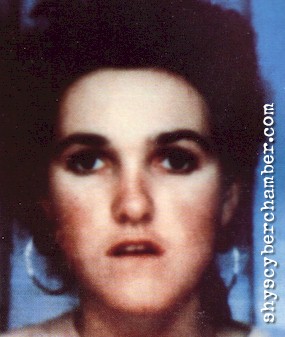
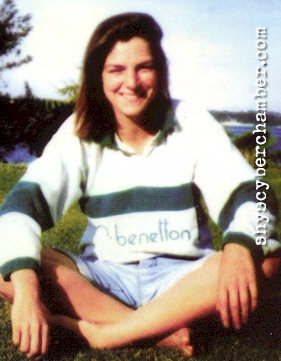 Both girls were described as confident, outgoing and sensible.
They intended winding up their Australian holiday by going to
Queensland and Darwin and then flying to Indonesia. Both phoned
their parents on 16th April 1992 and told them they were going fruit
picking, but the last confirmed sighting of the girls was at a
travellers' rest area at Mittagong, just 20 minutes drive from the
Belanglo State Forest. They were the last of the backpackers to
go missing and, several months later, the first to be found dead.
 Deborah's family formally reported her missing to the police on
January 15th. Two months later a woman found a backpack bearing
the name Gibson and containing a tin of sardines in the gorge.
It contained pine needles but there were no such trees in the area.
Work records later revealed Milat was fixing roads nearby when the
items were discovered.