|
shyscyberchamber.com
|
|
BAD PEOPLE |
Date Added |
|
 |
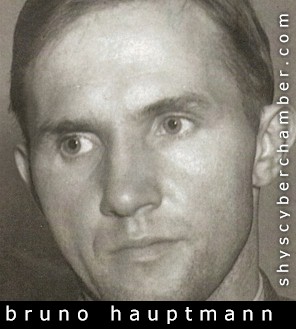
Bruno
Hauptmann |
November 2002 |
|
|
 |
|
|
Bio |
|
|
Full Name |
Bruno Richard Hauptmann |
|
|
Date of Birth |
26th November 1899 |
|
|
Date of Death |
3rd April 1936 |
|
|
Known Also As |
UNKNOWN |
|
|
Hit Count |
1 |
|
|
Information & Pictures |
|
|
It was a damp, windy
evening. Colonel Charles Lindbergh, the most famous aviator in the
world, was chatting with his wife Anne in the living room of their
mansion in New Jersey, near the village of Hopewell. Lindbergh relaxed
by the log fire. He had forgotten that this evening, Tuesday 1st March
1932, he had been due to speak at New York University.
It was almost five years since Lindbergh, then twenty five years old,
had become the first man to fly alone across the Atlantic Ocean. His
thrilling journey of thirty three and a half hours from New York to
Paris had created a legend of which Lindbergh - dubbed 'The Lone
Eagle' - had soon tired. His mansion, still incomplete, and its 200ha
(500 acres) of land were intended to shield the aloof pilot and his
family from the glare of public curiosity.
Usually, the Lindbergh's stayed at Hopewell on weekends and spent the
week at Mrs Lindbergh's family home at Eaglewood, New Jersey, opposite
New York City. However, their twenty month old son, Charles Jnr, had
developed a cold and his mother, who was three months pregnant, did
not want him to make the journey back to Eaglewood until he was well
again. |
|
|
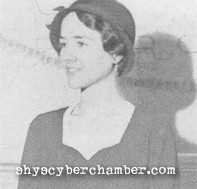
[ Anne
Lindbergh ]
Anne Lindbergh, the mother of the kidnapped baby, was the second
daughter of the banker and diplomat Dwight Morrow. Born in 1906, she
spent her childhood in the comfort of homes in New Jersey , Maine and
New York City. A dark haired passionate girl, Anne loved to read
literature and record her own thoughts in a diary. In public, she
often appeared shy and reticent, feeling eclipsed by her more
flamboyant elder sister, Elisabeth. In December 1927, Dwight Morrow,
then US Ambassador to Mexico, invited America's newest hero, Charles
Lindbergh, to make a goodwill visit to Mexico City. Anne was there
too, having returned from college in Massachusetts for Christmas. Her
diary conveys her admiration for the self-possessed pilot with blonde
hair and a sudden, broad smile. Anne and Charles were married at
Anne's family home in Eaglewood, in May 1929. Charles Jnr was born on
22nd June 1930, Anne's birthday. |
|
|
Lindbergh had arrived
home at 8.30pm to be told that his son was much better and was soundly
asleep in the nursery. After dinner, he and his wife had gone into the
living room, while their housekeeper, Elsie Whately, and her husband
Oliver, their butler, cleared away the dishes.
Soon after 9pm, while they were chatting, Lindbergh heard something
that caught his attention. It sounded like wood cracking. His wife
said she had heard nothing. They both listened intently for a moment,
but heard only the wind in the chimney. Ten minutes later, they went
upstairs to their bedroom to run baths.
At about 9.40pm, Lindbergh went back downstairs to work in the
library. He was a technical consultant to America's two leading
airlines, Transcontinental Air Transport and Pan Am. Upstairs, Mrs
Lindbergh rang for Mrs Whately and asked for a hot lemonade.
At the same time, Betty Gow, the nurse went to check that the baby was
comfortable. It was shortly after 10pm when Gow entered the nursery,
which lay alongside the Lindbergh's suite and overlooked the southeast
corner of the estate. The nurse did not switch the nursery light on,
to avoid waking Charles Jnr, but she did turn on an electric heater to
warm her hands before touching the baby. While waiting, she became
aware that she could not hear the child's breathing. |
|
|
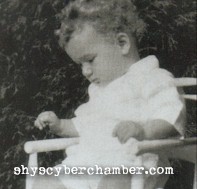
[
Charles Lindbergh Jnr ]
Charles Lindbergh Jnr was born on 22nd June 1930. Charles Augustus
Lindbergh Jnr was a happy, robust child with an independent nature. On
the night of the kidnap, he should have been at his grandparents'
home, but as he had a cold he wasn't taken there. |
|
|
Miss Gow walked across
to the solid wooden crib, which was lit by light from the hallway and
peered into it. The crib was empty. Concerned, she knocked at her
mistress's door and entered. 'Mrs Lindbergh, do you have the baby?'
she asked.
The child's mother looked worried. 'Why, no,' she said. The nurse
quickly suggested that Charles Jnr might be with his father.
Hurrying downstairs, Miss Gow tried without success to conceal her
anxiety when she entered the library and asked about the baby. 'Isn't
he in his crib?' Lindbergh asked her.
Moments later, the tall, lithe figure was running up the stairs to the
nursery. His wife was already there. They found the bed unruffled. The
impression left by their son lay cleanly in the bedclothes. The baby
could not have left the crib by himself. 'Anne,' Lindbergh cried out
to his wife, 'they've stolen our baby!' |
|
|
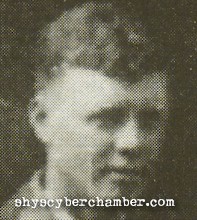
[ Charles Lindbergh ]
At dawn on 20th May 1927, Charles Lindbergh, a twenty five year old
Swedish-American with a boyish face, lifted his tiny aircraft, the
Spirit of St Louis, into the drizzle over New York City and headed
shakily out towards the Atlantic Ocean. His destination was Paris,
France. Millions prayed for Lindbergh's success, including 40,000
boxing fans who stood with bowed heads at New York's Yankee Stadium
that evening. Without possessing a radio or sextant, Lindbergh had to
navigate by dead reckoning through turbulent winds. After flying
5,415km (3,610 miles) in thirty three and a half hours, the
single-engine aircraft landed at Le Bourget airport in Paris on the
evening of the 21 May. Its exhausted pilot had survived hair-raising
dangers and hallucinations to become the first man to fly solo across
the Atlantic. 'It was the first time I'd been abroad,' he was to say. |
|
|
Lindbergh knew how to act decisively and
shrewdly at the worst moment of a crisis. He saw an unfamiliar
envelope lying on a radiator grille by the sash window in the corner.
The window had been closed, but its shutters were ill-fitting and
could not be sealed from within. There were reddish clay marks on a
chest near the window and the floor.
Lindbergh told his wife and their servants to touch nothing until the
room could be checked for fingerprints.
Whately, the butler, telephoned the local Hopewell police and
Lindbergh personally rang the New Jersey state police and his own
attorney, Colonel Henry Breckinridge in New York City.
The women searched the house and found nothing. Lindbergh and Whately
tried to search the land to the southeast of the house, using vehicle
headlights as a guide, but gave up. Whately was sent into the village
to fetch a flashlight for their search. |
|
|
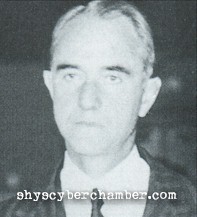
[ Colonel Henry
Breckinridge ]
Colonel Henry Breckinridge, Lindbergh's lawyer and former US
Assistant Secretary for War, was Lindbergh's right hand man in his
campaign to free his son. |
|
|
Soon the local police Chief, Harry
Wolfe, arrived with his assistant. Lindbergh showed them the nursery,
but would not let the officers touch anything. Mrs Lindbergh sat in
silence in the living room as police searched outside the southeast
window.
There were two indentations in the clay beneath the window. Some 18m
(60 feet) away lay the bottom two sections of a poorly-assembled,
collapsible ladder. The side rails fitted into the imprints on the
soil and the top rung of the lower section was split. Lindbergh
remembered the sound of cracking wood he had heard soon after 9pm.
The top section of the ladder lay three metres (10 feet) from the
other sections. A chisel also lay nearby. At this stage, a squad of
state detectives arrived, led by the force commander, Colonel Norman
Schwartzkopf, and his deputy, Major Charles Schoeffel.
An examination of the nursery was begun, but it was after midnight
before a fingerprint expert, Corporal Frank Kelly, arrived. His test
found no prints on the envelope. Schoeffel read the note inside, and
gestured for the local police to leave. |
|
|
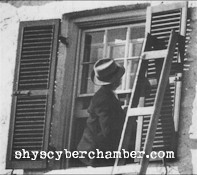
[ Searching the Nursery
]
A detective examines the nursery window by which the kidnapper
entered the Lindbergh house. The crude ladder, with its widely spaced
rungs, was replaced there by the police after being found in the
grounds. |
|
|
When they had gone, Lindbergh was given
the note. Written in pencil, it read:
Dear Sir!
Have 50 000 $ redy 25 000 $ in 20 $ bills 15 000 $ in 10 $ bills and
10 000 $ in 5 $ bills. After 2-4 days we will inform you were to
deliver the Mony.
We warn you for making anyding public or for notify the Police
the chld is in gute care.
Indication for all letters are singnature and 3 holds.
The letter ended, not with a conventional signature, but with two
interlinked blue circles, at the centre of which was a round red blob.
Three holes were punched in a line across the symbol.
Lindbergh had became an immensely wealthy man since his transatlantic
flight, with assets around $500,000 at the time of the kidnapping. The
$50,000 demand was well within his means.
Lindbergh told the detectives in the nursery that there must be no
interference in the payment of the ransom. No one seriously challenged
him. The main aim was to retrieve his child. |
|
|
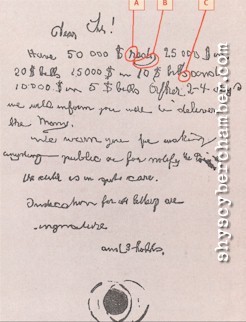 [
Ransom Letter ]
Analysis of the handwriting on the ransom note suggests that the
kidnapper is mentally disturbed, with manic depressive tendencies. He
was also aggressive and resentful and his neuroses could lead to
explosive hostility and aggression. The analysis also suggests that
the kidnapper was a daydreamer who, through a sense of inferiority,
liked being the centre of attention. The writer was also liable to be
coarse and occasionally vulgar. He appears to have strong physical
resources. He could be inhibited, over-cautious, self-disciplined and
economical.
A - Unusually shaped 'r' = eccentric character
B - Long loop on 'y' = mother fixation
C - Enrolled 's' = shrewd and calculating
|
|
|
Lindbergh and his attorney, Henry
Breckinridge, were convinced that they were dealing with a
professional gang of kidnappers, who would understand that his
overriding aim was to have his son back. Ignoring the wishes of
Colonel Schwartzkopf, the New Jersey police chief who had by now
turned the garage at Hopewell into his headquarters, Lindbergh put out
feelers to the underworld for information.
On 4th march 1932, two days after the kidnapping, the press published
a statement by Lindbergh in which he promised he would 'not try to
injure in anyway' the kidnappers if a ransom could be exchanged. The
state's Attorney General, William Stevens, publicly announced that
Lindbergh had no authority to offer immunity from prosecution.
However, on 5th and 6th March, Lindbergh received two letters, both
posted in the New York City area and signed with the interlocking
circles seen on the original ransom note. The first remonstrated with
Lindbergh for involving the police, saying the ransom had been raised
from $50,000 to $70,000, and that there would be no deal until 'the
Police is out... and the Pappers are quiet'. The second note told
Lindbergh that his son was well, but that the kidnappers would not
deal with any go between selected by Lindbergh. 'Our dinaping was
pland for a year allredy,' it said. |
|
|
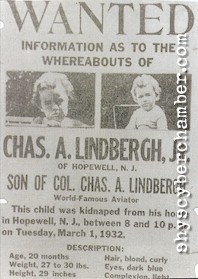
[ Information Wanted
Poster ]
The police issued this Information Wanted Poster in their search
for the Lindbergh child. The height of 29 inches was a mistake, later
corrected, for 2ft 9in. |
|
|
As Lindbergh waited for his underworld
contacts to report, a little-noticed article appeared in a local
newspaper in a New York borough. The Bronx Home News of 8th March ran
a front page advertisement by a local man Dr John Condon, who offered
'all my life's savings' as well as the Lindbergh ransom if the
kidnappers would use him as a confidential go-between.
'I am ready, at my own expense, to go anywhere,' Condon wrote. His
purpose was to show Lindbergh that 'the American people are grateful
for the honour bestowed upon them by his pluck and daring'. Condon, a
seventy two year old teacher in semi-retirement, was gently ridiculed,
even by his family.
However, the next day, he returned from giving a lecture to find a
pencil written envelope. Inside was a not accepting Condon as
negotiator, and a second smaller, white envelope.
The note told Condon to 'handel incloced personaly to Mr Lindberg' and
that, when the ransom was prepared, a message reading 'Money is redy'
should be placed in the New York American Newspaper.
Condon rang Lindbergh at Hopewell, but aroused little interest until
he mentioned two interlocking circles at the end of the note. There
was an excited response. Two hours later, Condon was welcomed at
Hopewell. Plans were quickly formulated. To avoid using Condon's name,
messages to the kidnappers would be signed 'Jafsie' (pronounced Jay-eff-see)
- John Francis Condon's initials when spoken. |
|
|
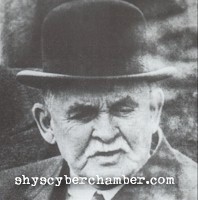
[ Dr John Condon ]
Dr John Condon was the elderly New Yorker who offered to be an
intermediary between Lindbergh and the kidnappers. In his new role, he
took on the nom de plume 'Jafsie'. |
|
|
The first message appeared in New York
American on 11th March. It read, 'Money is ready - Jafsie' and avoided
the kidnappers misspellings. That evening, Condon took a phone call
from a man with what he thought was a Scandinavian or German accent.
The caller told him to stay in from 6pm to midnight for the rest of
the week.
While on the phone, Condon heard what sounded to him like Italian
voices in the background. Suddenly, a man said 'Statti zitto!', which
Condon knew meant 'Shut up!' in Italian.
From then on, events gathered pace. On the following night, 12th
March, a taxi driver delivered an envelope to Condon's house at 2974
Decatur Avenue, in the Bronx. It set in motion a plan to make direct
contact with the kidnappers. Breckinridge, who was staying at Condon's
house in order to monitor developments, approved the plan. |
|
|
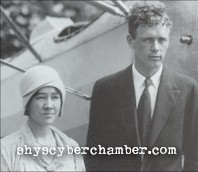
[ Charles and Anne
Lindbergh ]
Charles Lindbergh poses with his wife Anne shortly after there
marriage in 1929. Some three years later came the kidnap of their
first child. |
|
|
Later that evening, Condon and a friend
Al Reich, a former boxer, followed the kidnapper's instructions. They
took up positions by the western fence of Woodlawn Cemetery in the
Bronx. Condon saw an Italian-looking man with a handkerchief over his
face walk by, and decided he was a look out.
Shortly after, in Condon's account, a white handkerchief was waved at
him from inside the cemetery. In the shadows by the gate, he found a
man in a dark coat his hat pulled down and a handkerchief in front of
his face.
'He spoke,' Condon was to write in his book Jafsie Tells All,
published in 1936, 'and I recognised at once the guttural voice that
had talked to me over the telephone the night before.'
Condon described the man as about 1.73m (5ft 8in), aged 30-35, with
light brown hair. He gave his name as 'John", and said the kidnap gang
had six members. Two, were women looking after the baby on a boat six
hours' travelling time away.
Suddenly, John asked, 'Would I burn if the baby is dead?... Would I
burn if I did not kill it?'
Condon understood that John was asking if he would be executed in the
electric chair if the baby died, but not by John's hand directly.
Worried Condon asked about the boy, but John said he was in good
health.
Arrangements were made for further negotiations, and John slipped away
into the darkness.
After another flurry of messages, a package arrived at Condon's house
on 16th March. Breckinridge then phoned Lindbergh, who arrived in
disguise to avoid reporters. |
|
|
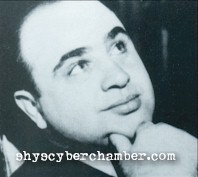
[ Gangster Aid ]
Immediately after the kidnapping, the Chicago gangster Al Capone,
serving a long jail sentence for tax evasion, offered to secure the
return of the Lindbergh baby in exchange for his freedom. The US
government dismissed his offer. However, Lindbergh and his lawyer,
Henry Breckinridge, believed that underworld contact were needed to
negotiate with the kidnappers. On 6th March, Charles Lindbergh
authorised two racketeers, Salvy Spitale and Irving Bitz - suggesed by
a man named Morris Rosner - to act as go-betweens. For this, the
aviator was loudly condemned by police chiefs and religious ministers.
On 11th March, Rosner announced that the child was well and would be
home soon. But Spitale, speaking a few days later, acknowledged that
'this one was pulled by an independent' - meaning amateurs. |
|
|
The package contained his son's sleeping
suit and a note making arrangements for the ransom payment.
The $70,000 was assembled at the J.P. Morgan bank. Lindbergh ordered
the bank to keep no record of the serial numbers, but the US Treasury
refused to allow the kidnappers off so leniently. It insisted that the
bulk of the ransom be paid in gold certificate bills, which were the
easiest to trace. |
|
|
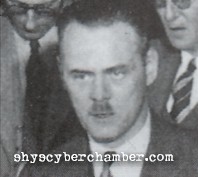
[ Colonel Norman
Schwartzkopf ]
Colonel Schwartzkopf, head of the New Jersey State Police, was one
of the first officers to arrive at the scene of the kidnapping. |
|
|
Colonel Schwartzkopf of the New Jersey
police, and senior detectives in the New York Police Department, were
aware of the imminent exchange. They disapproved of Lindbergh
conducting matters on his own, but his influence was such that they
promised not to interfere. There were to be no police undercover
agents in the vicinity of the ransom payment, and effectively no
attempt to catch the kidnappers until the baby was home.
Finally, at 7.45pm on Saturday, 2nd April 1932, an envelope was
delivered by a taxi driver to Condon's house. Following instructions,
Condon and Lindbergh set off with the money. Less than an hour later,
with Lindbergh waiting in the car, Condon was inside the darkness of
St Raymond's Cemetery in the Bronx. Both men heard a voice shout, 'Hey
Doc!'
Soon, the man known as 'Cemetery John' approached Condon. He was again
wearing dark clothes, and this time had a fedora pulled down over his
face. Condon told him that only $50,000 had been raised, but that it
was available there and then. Cemetery John agreed to accept it. They
arranged to meet by the same hedge a few minutes later to exchange the
ransom for a note describing where the child could be found.
Fifteen minutes later, the exchange was carried out. 'The gang says
your work is perfect,' Cemetery John told Condon. The note was not
intended to be opened for six hours, but Cemetery John said the boy
was on a boat named Nelly near the Elizabeth Islands, along the coast
of Massachusetts. Then they parted. |
|
|
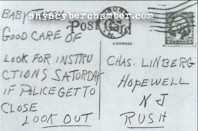
[ The Letters ]
Many experts were puzzled by the ransom note found at Hopewell, and
the kidnapper's notes to Dr Condon and Lindbergh. Simple words, such
as 'ready', 'good' and 'child' were misspelt as 'redy', 'gute' and 'chld',
while more difficult ones, such as 'indication', 'notify' and
'instructions', were spelt correctly. There was no constant pattern,
as many long words were misspelt also. The deputy commander of the New
Jersey police, Major Charles Schoeffel, was sent to Europe in March
1932 to consult experts in Britain and Germany. Scotland Yard decided
the letters were the work of inexperienced villains, and confirmed the
view of the American police that they were written by a Germanic
person. Major Schoeffel found out little more in Germany or Austria.
It was never established if the interlocking circles on each of the
ransom letters carried any significance. |
|
|
In the car, the boy's father read the
note. 'The boy is on Boad Nelly...' it said, '...two person are on the
Boad, the are innosent.'
Next morning, Lindbergh set off alone by plane to scour the region
near the Elizabeth Islands. Day after day he searched, but he never
found the boat, Nelly or his son.
The New Jersey and New York police were exasperated. They had deferred
to Lindbergh's wishes, only to discover that he had been easily
deceived. Little had emerged in the way of clues - a footprint left by
Cemetery John during the handover, a footprint outside the nursery at
Hopewell, unidentified fingerprints on the ladder in the Hopewell
grounds, and the misspellings of the kidnapper's ransom notes. |
|
|
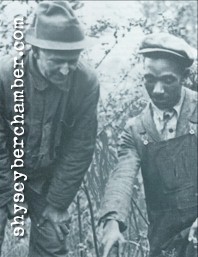
[ William Allen ]
Truck driver William Allen points to the spot in the wood near
Hopewell where he found the body of Charles Lindbergh Jnr. Beside
Allen stands Orville Wilson, who was in the truck with him at the
time. |
|
|
On 12th May, ten weeks and three days
after the kidnapping, two truck drivers found the badly decomposed
body of Charles Lindbergh Jnr in some woods about eight kilometres
(five miles) from the Hopewell mansion. A post mortem indicated that
he died of a fractured skull, perhaps sustained immediately after the
kidnapping.
For the police, the investigation now depended on tracing the ransom
money. By the end of 1932, the banks - all of them in New York -
reported the deposit of only 27 marked bills in various denominations.
So, the police inquiries came to nothing. |
|
|
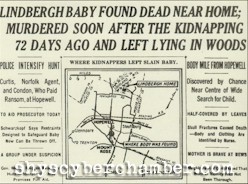
[ Lindbergh Baby
Discovered ] |
|
|
On 16th September 1934, the manager of
the Warner-Quinlan filling station, on New York's East Side, took a
$10 gold certificate bill from a customer. The government were
withdrawing gold bills and the manager Walter Lyle, remarked, 'You
don't see these around much any more.'
The customer replied, 'I have only about a hundred of them left.'
Fearing that his bank might reject the gold bill, Lyle jotted down the
registration number of the customers car : 4U13-41. Two days later,
when the police called, Lyle remembered it was a 1931 Dodge sedan. Its
owner was well dressed and spoke with an accent. |
|
|
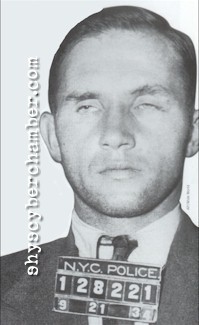
[ Bruno Hauptmann ]
A mug shot taken or Bruno Hauptmann on 21st September 1934, two
days after his arrest by the New York City Police. Throughout, he
insisted that he had nothing to do with the kidnapping. |
|
|
The police quickly traced the Dodge to a
thirty four year old German carpenter, who lived at 1279 on East 222nd
Street, the Bronx. His name was Bruno Richard Hauptmann.
Hauptmann had a German accent and was a man who could make ladders. He
also lived in the right area to have noticed Dr Condon's appeal in the
Bronx Home News, and he still had 100 gold bills left in 1934. He was
just the man that the police were looking for.
Bruno Hauptmann was arrested on 19th September in his car. 'What is
happening? What is this?' he asked. Another gold bill, worth $20, was
fund in his trouser pocket. Its serial number matched that of one of
the ransom bills.
Hauptmann was driven to a police station on the Lower West Side. FBI
agents were present, as well as Colonel Schwartzkopf, his New Jersey
team, and a squad of New York detectives. Their suspect, dressed in a
dark suit was about 1.78m (5ft 10in) tall, had lightish brown hair and
matched Condon's description of Cemetery John.
Hauptmann said that on 1st March 1932 - the day of the child's
abduction - he had been working at the Majestic Apartments on 72nd
Street in New York. Officers were sent to check the story. Hauptmann
firmly denied ever having been in Hopewell.
He answered rounds of questions calmly until he was accused of
kidnapping and killing the child. 'No,' he shouted with mounting fury.
'No, I did not.' Within hours of his arrest, Hauptmann had been
charged with kidnapping, murder and extortion. |
|
|
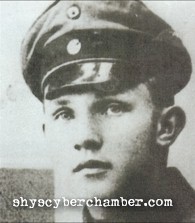
[ Bruno Hauptmann ]
At the age of nineteen, Richard Hauptmann - he disliked the name
Bruno, preferring his second name - was called into the German army
and sent to the Western Front where he was a machine gunner. Wounded,
he was in a hospital when the war ended. |
|
|
A small number of those present felt
that Hauptmann seemed more puzzled than sinister. But the mood
hardened when he was asked about the gold bills.
Hauptmann said he had saved $300 to guard against inflation. But e
seemed to have become increasingly nervous.
Later, his wife Anna was questioned. Her recollection of how she and
her husband spent the vital days of 1st March and 2nd April, the dates
of the kidnapping and the ransom payment, matched that of her husband.
She created a picture of a close knit family, who enjoyed musical
evenings with immigrant friends and neighbours and their baby son,
Manfred.
Hauptmann was asked to take a handwriting test. 'I'll be glad to
because it'll help me get out of this thing,' he said. The tests and
the questions continued for most the night.
On the following morning, 20th September, police turned over the house
on 222nd Street, in the Bronx. In the garage, detectives found a huge
stash of gold bills, carefully hidden. It totalled $13,760. The serial
numbers on the bills showed it was all Lindbergh ransom money. |
|
|
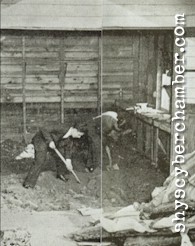
[ Hauptmann's Garage ]
Police digging up the floor of Hauptmann's garage in search for the
ransom money. They found $11,930 in a shellac tin hidden under rags
and $1,830 wrapped in newspapers. More finds were to come. |
|
|
They asked Hauptmann why he had lied. He
told them that the gold bills had been left at his house, in an
unmarked package, by a German business associate, Isidor Fisch.
According to Hauptmann, Fisch had left the package shortly before
returning to Germany on 6th December 1933. Hauptmann did not realise
what the packet contained until it accidentally soaked one day. Since
Fisch had owed him about $7,500, Hauptmann had felt free to spend some
of the gold bills.
Fisch, he said, had died in Leipzig from consumption in March 1934,
without reclaiming his money.
The detectives asked why he had lied. From fear, Hauptmann answered.
They asked why he had not sent Fisch's money to his next of kin, a
brother in Germany with whom Hauptmann corresponded. Fisch owed him
money, Hauptmann insisted. But what about the balance, persisted
police, the other $6,000? Hauptmann said nothing. |
|
|
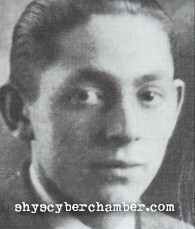
[ Isidor Fisch ]
The shadowy figure of Isidor Fisch haunted Hauptmann throughout his
interrogation. Evasive and shy, with the smile of a predator, Fisch
specialised in conning friends and associates into investing in bogus
or bankrupt companies. Almost none saw their money again. Fisch, a
Polish Jew brought up in Germany, immigrated to New York in the
1920's. For a while, he worked steadily as a cutter in the fur trade.
But from 1930 onwards, he began fleecing people of their savings.
Later in 1932, he decided that Hauptmann, a shrewd and honest investor
on the stock market, would be a useful partner, able to turn Fisch's
illicit earnings into sound investments. The partnership proved
lucrative though Hauptmann had only a hazy idea of what Fisch was up
to. Among other things, Fisch was involved in selling 'hot' Lindbergh
ransom money at a discount. Indeed, he paid for his own sea journey to
Germany, in 1933, with 'hot' gold certificate bills. |
|
|
Hauptmann was paraded before the world's
press photographers. The Police Commissioner of New York, General
O'Ryan, announced that the case was solved. On 22nd September,
Hauptmann - the target of sustained newspaper vilification - was
indicted for extortion by a Grand Jury in the Bronx, and committed for
trial in two weeks time.
On the same day, police found another $840 in gold bills, and a
pistol, concealed at 222nd Street. Hauptmann again assured the
detectives that there was no more. The Bronx District Attorney, Samuel
Foley, commented to news reporters, 'He told us the same story last
week after we found the first money.'
Hauptmann also lied to the police over his past, saying he had never
been arrested. A check with the German authorities revealed that he
had once spent four years in prison for a series of robberies.
Since the kidnapping and murder were New Jersey crimes, legal moved
were started to extradite Hauptmann from New York to New Jersey. By
this time, he was represented by an attorney, James Fawcett, who
quickly became convinced that his client was innocent. The US Attorney
General was asked publicly if Hauptmann was guilty, 'I didn't know
anyone doubted it,' he replied.
Extradition was quickly granted. On 19th October, after losing his
appeal against it, Hauptmann was transferred to the County Jail at
Flemington, New Jersey, to await trial on the most serious charges -
kidnapping and murder.
Detectives had been busy trying to link Hauptmann to the footprints at
Hopewell and St Raymond's Cemetery, to the ladder and to the
handwriting of the ransom notes.
At this stage, Dr Condon was unsure that Hauptmann was Cemetery John
and did not want to commit himself, knowing that Hauptmann had a
family. 'If I identify him, it will mean the electric chair.' |
|
|
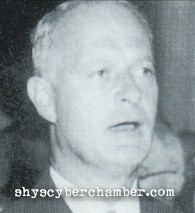
[ James M Fawcett ]
Defence attorney James M Fawcett attends the arraignment of Bruno
Richard Hauptmann at the Bronx County Court on 24th September 1934.
The judge set bail at $100,000. |
|
|
The trial of Bruno Richard Hauptmann,
for the murder of Charles Lindbergh Jnr opened on 2nd January 1935. It
was held at Hunterdon County Court in Flemington, New Jersey, before
Judge Thomas Trenchard, who had presided at 91 previous murder trials.
The prosecution was led by the Attorney General of New Jersey, David
Wilentz, and the defence team by Edward Reilly, a seasoned trial
lawyer from New York.
The first day passed in selecting the jury of eight local men and four
women. When the trial proper began the next day, the small courtroom
was packed with hundreds of people. Newspapers and radio stations
across the USA and the world had sent reporters and commentators. |
|
|
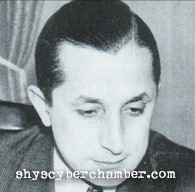
[ David Wilentz ]
The Chief Prosecutor David Wilentz. The Prosecution's approach,
appealing to patriotism, was crude but effective with the jury. |
|
|
In the well of the court were the tables
for both sides' counsels. Hauptmann sat just behind wearing a dark
suit looking pale. The jury sat to his right, facing a plain wooden
chair where each witness would sit and give evidence.
Hauptmann, who was guarded by State Troopers throughout the trial,
pleaded not guilty. He looked defiantly confident as Wilentz rose to
outline what was known about the case, the actual kidnapping at
Hopewell.
'He came there with his ladder, placed it against the house... then as
he went out that window and down the ladder of his, the ladder
broke... and down he went with this child,' Wilentz said. 'In the
commission of that burglary the child was instantaneously killed when
it received that first blow...'
Wilentz promised the jury that expert witnesses would link the ladder
at Hopewell to Hauptmann and identify him as a lone kidnapper,
murderer and extortionist. The prosecutor appealed shamelessly to the
emotions of the jury, leaning heavily on the public desire for
vengeance and heroic adulation that Lindbergh, sitting with his wife a
short way from Hauptmann, still commanded. |
|
|
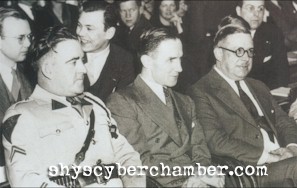
[ Hauptmann with State
Troopers ]
At his trial in Flemington, New Jersey, Hauptmann (second from
left) sits flanked by a uniformed state trooper and Deputy Sheriff
Hovey Low. He was confident and relaxed evening allowing an occasional
smile. |
|
|
Soon, Lindbergh was called to testify.
He looked exactly like the gaunt, tall, quiet hero of his photographs.
Lindbergh described the night the ransom money was handed over at St
Raymond's Cemetery.
He asserted that he had heard a man cry out 'Hey Doctor!' in a foreign
accent. He had previously testified that the cry was 'Hey Doc!' and
had certainly made no mention of an accent.
Wilentz was unperturbed. 'Whose voice was it, Colonel?' he asked.
'That was Hauptmann's voice,' he replied.
Reilly, for the defence, missed the opportunity to cast doubt on
Lindbergh's memory and on his ability to identify a man from two
syllables that were uttered a long way away and two and a half years
previously. Reilly was to forsake many similar opportunities during
the trial.
A succession of witnesses was called to describe events at the
Lindbergh mansion. There had been conflicting statements over how many
sets of footprints were found leading away from the house. State
Troopers Joseph Wolfe and Nuncio de Gaetano, who at the time reported
finding two sets of footprints, now swore that they had only found
one. The state was intent on proving that Hauptmann alone was
responsible.
As the trial entered its second week, the prosecution called in a
nearly blind eighty seven year old witness. He claimed to have seen
Hauptmann at Hopewell, with a ladder in his car, on the day of the
kidnapping. The defence did little to discredit such unreliable
testimony. |
|
|
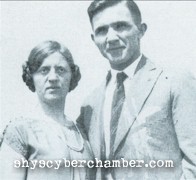 [
Bruno & Anna Hauptmann ]
Hauptmann met his wife Anna in 1924, the year he slipped ashore as
an illegal immigrant to the USA. Anna Schoeffler worked as a maid for
a rich Jewish couple in New York and the couple met at the seaside
resort of Coney Island. Hauptmann was to admit that, during their
courtship, he glossed over his crimes and prison record for fear 'that
I might lose her love'. But Anna, a year older than Hauptmann, knew
what the poverty and despair of Germany had done to many young men
after the First World War, and urged him to put the past out of his
mind. They were married on 10th October 1925, in Brooklyn. Their only
child Manfred, was born in November 1933, less than a year before
Hauptmann's arrest. |
|
|
On 9th January, the sixth day of the
trial, Dr Condon - the celebrated 'Jafsie' of the ransom negotiations
- took the stand. By dawn, a thousand people were queuing for a few
spectators' seats. ' I come here clear across the country to see
Jafsie on that stand,' said one woman.
Condon, examined by Wilentz, described his first meeting with Cemetery
John at Woodlawn Cemetery in the Bronx on 12 March 1932.
"And who is John?' Wilentz asked.
'John is Bruno Richard Hauptmann,' the witness answered, emphasizing
each name and pointing to the defendant.
When finally Reilly rose to cross examine Condon, the atmosphere in
court grew more tense. It was generally agreed that if Reilly could
not shake Condon's evidence, then Hauptmann would be convicted.
Prior to the trial, Condon had several times refused to identify
Hauptmann as Cemetery John, but he now put up a smokescreen of words
to justify his u-turn. Reilly had met his match, and proved unable to
discredit Condon. |
|
|
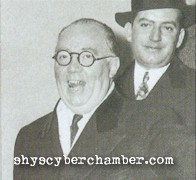
[ Edward Reilly ]
The Chief defence council, Edward Reilly, fifty two, was a tall,
florid, hard-drinking dandy. He frequently took on un-winnable murder
cases, and was nicknamed 'The Bull of Brooklyn' for his flamboyant
courtroom style. Throughout the Hauptmann trial he was in the pay of
the anti-Hauptmann Hearst Press, and he had long been an ardent
admirer of Lindbergh. In court, Reilly's grasp of his brief was
inadequate and he often muddled names and facts. His worst fault was
his failure to secure damaging admissions from hostile witnesses. This
became so obvious that Lloyd Fisher, number two on the defence team,
accused Reilly in open court of 'conceding Hauptmann to the electric
chair'. Reilly's relationship with the local lawyers in his defence
team deteriorated and he quit before the appeals - but only after
submitting a hefty bill to the Hauptmann's. The local men believed
Hauptmann was innocent, but Reilly, initially at least, thought him
guilty. He visited his client in prison just four times, for a total
of thirty eight minutes. Reilly was the worst defender Hauptmann could
have chosen. |
|
|
The prosecution produced further
witnesses who testified to seeing Hauptmann near the Lindbergh's
house, or who linked him to the ransom notes or the ransom money in
New York.
Government experts then took the court through Hauptmann's complex
financial affairs. They were followed by eight prosecution handwriting
experts, led by the Osborn father and son team, who swore that the
ransom notes were written by Hauptmann. The younger Osborn had by this
time changed his mind. Reilly had only one expert to disagree with
them.
Wilentz had promised to link the ladder at Hopewell to the defendant.
He called a government wood expert, Arthur Koehler, who testified that
one of the rail lengths on the ladder used in the kidnapping matched a
stretch of wood in the floorboards of Hauptmann's attic. |
|
|
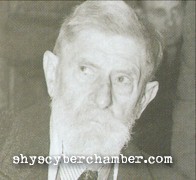
[ Amandus Hochmuth ]
Though barely able to see without his glasses, trial witness
Amandus Hochmuth, eighty seven, claimed he saw Hauptmann in a car that
had turned onto the Lindbergh drive on the morning of the kidnapping.
For his tale, Hochmuth got $1,000 in reward money. |
|
|
The defence began its case on the
afternoon of the 17th day of the trial, 24th January. Lloyd Fisher, a
younger, more sincere attorney than Reilly, made a simple opening
speech. Hauptmann, he said, would prove that on 1st March and 2nd
April 1932, the days of the kidnapping and the ransom payment, he was
nowhere near Hopewell or St Raymond's Cemetery.
Hauptmann walked confidently to the witness chair. He wore a double
breasted grey suit with a white handkerchief in his breast pocket. The
Troopers moved to either side of the chair to guard him.
In his evidence, Hauptmann explained that the misspellings in his
handwriting samples had been 'because of the dictation' by police and
officials who had wanted him to write it that way, and not because he
was a writer of the ransom notes. |
|
|
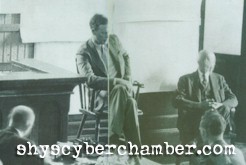
[ Charles Lindbergh ]
Lindbergh, seen here giving evidence at the trial, was a most
damning prosecution witness. He seemed a paragon of integrity as he
pointed to Hauptmann as the man whose voice he heard at St Raymond's
Cemetery during the ransom handover. |
|
|
His Chief counsel, Reilly, pointed to
the kidnapper's ramshackle ladder, which stood in the well of the
court.
'Did you build that ladder?'
'I am a carpenter,' Hauptmann said with a smile. There was loud
laughter in the court.
'Did you build this ladder?'
'Certainly not,' Hauptmann said.
Hauptmann told Reilly how he found the gold certificate bills in the
package left by Isidor Fischer, of the money Fisch owed him, and of
being beaten up by police at Greenwich Street in New York.
Then, cross examined by Wilentz, Hauptmann admitting lying in custody.
The clashes between the men became more heated. Wilentz was vengeful
and high voiced. Hauptmann was coldly determined. He seemed assured,
and when he made a telling reply, he tended to smile. This irritated
Wilentz.
'You are smiling at me every five minutes,' Wilentz said.
'No.'
'You think you are bigger than everybody, don't you?' Wilentz
continued.
'No,' replied the defendant, 'but I know I am innocent.' This
knowledge gave Hauptmann an inner strength. |
|
|
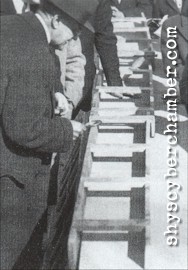
[ The Ladder ]
The ladder found in the grounds at Hopewell was a crude, home-made
effort. It was six metres (20 feet) long when extended and had rungs
46 cm (18 inches) apart, rather than the usual 30 cm (12 inches).
Police confirmed that it fell several feet short of the nursery
window. This would have made it extremely difficult for a lone
kidnapper to climb unaided out of the window when carrying the
Lindbergh baby. The prosecution however, set out to prove that
Hauptmann had done just that. A New York detective, Lewis Bornmann,
and a government wood expert, Arthur Koehler, spent months trying to
trace the yard where the timber for the ladder was bought. The wood
was widely used, but they decided with little justification that it
came from a lumber yard used by Hauptmann. Bornmann then assert that
one of the ladder's rails came from a floorboard in Hauptmann's attic.
The defence lawyers protested that they had been denied access to the
house to test the Bornmann - Koehler findings. In court, defence wood
experts largely demolished the findings, but to no avail. |
|
|
Hauptmann was, however, uncertain in
some of his evidence. He was unsure of the exact dates he worked at
the Majestic Apartments. Records subsequently proved that he did, in
fact, work there on 1st March 1932.
Wilentz asked about the telephone number of Dr Condon, which was
written on a closet door in Hauptmann's home. Naively, Hauptmann said
he had no recollection of writing it, but, since the handwriting
resembled his own, he much have written it. He could not explain why.
(After the trial, it emerged that a reporter with the Daily News in
New York, named Tom Cassidy, had written it there, after Hauptmann's
arrest, as a joke and because it would make a good story.)
In his final speech for Hauptmann, Reilly derided the prosecution
contention that Hauptmann was the kidnapper at Hopewell. 'How in God's
name did Hauptmann in the Bronx know anything about the Lindbergh
home?' he asked. He demanded to know what evidence had been produced
to show that Hauptmann knew the baby was to stay at Hopewell on
Tuesday for the first time or how he knew the layout of the house.
Step by step, Reilly tried to show how flimsy the case against
Hauptmann as the maker of the ladder, the writer of the ransom notes
and the recipient of Lindbergh's $50,000 payment. He suggested that
the police, desperate for evidence, had fabricated their own or placed
pressure on witnesses. |
|
|
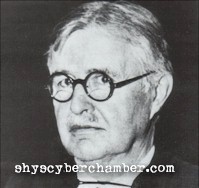
[ Justice Thomas
Trenchard ]
In his summing up, Justice Thomas Trenchard seemed to be fair to
Hauptmann, but a number of those present, such as the English author
Ford Madox Ford, detected a bias in his emphasis on certain words. |
|
|
The mob wants the German carpenter
killed,' Reilly ended, 'as mobs for the past 2,000 years have cried
for the death of a person... where are our feelings when we have sent
an innocent man to his death?'
Wilentz, in his own final speech, preferred character assassination to
a resume of evidence. He described Hauptmann as 'Public Enemy Number
One of the World!... Look at him as he walks out into this room,
panther-like, gloating, feeling good.'
The prosecutor played upon a wide-spread anti-German sentiment.
'Now what type of man would kill the child of Colonel Lindbergh?' he
asked. 'He wouldn't be an American... the federal authorities have
found that animal, and animal lower than the lowest form in the animal
kingdom.'
The following morning, 13th February 1935, Judge Thomas Trenchard
began his summing up. It lasted one hour and ten minutes. At 11.23am,
the jury retired to consider it's verdict. |
|
|
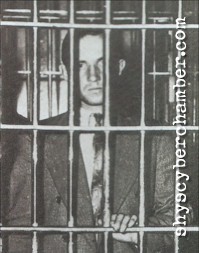
[ Bruno Hauptmann ]
Bruno Hauptmann stands behind bars in Flemington Jail. Though found
guilty, many voiced their concern about the evidence. The famous
criminal lawyer Clarence Darrow said: 'I haven't seen anything there
to indicate murder, have you?' |
|
|
At 10.44pm that night, the twelve jury
members returned. The foreman, Charles Walton, rose to his feet to
announce the jury's decision. It had found Hauptmann guilty of murder
in the first degree. Reilly then made each one repeat the finding. The
defendant, made to stand, kept his grip while Judge Trenchard
sentenced him to death; then he was taken back to his cell where he
collapsed.
Inside the death cell of Trenton State Prison, Bruno Richard Hauptmann,
Prisoner 17400, began writing the story of his life to raise money for
an appeal. There was also a market for his signature. At fund-raising
meetings in the Bronx, several thousand people, many German
immigrants, paid to hear Hauptmann's wife Anna and his counsel declare
his innocence. Some $20,000 was needed to finance an appeal.
Hauptmann sacked his attorney, Reilly, after being presented with a
legal bill of $25,000 which Hauptmann thought to be excessive
considering his circumstances.
The public mood was beginning to slowly turn. Lindbergh ransom bills
were still appearing on the street, and Millard Whited - a vital
witness who placed Hauptmann in the vicinity of Hopewell on 1st March
1932 - had been jailed for theft. Many public figures and members of
the public who believed that Hauptmann was, to some degree, implicated
in the kidnapping expressed disgust at the way he had been prosecuted,
and the lack of solid evidence. |
|
|
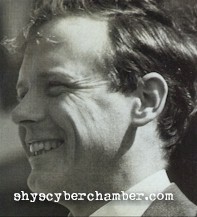
[ Charles Lindbergh ]
The claim of Lindbergh that it was Hauptmann's voice he heard at
the Cemetery virtually assured the German's conviction. No one at the
trial doubted Lindbergh's memory. |
|
|
On 2nd May 1935, New Jersey's Court of
Error and Appeals began hearing Hauptmann's appeal in Trenton. His
lawyers criticized the legal basis of the case, and the prosecuting
style of David Wilentz, the state Attorney General. Wilentz, who was
present, repeated his statement that Hauptmann was an animal.
On 9th October, the court announced its ruling. 'The evidence,' said
the judges, 'pointed to guilt from so many directions that no
reasonable doubt was left.'
The case did, however, disturb the Governor of New Jersey, Harold
Hoffman, who, at thirty nine, was among the younger and more
independent minded national politicians. Hoffman spent an hour with
Hauptmann in the death cell on 16th October, and was impressed by the
fact that the prisoner did not ask for mercy, but a further
investigation. Hoffman agreed to one. |
|
|
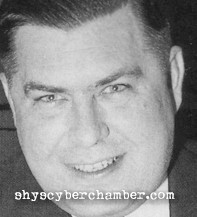
[ Governor Harold
Hoffman ]
The only one in authority to champion Hauptmann after his
conviction was Governor Harold Hoffman of New Jersey. A shrewd
politician, he had worked as a sports writer and been an army captain
in the First World War, before becoming, at thirty nine, the youngest
State Governor in the USA. Already dismayed by the atmosphere of the
trial, Hoffman was deeply affected by the way Hauptmann, whom he
visited with in the death cell, and his wife Anna asserted Hauptmann's
innocence. The intensity and eloquence of their denials could not, he
felt, be mere theatre to cheat the law. 'I do doubt that this crime
could have been committed by any one man,' Hoffman stated publicly. He
tried hard to secure fresh evidence, especially from Dr Condon, the go
between, but was outwitted by the prosecution lawyers. Hoffman's
efforts to save Hauptmann cost him much public support. He was voted
out of office in 1938. |
|
|
The Governor, who was also chairman of
the Court of Pardons in New Jersey, seemed Hauptmann's only hope. On
9th December, the Supreme Court refused to hear his case, and on 27th
December, Lindbergh sailed to England with his family. A single
expression of doubt from Lindbergh would have been enough to commute
Hauptmann's sentence to life imprisonment. Hauptmann's execution had
been set for the week beginning 13th January 1936.
On 11th January, the Court of Pardons confirmed the death sentence -
by now set for 17th January. Hoffman alone had voted for commutation.
He became more convinced than ever of Hauptmann's innocence when he
read that Hauptmann had rejected a newspapers offer of $90,000,
payable to his wife, in return for a confession.
On 16th January, Hoffman granted a temporary reprieve, and continued
his investigation. Concrete proof all but emerged that Hauptmann had
been working at the Majestic Apartments on 1st March 1932, but again,
the time sheets could not be found. |
|
|
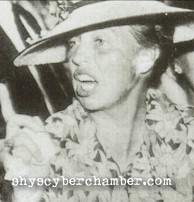
[ The Protests ]
The verdict against Hauptmann led to some of the most respected
figures in American public life expressing their disquiet. President
Roosevelt's wife, Eleanor (above), commented, 'The entire trial has
left me with a question in my mind.' In July 1935, six months after
the trial ended, the American Bar Association criticized both sides.
'To treat a simple trial as a public show... is to cheapen life
itself,' it said. America's most famous criminal lawyer, Clarence
Darrow, described the prosecution's evidence as flimsy. |
|
|
In accordance to the law, a new
execution date was set. Intense pressure was brought to bear on
Hauptmann to confess, and settle all doubts once and for all. New
York's leading criminal lawyer, Samuel Leibowitz, was among those who
pleaded with Hauptmann to admit to the crime. Hauptmann insisted he
was innocent of kidnapping and murder. The Court of Pardons refused to
reprieve Hauptmann again. |
|
|
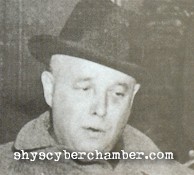
[ Samuel Leibowitz ]
In the final weeks before the execution, many lawyers and
politicians who thought Hauptmann guilty were increasingly unsettled
by criticism of the conduct of the trial, and by the doubts that were
being voiced about Hauptmann's guilt. For their own peace of mind,
they were determined to get a confession, and so settle matters.
Samuel Leibowitz, a fast talking New York lawyer who had once got the
Chicago gangster Al Capone acquitted on a triple murder charge,
believe Hauptmann guilty, but felt the trial was unjust. Leibowitz
visited Hauptmann in his cell three times, on the last occasion
describing an electrocution in brutal detail to shock Hauptmann. But,
Hauptmann would not change his story; he had nothing to confess. These
visits were highly publicized and Leibowitz had to explain his
failure to the press. Lamely, he said Hauptmann had been evasive and
deceitful. Like many others, Leibowitz was unable to accept that
Hauptmann might be telling the truth. |
|
|
On 2nd April 1936, Hauptmann wrote,
thanking Governor Hoffman for his efforts and addressed a passage to
David Wilentz, his prosecutor, saying '... I swear by God that you
convicted an innocent man. Once you will stand before the same judge
to whom I go in a few hours. You know you have done wrong on me... I
beg you, Attorney General, believe at least a dying man. Please
investigate, because this case is not solved, it only adds another
dead to the Lindbergh case.' |
|
|
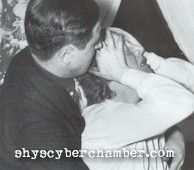
[ Anna Hauptmann ]
Anna Hauptmann supported by a newspaper reporter, clasps her head
in anguish at the news of her husband's execution. Ghoulishly, the
press had gathered outside her hotel room in Trenton to see her
reactions. Hours later she returned home to the Bronx. |
|
|
On 3rd April 1936, Hauptmann was
executed in the electric chair at Trenton State Prison, New Jersey. |
|
|
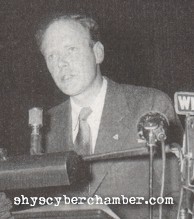
[ Charles Lindbergh ]
Lindbergh speaks at a rally of the America First Committee - an
isolationist movement of which he was chairman - at Philadelphia in
early 1941. America entered the war that December after the attack on
Pearl Harbour. |
|
|
In 1936, Lindbergh visited Germany as a
guest of the Nazi Government. His visits to aviation centres led him
to warn the British and American governments against the growing power
of the Nazi's. Lindbergh came to admire the Nazi's and, after war
broke out in 1939, he made several radio broadcasts urging America not
to join in.
The American President Franklin D. Roosevelt attacked Lindbergh's
pro-Nazi and isolationist stance, and Lindbergh resigned his reserve
commission in the Army Air Corps (AAC). When America went to war in
1941, Lindbergh offered his services to the AAC, but was rejected - a
deep humiliation. Still, as a civilian, he became a consultant to an
aircraft corporation in the Pacific, flying many dangerous combat
missions against the Japanese.
Lindbergh later worked for Pan Am as a technical consultant, wrote a
book about his famous solo flight and became interested in ecology. He
died in Hawaii in 1974, aged seventy two. He and Anne had six more
children after the death of Charles Jnr. |
|
|
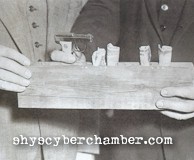
[ Discovery at
Hauptmann's ]
A few days after the discovery of the money in Hauptmann's garage,
police also found there a tiny pistol and a further $840 hidden in the
holes of a wooden drill stand. |
|
|
Harold Hoffman lost his office of
Governor in 1938. In 1954, rumours that he had plundered state funds
led to his resignation from the Division of Employment Security. He
died six weeks later, admitting that he had embezzled money. |
|
|
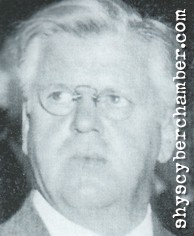
[ District Attorney
Samuel J Foley ] |
|
|
Edward Reilly died of a stroke aged
sixty four, in 1940. He had suffered from untreated syphilis. |
|
|
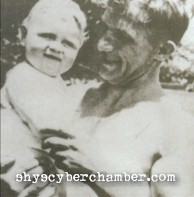
[ Bruno & Manfred
Hauptmann ]
Hauptmann found his baby son Manfred a source of joy. He wrote: 'My
wife and child! My heaven on earth.' Father and son are pictured here
enjoying life on rural Hunters Island, a promontory off the Bronx. |
|
|
Anna Hauptmann faded into obscurity, but
in 1984, aged eighty five, was living near her son Manfred and his
family in Philadelphia. |
|
|
BACK TO TOP |
|
 Check out
the
latest
Crypt Polls!
|