|
|
|
|
|
|
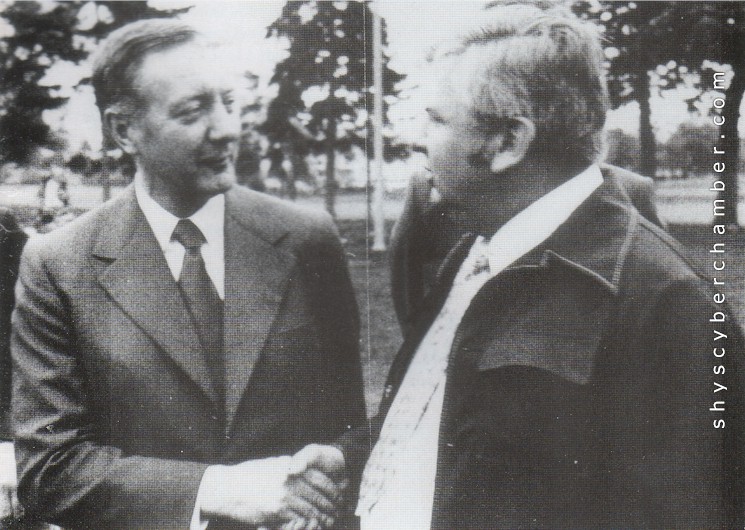
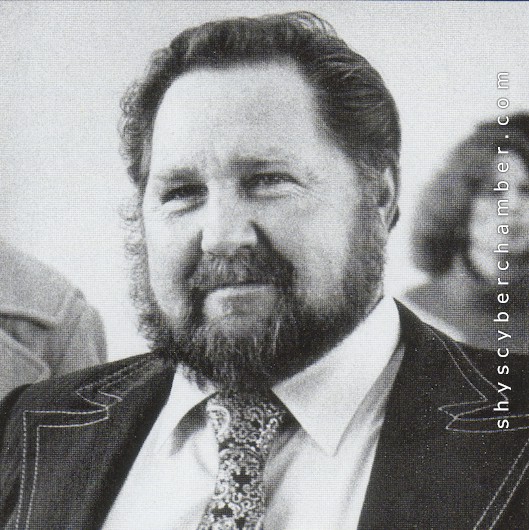
| SAM STAPLETON |
ROBERT WINCH |
JAMES MAZZARA |
RICHARD JOHNSTON |
LOST BOYS :
Young men
who hustle on the Chicago streets know they are taking risks, but many of Gacy's
victims were ordinary boys still living at home. For example Samuel
Stapleton, aged 14, was merely walking home from his sister's place, in May
1976, when he vanished. Eighteen year old Richard Johnston was on his way
home from a concert in Uptown. |
|
|
Gacy had heaved a sigh of relief when the policemen left.
But now Bad Jack had left him, as usual, with the problem of disposing of the
corpse. There was no more room in the crawl space under the house, where
he had buried almost all the bodies. Robert Piest's corpse would have to
be dumped in the local Des Plaines River, just as three of his other recent
victims had been.
After the police had left, a former employee, Michael Rossi, called to borrow
some Christmas tree lights. 'They're in the attic,' said Gacy, and hurried
up there before the youth - who was familiar with the house - could offer to go
and get them. Then Gacy and Rossi spent some time drinking beers and
smoking a joint.
Later that night, Gacy lost no time in wrapping the corpse in a blanket and
carrying it out to his Oldsmobile. He put it into the boot and drove south
on I-294 to the bridge over the Des Plaines River. There he stopped and
heaved the body over the parapet into the water. He then hurried back to
Des Plaines, and his long-delayed interview with Lieutenant Kozenczak.
By now in a rush, Gacy skidded on the icy road, landing in thick mud on
the riverbank. A highway patrolman spotted the car and asked Gacy if he
wanted a tow-truck. Gacy, who was inherently mean, declined the officer,
as it would cost money. Instead, he tried to get the car out by jacking up
the rear wheel and placing the spare tyre under it.
When that failed, he reluctantly asked the patrolman to call a tow-truck.
It arrived 20 minutes later, and the operator winched the car out of the mud and
on to the road. Gacy, unwilling to part with his cash, pretended he was a
police officer, and tried to persuade the truck driver to charge the tow to the
Cook County Lighting Department. When this was flatly refused, Gacy took
out his wallet and suddenly handed over $20. He then drove to the police
station where, at 3.20am, he was surprised to find that Kozenczak had given up
waiting for him. |
|
|
|
|
|
|
|
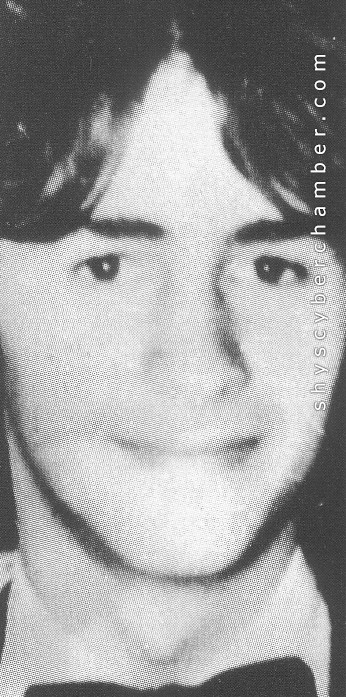
| ROBERT GILROY |
MATTHEW RONAN |
JOHN SZYC |
FRANK LANDINGIN |
VANISHED :
When their children disappeared, many parents eventually assumed they
had run away. Incredibly, no one - not even the police - saw any
significance in the number of young men who had gone missing on the north side
of Chicago within a few months. Among Gacy's victims in 1977 was John Szyc,
whose car Gacy later sold, and hitchhiker Robert Gilroy. |
|
|
On 23rd December 1978, two days after Gacy's arrest, the police
dug up the first two corpses from the crawl space beneath the bungalow.
One of them was encased in concrete, the second in a plastic wrapper. Over
the two days of Christmas, the 24th and 25th, the search for bodies was halted.
On 28th December, six more bodies were exhumed; one was buried under the floor
of the garage. A driving licence in the name of Frank Landingin indicated
that Gacy was also responsible for the death of a bearded young man whose naked
body had been taken from the Des Plaines River in November, and had been
identified from fingerprints.
The discovery of more driving licences and identification papers pointed to the
identity of other victims. A few days later, ten bodies were removed and
the day after that, six more. Three of them were placed so close together,
and were in such a similar state of decomposition that the police surmised that
they had all been killed together.
The murders were creating a nationwide sensation. The house was
permanently surrounded by TV cameras and newsmen, and every news bulletin showed
photographs of the ordinary looking house, with Christmas lights twinkling
outside.
The apparent innocuousness of the house and its fairly harmless looking owner
heightened the shock and revulsion that viewers felt as the foul reality of
Gacy's deeds were revealed. Parents all over the country were suddenly
terrified that their missing teenage sons might be buried in that terrible crawl
space at 8213 West Summerdale Avenue.
A few had already had their worst fears confirmed. These included the
families of John Butkovich - who had been missing since August 1975 - Gregory
Godzik, John Szyc and Rick Johnston. About a fortnight after the search
began, Dr Robert J. Stein, the Cook County Medical Examiner, had 27 corpses in
his morgue. The count of those recovered from Gacy's house or elsewhere on
the property would eventually reach 29. With another four victims
discovered dumped in the Des Plaines River (including the body of Robert Piest),
Gacy's murder tally came to 33. It gave him the record for committing the
most murders in US history. How, everyone wanted to know could he have got
away with it? |
|
|
 JOHN GACY
:
John Gacy, with a moustache, sitting in the rear of a police car after his
arrest in December 1978. For days, he had been overtly followed by a
police surveillance team in order to put him under pressure. |
|
|
From a fairly young age, it was clear that John Wayne Gacy had
psychiatric problems and that they were linked to his father, John Stanley Gacy.
Gacy senior was a violent bully and an alcoholic. He was also a man who
would never admit that he might be in the wrong. 'If my father said the
sun wouldn't rise tomorrow,' Gacy remembered, 'you couldn't disagree with him.
He'd argue you into the ground.'
From John Gacy's earliest childhood, his father used a razor strop on the little
boy; he equated punishment with teaching. The child could never do things
right, was 'dumb and stupid', did not want to learn. The father screamed
and threatened and beat him. His father detested him for his sickly
weaknesses, and for not being interested in manly sports.
Even the many blackouts he suffered - the result of a head injury he received as
an 11 year old - did not bring him sympathy; Gacy senior accused him of
play-acting.
Once, when he was older, Gacy junior tried to stop his father beating on his
mother; in the fray, he managed to pin his father against the wall, but could
not bring himself to punch him. It was a struggle of love and hate.
Lack of acceptance by his father helps to explain how he became obsessed with
being liked and admired by other people. He also learnt how to kill his
finer feelings, absorbing his father's percept that the other person was only
out to exploit him - and that he, John Gacy, had better do it first. |
|
|
GACY'S ART :
Gacy made these two striking pictures when he was in prison after his
arrest in 1978. They give vivid expression to two sides of his complex
personality. The clown reflects his desire to be loved and accepted, while
the cracked skull illustrates his fascination with death. |
|
|
Gacy's sexual history began at the age of four, when a retarded
15 year old girl removed his trousers and played with him. At six years
old, Gacy was caught with a neighbours son and the boy's little sister, all
naked and playing sex games.
For this, John was badly beaten by his father, but it did not prevent a
contractor friend of his father's from taking him for rides in his truck, and
fondling him.
In the same year, 1949, his mother found her underwear draw empty, and
discovered all her knickers under the front porch in a box; Gacy said he liked
the soft feel of the material. Again, he was beaten.
Gacy's father never spoke to his son about sexual matters; however, his mother
had impressed upon him that sex was something marvellous and sacred. At
18, however, he weighed nearly 200 pounds, and felt so ugly that he did not
bother to find a girl to date. One day, though he encountered a willing
girl whom he managed to undress in his father's car. He was fascinated by
the sight of her naked body, but when it became clear that she expected him to
make love to her, he fainted.
Conflicts with his father soon drove him away, to Las Vegas, where he worked in
the Palm Mortuary as a janitor. Being obsessively tidy, he made an
excellent caretaker. He was fascinated by the sight of dead bodies,
particularly those of young men. One teenager who was brought in actually
had an erection in death. Gacy was so excited by this that, as he later
told prison psychiatrists, he got into the boy's coffin, and positioned himself
under the corpse. It was a moment that married horror, sex and death in
his soul. |
|
|
PROFESSOR LAWRENCE Z. FREEDMAN :
Professor Lawrence Z. Freedman, a psychiatrist at the University of
Chicago, made a study of Gacy, involving 50 hours of interviews with him.
Freedman believed that the 'most common mass murders are committed by killers
frustrated with society...', who often wish to be liked and admired. He
summed up Gacy as a 'pseudo-neurotic schizophrenic paranoid'. |
|
|
Gacy shared another thing with most sex killers - he was a
pathological liar and thief from an early age. He lied - for example,
inventing a career in the Marines - to impress people. He stole because it
made him feel clever and superior. His sadism may have been built on his
childhood experiences of violent beatings by his overbearing father.
Gacy was not necessarily lying when he insisted that he was a kind of Jekyll and
Hyde figure, though he claimed he had no less than four personalities (three of
them variants of an alter ego called 'Jack', including 'Bad Jack' and 'Smart
Jack'). But such an admission is not evidence that he was a multiple
personality, such as the patient in the famous 'Three Faces of Eve' case.
Here there was medical testimony to prove that Eve had three personalities;
however, no such testimony supported Gacy's claim.
There was plenty of testimony about his sexual confusion, and denial of
homosexuality - he preferred to project this onto the other person. It was
this hate of the homosexual within himself, and the furious rage it provoked,
that probably underpinned the murders.
Gacy may well have been telling the truth in asserting that many of his murders
were, on the surface, the outcome of quarrels. Gacy was intensely
self-assertive. His upbringing had left him with a powerful need to impose
his will on others. When someone quarrelled with him, he had no doubt
whatever that he was in the right, and would have felt no compunction in
killing. But killing also fed his craving for dominance, so that sadism
became a basic part of the murders. (The screams heard by the neighbours suggest
that he tortured his victims.)
Yet, it is probably true to say that he was, on another level, an apparently
decent person who needed to please people and receive respect. It is not
surprising then that at the trial, the psychiatrist Lawrence Z. Freedman said
that Gacy was one of the most complex personalities he had ever encountered.
|
|
|
KENTUCKY FRIED CHICKEN
:
During the 1960's, held a responsible job running three Kentucky Fried Chicken
outlets, owned by his father in law, Fred Myers, in Waterloo, Iowa. But
Gacy used his position to exploit and blackmail his young mail employees. |
|
|
As the facts about Gacy began to emerge, the Des Plaines Police
Department fount it hard to conceal its embarrassment. Gacy's record was
so appalling that it seemed incredible he had still been at liberty to murder
Robert Piest.
In 1968, when Gacy was 26 years old and running a flourishing fried chicken
business, he was suddenly accused of attempting to rape one teenage boy and
committing an indecent act with another. The community in which he then
lived - the town of Waterloo, Iowa - was stunned, as was Gacy's wife.
After all, he was a prominent and active member of the local Jaycees (Junior
Chamber of Commerce), known for his charitable and social work; the kind of man
who looked likely to end up as mayor.
Gacy had invited Edward Lynch, a 16 year old employee of his Kentucky Fried
Chicken business, to his home while his wife was in hospital, giving birth.
The boy described how they had played in the pool, and Gacy had suggested the
loser should perform oral sex on the winner. The boy flatly declined.
After showing his pornographic films, Gacy made a sudden attack on his guest
with a kitchen knife.
Lynch succeeded in wrestling free, whereupon Gacy apologised profusely, and
explained that he was under strain. When the boy agreed to forget it, Gacy
showed him another blue movie. Towards the end, he went out of the room
and returned with a chain and padlock. Slightly ashamed of reacting so
violently to the earlier 'horseplay', and afraid of losing his job, the boy
allowed Gacy to manacle his hands behind him. Moments later, he realised
that he had been too trusting as Gacy hurled him face downward on the floor, and
locked his hands around his throat.
Lynch then lost consciousness briefly. When the boy recovered, Gacy was
unchaining his hands and asking if he was all right. 'I'll take you home,'
he said. 'I didn't mean to do that...' A few days later, Lynch was
sacked.
In the case of the second accusation, it was obvious that the sexual acts had
taken place by mutual consent. The youth, Donald Vorhees, was the 15 year
old son of a fellow Jaycee, and had accepted an invitation to go back to Gacy's
home to watch a pornographic movie. Once again, Gacy's wife was away.
After watching the film, Gacy initiated a discussion about sex, then said he had
head that the boy had been known to perform fellatio. According to the
youth, he was then forced to have oral sex with Gacy. |
|
|
MARLYNN MYERS :
Gacy's first wife, Marlynn knew little of her husband's sexual activities with
teenagers. It was while she was out of town that he brought them back to
the house. |
|
|
On two occasions, Vorhees went back to borrow money from Gacy,
and each time, oral sex had occurred. But when the youth's father
mentioned that Gacy was standing for president of the Jaycees, and the he was
going to be Gacy's campaign manager, the boy warned him that Gacy was not as
honest and decent as he appeared. The father demanded that his son give
him more information, and when the secret came out, he went straight to the
police to report Gacy.
Gacy was accused of threatening and abusing Edward Lynch as well as Donald
Vorhees. His first reaction was to deny everything and demand a lie
detector test. When this was given - twice - it showed unmistakably that
he was guilty.
Yet he continued to maintain his innocence with a passion that convinced many
people. Gacy's explanation was that Edward Lynch was simply trying to get
back at him for giving him the sack. As for Vorhees, he later admitted
that the charge of having sex with the boy was true, but insisted that it had
been with full mutual consent, and that anyway, he was merely 'experimenting'
with homosexuality to see what it was like.
Those who were inclined to believe him had their faith severely tested when he
was further accused of hiring a teenage boy to beat up Donald Vorhees, followed
by a completely unrelated charge of burgling the storeroom of a lumber company
in nearby Raymond.
The burglary had been carried out by Gacy and one of his young employees,
Russell Schroeder, and the motive was fairly obvious - to place Schroeder in a
compromising position so that he could be blackmailed. |
|
|
JOHN GACY & HIS WIFE MARLYNN
:
Gacy was living in Waterloo, Iowa, when he was arrested in 1968 on sodomy
charges. He was so well respected in the community - he is seen here at a
function - that many thought he had been framed. |
|
|
Gacy had another personal quirk. He sometimes pretended he was a
policeman and drove a car equipped with a spotlight and police radio. On
this occasion, he had invited Schroeder to go with him on his 'rounds', then
crow-barred his way into the lumber company building, where Schroeder was
ordered to break into the Coke machine and help himself to the cash. This
amounted to just three dollars. Gacy stole an extension cord and a can of
paint. Later, they burgled yet another business, which Gacy was supposed
to be 'guarding'; he even got Schroeder to steal some hubcaps off a few cars at
an Oldsmobile lot in Waterloo. Schroeder insisted that he had never
previously stolen anything in his life, and that he had only done so because he
had been ordered to do so by Gacy.
The blackmail came later, when Gacy told Schroeder that he wanted Donald
Vorhees beaten up and forced to promise not to testify. At first,
Schroeder refused, but under pressure, allowed himself to be 'persuaded'.
The following day, 30th August 1968, Schroeder introduced himself to Vorhees on
the local campus, and explained that he had been selected to act as his 'big
brother' for a few days.
Vorhees, flattered that a youth two years his senior should show an interest in
him, readily agreed to go for a drive to help his 'big brother' pick up some
stolen liquor hidden in a remote wooden area. Once there, Schroeder
sprayed a can of Mace - supplied by Gacy - in his eyes; Vorhees fell screaming
into a creek. As he scrambled out of the water, Schroeder sprayed more
Mace, then began to punch him, shouting that he was not to testify against John
Gacy. Vorhees lashed out and succeeded in hitting his assailant on the
nose, and making it bleed. Running blindly into the woods, Vorhees managed
to escape while Schroeder tried to staunch the flow of blood.
The next day, Schroeder was arrested.
He refused to implicate Gacy, saying that he had been hired by a man named Jim.
But the next day he had a change of heart, and told the story of the burglary,
and of being blackmailed into attacking Donald Vorhees. |
|
|
JUDGE PETER VAN METRE :
Judge Peter Van Metre sentenced Gacy
to ten years' imprisonment, the maximum time permitted for a charge of sodomy in
the 1960's. Van Metre had previously been criticized for his lenient
sentencing. |
|
|
While Gacy was in jail awaiting trial, the
police collected the testimony of two more teenage employees. One, Richard
Westphal, described how Gacy had joked that if he caught him sleeping with his
wife, Westphal would owe Gacy a 'blow job'. One night, in January 1967,
when the boy was working late at Gacy's house constructing a basement bar, Gacy
told him he could stay the night.
As soon as the boy was in bed, Gacy's wife
Marlynn came in and seduced him. The light went on and Gacy burst in.
'Now you owe me a blow job,' Gacy cried triumphantly. He and his wife went
off - it had obviously been prearranged - leaving the embarrassed youth in bed.
A few days later, Gacy insisted on receiving his 'payment.'
The other boy had a more sinister story to tell. He had spent an evening
with Gacy getting drunk at a local quarry, and clambered out of the car to
vomit. The next minute, Gacy was standing beside him holding a
six-shooter.
'Let's play Russian Roulette,' said Gacy, removing five bullets from the
chambers. The youth objected: 'I might get killed.'
'That's the idea,' said Gacy. 'You know too much.' He pointed the
gun at the boy's head and pulled the trigger. It clicked on an empty
chamber. Four more times he pulled the trigger on empty chambers.
'This is it.' He pulled it a sixth time - and again it clicked. Gacy
burst into laughter, and drove the boy home. |
|
|
THE GACY CASE :
The Gacy case made headlines in the local newspapers, shocking friends and
associates. Gacy was sent to the Iowa State Reformatory for Men where he
quickly became a model prisoner. |
|
|
He had even, it emerged, persuaded some of his male employees that he
was a sex researcher, appointed by the Governor of Illinois, to conduct
scientific research in order to change the sex laws of the state. This
involved experimenting with homosexuality. At least one 15 year old
allowed himself to be taken to a motel room in the interests of science.
Gacy stood trial in November 1968, and pleaded guilty to sodomy. (Under
American law, the charge covers oral sex.) For a while, it looked very
much as if he would receive probation. But Judge Peter Van Metre rejected
the psychiatrists' plea that Gacy, a bisexual and sociopath, was just
'thrill-seeking' in his sexual activities with Vorhees, and that all he needed
was 'intense parole supervision'. Recognising that the evidence showed
Gacy to be a highly manipulative personality who would go to enormous lengths to
seduce young boys, and who had a disturbing sadistic streak, the judge sentenced
John Gacy to ten years in jail. The next day Marlynn Gacy - now the mother
of two children - sued for divorce.
In the Iowa State Reformatory for Men at Anamosa, Gacy displayed his
chameleon-like ability to appear decent, hard-working and respectable. He
became prison cook, and threw himself into the job with enthusiasm.
Incredibly, there was a chapter of the Junior Chamber of Commerce even in
prison, and Gacy joined it and became one of its most prominent members.
His conduct was so good that he was paroled after only 18 months.
He had told some friends in Waterloo - who still believed he had been framed by
political rivals - that he intended to re-establish himself in the town.
But within 24 hours of his release, he was on his way to Chicago. |
|
|
8213 WEST SUMMERDALE AVENUE :
John Wayne Gacy committed all the murders we know about at his one storey,
ranch-style house at 8213 West Summerdale Avenue in unincorporated Norwood Park
Township, on the northwest corner of Chicago. Here he buried 28 bodies in
the crawl space below his house, and one under his garage floor. The rest
he threw into the nearby Des Plaines River. |
|
|
A man with Gacy's energy, charm and determination was bound to
succeed, which was why Gacy's parole officer allowed him to move to Chicago.
Gacy soon proved him right. He moved in with his mother - his father had
died while he was in jail - and found a job as a short-order cook. There
were plenty of jobs of this kind, and he moved regularly to better himself.
Soon, he decided to start his own business. He called it PDM (standing for
Painting, Decorating and Maintenance) Contractors.
On one of his first jobs in June 1971, he met the room-mate of the man whose
apartment he was decorating. The room mate, who was gay, lost no time in
offering sex. He also told Gacy where to pick up hustlers - at the local
Greyhound bus terminal. He added that the corner of Clark and Broadway, on
Chicago's North Side, was a well-known gay area, bustling with male prostitutes.
This advice was to lead to Gacy's first encounter with the law in Chicago.
In February 1971, a young man went to the police and complained that Gacy had
picked him up at the Greyhound depot and tried to force him to have sex, using
violence. But the youth failed to appear in court, and the charge was
dropped. The Parole Board never learned of the incident, and Gacy was
released from his parole eight months later, in October 1871.
By now, Gacy had moved into his own home, a two bedroom bungalow in West
Summerdale Avenue, Norwood Park Township, an unincorporated community on the
northwest edge of Chicago, just a few streets south of the John F. Kennedy
Expressway. The place had only one problem: the crawl space under the
floor was inclined to fill with water from an underground stream. To deal
with this, Gacy installed a pump. He introduced himself to his next door
neighbours, the Grexas, and invited them in for Christmas to meet his mother and
family. They found him charming. John also introduced them to a
woman named Carol Lofgren, a divorcee with two young daughters, and the Grexas
sensed romance in the air. |
|
|
MARION GACY :
While he was at the Iowa State
Reformatory for Men, John Gacy's mother, Marion, moved into an apartment in
north Chicago. It had been paid off by Gacy senior before he died.
When Gacy was released on parole, he moved in with his mother - a step approved
of by his parole officer, believing it would give him the stability he needed.
Only a year later, he had readjusted so well that his mother helped him to buy
his own home, at West Summerdale Avenue. |
|
|
Christmas was also the time Gacy visited his father's grave,
something that upset him greatly. This time, ten days after Christmas
1971, Gacy committed his first murder. The victim was an unidentified
youth of about 18, whom he had picked up late at night outside the Greyhound
depot.
Gacy's own later account of the murder sounded, to say the least, unlikely.
He insisted that, after taking the young man home and having mutual oral sex, he
- Gacy - fell asleep in his own bed. At about 4am, he woke up to find the
youth standing over him with a butcher's knife. They wrestled, and fell
down. The knife went into the young man, killing him. So Gacy buried
him in the crawl space - because, he explained, with his record for homosexual
offences, the police would never have believed it was an accident.
When, on 1st July 1972, he married Carol Lofgren in the local church, neighbours
who attended the reception at his house notice an odd, musty odour - like a dead
rat or a sewage leak. Gacy said it was the water that kept leaking into
the crawl space.
To the Grexas, the marriage seemed happy enough. Gacy even had his mother
in law to live with them. But one day, when Mrs Grexa jokingly asked Carol
when a little one would be on the way, she replied that you have to have sex
before you could get pregnant. She did not add that her husband made no
secret of his taste for pornographic magazines full of nude men, or that he had
openly admitted that he preferred boys. |
|
|
GACY DRESSED AS POGO THE CLOWN :
In 1975, Gacy joined the Jolly Joker Club, whose members dressed as
clowns to entertain children at parties or hospitals. Gacy went as Pogo. |
|
|
John Gacy, meanwhile, was becoming something of a local celebrity. Now too
old (at about 33) for the Junior Chamber of Commerce, he approached the local
Democratic organisation and offered to work for them, even volunteering to use
his young building workers to keep their offices clean. They accept
eagerly.
He also joined a lodge of the Loyal Order of Moose - a fraternal, do-gooding
society - whose Jolly Joker Clown Club entertained many children over the public
holidays. Gacy designed himself a clown's costume, and 'Pogo the Clown'
became a familiar figure in the children's wards of the local hospitals, and at
Democratic fund-raising activities. 'When I was Pogo,' he said, 'I was in
another world.'
His young male employees saw another side of his character. Most
obviously, he was mean with wages. He insisted, for example, on paying
them only for the time they worked, not for travel between jobs. Since
they had to move from one job to another, sometimes several times a day, the
young men lost a great deal of money. One employee, 16 year old Tony
Antonucci - whom he had hired in May 1975 - had another complaint.
One evening in July, Gacy came to his home late at night with a bottle of wine.
After watching some stag films, Gacy started to wrestle, supposedly playfully,
with the boy. Suddenly, he slipped a pair of handcuffs onto Antonucci's
wrists; however, one cuff was quite loose, and when Gacy left the room for a
moment, the boy freed himself from it.
When Gacy returned, the youth tackled him, slipped the loosened cuff onto Gacy's
wrist, seized the key, unlocked the other wrist, and manacled both of Gacy's
hands behind him. Gacy struggled and screamed threats, then finally calmed
down and persuaded the youth to remove the cuffs. He made no further
attempts to force sex on Antonucci, who stayed in his employ for another nine
months. |
|
|
JEFF RIGNALL :
Jeff Rignall's photograph was taken soon after he had been
chloroformed
, raped
and savagely beaten by Gacy. On partly recovering from the ordeal, he took
out a private lawsuit against him. |
|
|
The Grexas' son Ron, also had a reason to get angry with Gacy. He too went
to work for him, and turned down propositions of sex for payment. But what
caused the rift was Gacy's usual meanness - his refusal to pay him for all the
hours he had worked. Ron Grexa became so angry that he threatened to burn
down Gacy's house. Gacy reported the threat to police, then called on his
neighbours to apologise, and hoped that their friendship would remain intact.
They accepted his apology and assured him it would.
Another young employee, John Butkovich, resented Gacy's meanness as well.
At the end of July 1975, he was complaining to his father, Marco, a Yugoslav
immigrant, that Gacy was refusing to pay him for his last two weeks' work.
Marco suggested that his son should inform the authorities that Gacy was not
deducting tax from his employees' pay cheques - a legal requirement.
That evening, John Butkovich and two friends called on Gacy to demand the money.
Gacy calmed them down and argued that Butkovich owed him money for materials
purchased on his contractor's account, and used for redecorating Marco
Butkovich's apartment.
Finally, the young men, smoked marijuana, drank beer and left. Gacy -
according to his later account - decided to go out and look for sex. In
the early hours of the morning, he saw John Butkovich getting out of his car.
Butkovich agreed to go back to Gacy's house and discuss their differences.
The following morning, said Gacy, he woke up in bed and went into the living
room. There he found John Butkovich lying on his back, hands cuffed behind
him, and a rope knotted around his throat. Gacy's evil alter-ego Bad Jack
had been at work again. Fortunately Carol and the children were away for
the weekend. Gacy lost no time in dragging the body to the garage and
burying it under the floor, which he concreted over.
The Butkoviches reported their son's disappearance to the police, who
over the next two years held over a hundred conversations with Gacy about the
missing boy. Finally, they gave up. They concluded that Butkovich
was a run-away. |
|
|
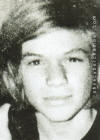 WILLIAM CARROLL JUNIOR :
William Carroll Junior, known as Billy, had been missing for two years when his
father, William Senior, finally learnt of his whereabouts: his body was one of
the 29 found under Gacy's house. A street-wise boy, he was only 16 when he
died. Gacy's victims were either
strangled with rope or asphyxiated by a
gag - often the boy's own underwear - thrust down the throat. |
|
|
Gacy and Carol divorced in March 1976. She was thoughtful
enough to accuse him of infidelity with another woman. Alone now, there
was nothing to prevent him from bringing his pick-ups back to the house.
His neighbours became aware of changes in Gacy's behaviour. Lights would
come on in his house in the small hours; his car was heard driving away and
returning at odd times in the night. Banging sounds were also heard.
A month after Carol had moved out, a young man named Darrell Sampson went back
tot he house on West Summerdale Avenue, and vanished. He was last seen
alive on 6th April 1976. On 14th May, a youth named Randall Reffett joined
Darrell Sampson in the crawl space. That was a busy day for Gacy, for he
also picked up 14 year old Samuel Stapleton as he was walking to his home a
block away. The two corpses were found buried together.
On 10th June 1976, Billy Carroll, who occasionally made money as a hustler, was
buried under the house. Two months later, Rick Johnston, aged 18, vanished
on his way back from a concert; his body, too, was exhumed from the crawl space.
On 11th December, another Gacy employee, 17 year old Gregory Godzik, made the
mistake of calling at Gacy's house on his way home from a date with a
girlfriend. His car was later found abandoned. His frantic parents
hired a private investigator to search for their son, but he made no headway.
On 20th January 1977, another youth who worked for Gacy, 19 year old John Szyc,
disappeared.
A clue to Szyc's disappearance emerged nine months later when a young man named
Mike Rossi was arrested for a minor offence while driving John Szyc's car.
Rossi referred the police to the man in whose house he was living, John Gacy.
Smoothly, Gacy explained that he had bought the car from John Szyc, who had
needed money to leave town. And they believed him. |
|
|
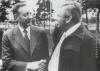 JOHN GACY'S FUND-RAISING :
John Gacy, shakes hands with Chicago's mayor Michael Bilandic at the
ground-breaking ceremony for a retirement centre in early 1978. Gacy had
donated trucks and performed as Pogo the Clown to raise funds for the scheme. |
|
|
Gacy was beginning to acquire a bad reputation among Chicago's
male hustlers. One, named Jaimie, went back to Gacy's soon after Gacy's
divorce, and was shocked when, after getting undressed, he was struck violently
in the face. He managed to avoid being handcuffed, but was hurled on the
bed and violently raped. Since he had been perfectly willing to do
whatever Gacy wanted, the force was unnecessary. He realised that Gacy was
one of those men who need to inflict pain to obtain maximum enjoyment out of
sex. After the rape, Gacy paid him $100 and drove him home. He had
been so badly beaten that he needed a month to recover.
On 6th January 1978, Gacy was arrested and taken to the police station. A
male prostitute, Robert Donnelly, had made a complaint. He had gone to
Gacy's house, agreeing to 'slavery sex', but not to what actually happened.
Gacy had handcuffed him, then spent the night alternately choking and raping
him, and holding his head underwater in a bath until he passed out. But
since Donnelly had agreed to 'slavery sex', the police decided not to pursue the
case.
The incident that came closest to causing Gacy's downfall occurred the following
Spring. On 21st March 1978, 26 year old Jeff Rignall accepted a lift from
a jocular fat man in the early hours of the morning. As they drove along
in his Oldsmobile, the man offered him a joint, which they smoked as they
talked. Suddenly, the fat man stopped the car and thrust a wet rag into
his face. It smelled of chloroform.
Rignall came to in a basement room, which had a picture of a clown on the wall.
Rignall's head and hands were locked in a kind of pillory. The floor was
covered with leather whips and plastic dildos, and he had been stripped naked.
Rignall was alternately raped and chloroformed. Finally, he woke up in the
snow in a park, in a state of physical agony, with bleeding and facial burns.
Medical examinations revealed that he had suffered permanent liver damage from
the chloroform.
Rignall was enraged, and decided to hunt down his assailant. He spent a
month sitting in a car at freeway entrances, watching for the black Oldsmobile
with its fat driver. In late April, he spotted it and followed it until he
got the licence number. He went to the police and told them he had found
his assailant. Yet even when he had identified John Gacy from a mug shot,
the police decided there was insufficient evidence for a conviction.
Rignall then went to an attorney and issued a civil warrant for Gacy's arrest. |
|
|
RONALD E. RHODE :
Ronald E. Rhode, a close friend of Gacy, was told by him that he - Gacy - could
'fool any psychiatrist' into believing he was insane, and thus get away with
murder. Sanity became the key issue at Gacy's trial. |
|
|
Meanwhile, Gacy was taking part in a Polish Constitution Day
parade, being photographed shaking hands with Rosalynn Carter, the wife of the
President. When he learnt of the warrant for his arrest, he promptly filed
a countercharge, saying that Rignall had tried to anaesthetise him with Rush, a
liquid - isobutyl nitrate - whose fumes are said to heighten sexual pleasure.
So Gacy remained at large. His crawl space was now so full that there was
no further room for corpses. In mid-June 1978, a youth named Tim O'Rourke
went out one night to buy cigarettes. His body was thrown into the Des
Plaines River. So was that of Frank Landingin, picked up on 3rd November
1978, and James Mazzara, who vanished some time in late November while he was
out looking for lodgings.
But success was making Gacy increasingly careless. When picking up his
latest victim, Robert Piest, in December 1978, Gacy unwittingly left a trail of
clues behind him. |
|
|
DEMOLISHING THE HOUSE OF DEATH :
The search for Gacy's victims under and
throughout his house on West Summerdale Avenue, in Norwood Park Township, left
it looking like a ruin. The brick facing had been torn down to reveal the
wooden under-cladding typical of 1950s tract housing. It was certainly
unfit for living in, being too hazardous - not that anyone would have cared to
stay there anyway. So, in April 1979, the one-storey ranch-style home was
demolished, although the vacant lot was still owned by Gacy and his mother.
Today, the weed-infested site remains empty, visited only by the occasional
tourist. |
|
|
By the time the 29 corpses had been removed from the crawl space,
in early 1979, Gacy's house was little but a shell. In the spring, it was
declared unsafe and torn down, so that nothing but swamp-like yellow mud
remained. The empty lot became an attraction for morbid-minded tourists,
but most of them clearly found it a disappointment.
In late April, 1979, with the recovery of Robert Piest's body from the Des
Plaines River, all of Gacy's victims were finally accounted for. Piest's
parents formed the Robert J Piest Foundation, to help fight the crime against
children.
In Chicago's Cermak Mental Hospital, Gacy was examined by a battery of
psychiatrists. From the beginning, he insisted he was the victim of the
evil alter-ego called Jack, who actually committed the murders (although he
later conceded that he, john, had committed a few of them). Jack himself
was split into separate characters, such as Smart Jack and Bad Jack. The
latter would take over late at night, when Gacy had been drinking, and make John
go out and look for victims. But Gacy altered his story so frequently that
in the end it was hard to believe anything he said. One of his
psychiatrists even threatened to quit if he did not stop lying.
Gacy insisted that many of the murders had been self-defence, including the
first, the Greyhound bus boy. Others had taken place in the course of
quarrels - the one preceding the Butkovich murder was about wages, the one
before the Godzik murder was about drugs, the one before the Szyc murder about a
car and so on.
Then Gacy gave another explanation for some of the deaths. The boys had
engaged in sexual relations willingly, and had agreed to have a rope tightened
around their necks in order to induce an erection and orgasm. His defence
team decided that most of these explanations would only alienate a jury.
They decided to plead insanity. |
|
|
JOHN GACY :
After his arrest, Gacy was taken for psychiatric examination and confined to his
bed by the use of leather restraints, allegedly because of a suicide attempt. |
|
|
John Gacy's trial opened on 6th February 1980, before Judge Louis
B. Garippo, with a speech in which the prosecution lawyer, Robert Egan, argued
that Gacy was quite simply an evil man. Defence attorney Robert Motta
argued that a man who could sleep in a house with 29 dead bodies was not evil,
but insane. Gacy, it emerged later, was indignant that his own defence
could not think up a story that might lead to his acquittal. For, as the
psychiatric examinations had disclosed, Gacy felt no remorse whatsoever about
his crimes. He had a self-justifying excuse for each and every one of
them.
One the second day of trial, parents of the dead boys gave evidence, many of
them crying or even fainting. Gacy looked on with an irritable sneer,
convinced all this was play-acting. A few days later, two youths who had
lived in Gacy's house (and been, according to Gacy, his lovers) gave evidence.
Both David Cram and Mike Rossi described how they had dug trenches in the crawl
space, on Gacy's instructions. The trenches, he told them, were for pipes.
Then detectives who had interviewed Gacy gave evidence about his confessions.
One of them, Greg Bedoe, described how Gacy had admitted to reciting the 23rd
Psalm to one victim as he strangled him.
During one confession, Gacy had demonstrated how he had killed many of the boys.
Using assistant State's attorney Larry Finer as a guinea pig, Gacy used a
ballpoint pen to twist his rosary around Finder's wrist, asking him to pretend
his wrist was a neck.
The defence case opened with the evidence of Jeff Rignall, who, in answer to the
questions of defence lawyer Sam Amirante, described the night of rape and
torture, and agreed that man who could do such things was not legally sane.
Prosecuting attorney William Kunkle, on cross-examination, pointed out that
Rignall; had written a book about his encounter with Gacy, and argued that his
appearance in court was merely designed to promote sales.
Inevitably the major role in the trial was played by psychiatrists. Dr
Thomas S. Eliseo, for the defence, testified that Gacy's intelligence was well
above average but said his tests indicated that he was a paranoid schizophrenic;
he was psychotic at the time of each murder. Kunkle then undermined
Eliseo's credibility by asked whether he was alleging that Gacy had committed 33
murders without being aware that he had done wrong. |
|
|
'JUDGE LOUIS B. GARIPPO' :
Judge Louis B. Garippo, 48, one of America's
most respected trial judges, was chosen to preside over the Gacy trial.
Years earlier, as State attorney, he had handled part of the case against
another notorious Chicago murderer, Richard Speck. |
|
|
The second defence psychiatrist, Lawrence Z. Freedman, said that Gacy was one of
the most complex personalities he had ever studied, but also insisted that Gacy
was psychotic (that is, insane). He agreed with the previous psychiatrist
that Gacy's psychosis had probably begun in the Anamosa prison around Christmas
1969, on the death of his father - who had always predicted that John would be a
failure, and who had died with his prophecy confirmed.
Freedman also underlined Gacy's total lack of feeling when describing these
crimes, and explained that Gacy killed when his psychological defence mechanisms
- such as repression of his murderous impulses - broke down. The deadly
anger was triggered when he engaged in sex acts with men: 'he projected his own
frightened awareness that this was homosexual... and he thought of them as
trash, to be put out of their misery...'. He thus killed them instead of
himself.
Two more psychiatrists, Dr Robert Traisman and Dr Richard G Rappaport, also
testified that Gacy was abnormal. Rappapport survived a gruelling
cross-examination by Kunkle, and made a powerful case for the view that Gacy's
sadism was some kind of reaction against his father, who was a bully and an
alcoholic. Gacy himself, was plainly delighted with Rappaport's testimony,
smiling at the jury as if to encourage them to listen carefully.
He looked less pleased when Robert Donnelly described his terrifying
night in Gacy's home, being alternately raped, strangled and half-drowned, and
even less so during the testimony of psychiatrist Arthur Harman, who insisted
that, although suffering from a personality disorder, Gacy was not insane.
Dr Robert Reifman underlined the point when he stated that Gacy was a
'narcissistic type'. 'I don't believe you can have 33 cases of temporary
insanity,' said Reifman. The very fact that he got Cram and Rossi to dig
graves in the crawl space indicated that he planned the murders. Gacy, he
argued, had simply faked insanity. Another prosecution psychiatrist, Dr
James Cavanaugh, confirmed this view.
In closing speeches, the prosecution repeated its view that Gacy was evil.
The defence again argued that he was insane. On 12th March 1980, the jury
took only two hours to decide it agreed with the prosecution - Gacy was not
insane. On the following day, as Judge Garippo sentenced Gacy to death, the
courtroom applauded. |
|
|
GACY'S EXECUTION :
One member of the crowd gathering for Gacy's execution outside the Stateville
Correctional Centre wears a wig and ghoulish T-shirt in reference to Gacy's days
as children's entertainer Pogo the Clown. |
|
|
- After sentencing, Gacy was taken to the Menard Correctional Centre, in the
southern Illinois town of Chester, where he spent the next 14 years on death
row.
- While in prison, Gacy began to paint, turning out
crude canvases of Pogo the Clown, and other cartoon-like works. They
fetched between $200 - $20,000 apiece. After his execution, many of the
canvases were publicly burnt.
- On 15th February 1983, a notorious Menard prisoner,
Henry Brisbon, stabbed Gacy in the arm with a sharpened wire. Gacy was
treated for the puncture wound and returned to his cell. In 1984, the
Illinois Supreme Court upheld Gacy's conviction, ordering him to be executed
by lethal injection. On 4th March 1985, the US Supreme Court denied
Gacy's appeal.
- On the morning of 9th May 1994, Gacy was flown by
helicopter from Menard to the Stateville Correctional Centre near Joliet, in
northern Illinois, for his execution. He was placed in the same cell
once occupied by mass murderer Richard Speck. In the afternoon, he was
allowed to picnic in the prison gardens with his family - he ordered Kentucky
Fried Chicken, fried shrimp, french fries, fresh strawberries and a Diet Coke.
At 12.01am, on 10th May, after saying prayers with a Catholic priest, 52 year
old Gacy was taken to the execution chamber, where 42 people were watching the
event through a plate-glass window.
- Lying down and strapped in, Gacy's arm was connected
to a box on the wall by a tube. At 12.40am, the signal was given to
release the lethal injection of three substances: sodium thiopentone to knock
him out; pancuronium bromide to stop his breathing; and potassium chloride to
stop his heart. But the tube feeding the chemicals got clogged, and he
remained obviously alive, choking for breath. It took 18 minutes for him
to die. Prosecutor William Kunkle said: 'He still got an easier death
than any of his victims.'
- Outside the prison, a 1,000 strong crowd had
gathered to celebrate the end. Some wore clown outfits, most, including
families of Gacy's victims and death penalty supporters, rejoiced. A few
lit candles.
|
|
|
BACK TO TOP |