|
shy
Crypt Keeper
 
Australia
2014 Posts |
 Posted - 16 March 2006 : 11:28:25 AM 


|
Nobody knows when people came up with the first vampiric figures, but the legends date back at least 4,000 years, to the ancient Assyrians and Babylonians of Mesopotamia. Mesopotamians feared Lamastu (also spelled Lamashtu), a vicious demon goddess who preyed on humans. In Assyrian legend, Lamastu, the daughter of sky god Anu, would creep into a house at night and steal or kill babies, either in their cribs or in the womb. Believers attributed sudden infant death syndrome and miscarriage to this figure.
Lamastu, which translates to "she who erases," would also prey on adults, sucking blood from young men, and bringing disease, sterility and nightmares. She is often depicted with wings and birdlike talons, and sometimes with the head of a lion. To protect themselves from Lamastu, pregnant women would wear amulets depicting Pazuzu, another evil god who once defeated the demoness.
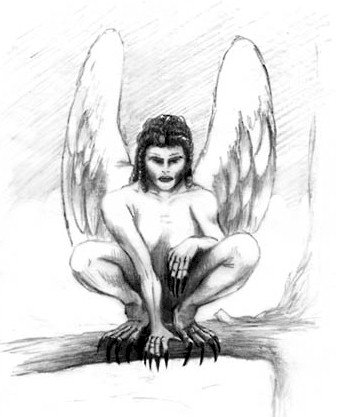
Lamastu and Lilith are often depicted with wings and sharp talons.
Lamastu is closely associated with Lilith, a prominent figure in some Jewish texts. Accounts of Lilith vary considerably, but in the most notable versions of the story, she was the original woman. God created both Adam and Lilith from the Earth, but there was soon trouble between them. Lilith refused to take a subservient position to Adam, since she came from the same place he did.
In one ancient version of the legend, Lilith left Eden and began birthing her own children. God sent three angels to bring her back, and when she refused, they promised they would kill 100 of her children everyday until she returned. Lilith in turn vowed to destroy human children.
Accounts of Lilith as a child-killer seem to be taken directly from the Lamastu legend. She is often described as a winged demoness with sharp talons, who came in the night, primarily to steal away infants and fetuses. Most likely, the Jews assimilated the figure of Lamastu into their tradition, but it's also possible that both myths were inspired by a third figure.
While she is often depicted as a terrifying creature, Lilith also had seductive qualities. The ancient Jews believed she would come to men at night as a succubus.
The ancient Greeks feared similar creatures, notably Lamia, a demoness with the head and torso of a woman and the lower body of a snake. In one version of the legend, Lamia was one of Zeus' mortal lovers. Filled with anger and jealousy, Zeus' wife, the goddess Hera, made Lamia insane so she would eat all her children. Once Lamia realized what she had done, she became so angry that she turned into an immortal monster, sucking the blood from young children out of jealousy for their mothers.
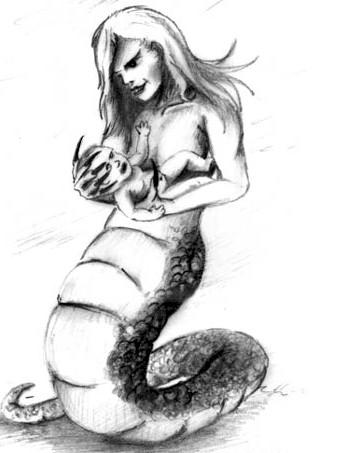
Like Lilith and Lamastu, Lamia is depicted as half-woman, half-animal. She has the torso of a woman and the lower body of a snake.
The Greeks also feared the empusai, the malicious daughters of Hecate, the goddess of witchcraft. The empusai, who could change form, came up from Hades (the underworld) at night as beautiful women. They would seduce shepherds in the field, and then devour them. A similar creature, the baobhan sith, shows up in Celtic folklore.
Vampire-like figures also have a long history in the mythology of Asia. Indian folklore describes a number of nightmarish characters, including rakshasa, gargoyle-like shape-shifters who preyed on children and vetala, demons who would take possession of recently-dead bodies to wreak havoc on the living. In Chinese folklore, corpses could sometimes rise from the grave and walk again. These k'uei were created when a person's p'o (lower spirit) did not pass onto the afterlife at death, usually because of bad deeds during life. The p'o, angered by its horrible fate, would reanimate the body and attack the living at night. One particularly vicious sort of k'uei, known as the Kuang-shi (or Chiang-shi), could fly and take different forms. The Kuang-shi was covered in white fur, had glowing red eyes and bit into its prey with sharp fangs.
Nomadic tribes and travelling traders spread different vampire legends throughout Asia, Europe and the Middle East. As these stories travelled, their various elements combined to form new vampire myths. In the past 1,000 years, vampire legends have been especially pervasive of eastern-European contributions. In the next section, we'll look at these creatures, the direct predecessors of the modern vampire.

|
|


 Early Vampires [p]


