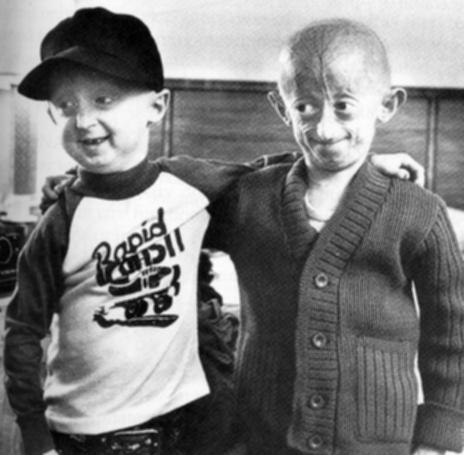
Children that look like old men.
Printed from: The Crypt
Topic URL: https://www.shyscyberchamber.com/topic.asp?TOPIC_ID=2032
Printed on: 21 July 2008
Topic:
Topic author: UnknownLoser
Subject: Children that look like old men.
Replies:
Posted on: 04 September 2005 06:21:38 AM
Message: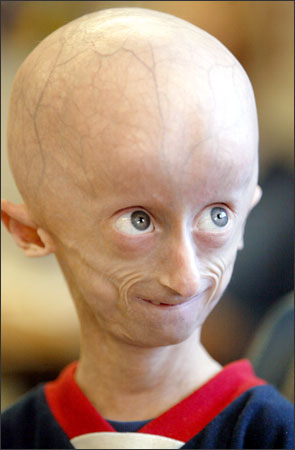

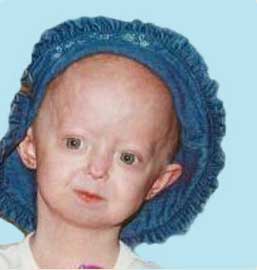
Leslie Gordon, MD, PhD is the Progeria Research Foundation’s (PRF’s) volunteer Medical Director and the Principal Investigator overseeing PRF's three research-related programs. Her son, Sam, was diagnosed with Progeria five years ago.
Q. What is HGPS or Progeria, and what causes this condition?
A. I'm referring to HGPS when I talk about Progeria, although there are other Progeroid Syndromes. Progeria is known as a “premature aging” syndrome, which affects children in a lot of different ways, but their cardiovascular system is the major system affected. All children with Progeria die of premature, severe arteriosclerosis, between ages eight to 20 years. Progeria affects one in four, to one in eight million children, but in a way it affects all of us because these children die of the typical heart disease that affects aging individuals. So understanding what's happening with children with Progeria helps us to understand how to help all of us who are aging normally.
Q. What is the prognosis for a child diagnosed with Progeria?
A. It's 100 percent fatal. The children die from heart attacks or strokes. It's similar to the heart disease of normal aging adults, but it’s accelerated, so these children have angina, strokes—all the typical things you would expect from somebody with arteriosclerosis.
Q. What special challenges do kids with Progeria have?
A. I would put them into two major categories. The first is everyday health. PRF quickly recognized that there wasn't any information out there about these children’s everyday health needs. Their doctors and physical therapists didn't know how to treat them. The families needed information and assistance. So, we started our third program—a medical and research database. We collect the data from medical charts in a confidential manner. Then we analyze the data and put out recommendation sheets on issues such as cardiac care, nutrition and physical therapy. Also, physicians and families call us all the time for advice. It's recommended that these kids have physical and occupational therapy at school so they call us to ask, "What should we have ready for this child? How should we be trained?" A child with Progeria who gets good physical therapy has a very different life from a child who does not.
The second challenge category is psycho-social. These children look very different from the rest of their peers yet intellectually and developmentally they're the same. Children with Progeria generally just want to be normal, everyday children, and they can be for the most part. They want to have fun. They don't want to think about Progeria, and Progeria doesn't have to consume their lives. They can have great friendships and a normal social life. I find that families with a Progeria child like to talk to other families experiencing Progeria, and PRF sometimes connects new families with those who have been living with Progeria for several years.
Reply author: UnknownLoser
Replied on: 04 September 2005 06:25:12 AM
Message:
BUT WAIT.......
It gets better...Linked to Aleins?
------------------------------------
It is not a paper comparing human children to extraterrestrials. Even though it is highly speculative in nature, apparently no one in the medical field has considered the possibility that the entities commonly referred to as Greys are afflicted with the rare disease progeria. It may also explain why hybridization is occurring between Homo Sapiens and the aliens or entities.
HUTCHINSON-GILFORD SYNDROME
Among humans, Hutchinson-Gilford Syndrome, often called "Progeria," has a very low incidence. On Earth it occurs about once in about every four to eight million births. Very little is known about what causes progeria, but it is thought to be a genetic disease, the result of a spontaneous mutation in the sperm or egg. (4) There is no effective treatment or cure. Life spans vary. Death typically occurs in the early teens, usually from complications of hardening of the arteries, resulting in coronary disease or strokes, although one individual in Japan lived to be forty-five. (4,5,9,10) Progeria occurs in all races of Man. Patient,(left), displaying symtoms of Hutchinson-Gilford Syndrome. The word "progeria" means "before old age". It is a disease which appears to cause premature ageing in young people, and was first identified in 1886 by two physicians by the names of Hutchinson and Gilford. (28)
There is more than one disease among human beings which feature alterations resembling premature ageing among the very young. (15,27) While Hutchinson-Gilford Syndrome may show signs of onset in children as early as one or two years of age, Werner’s Syndrome has a later onset in which individuals begin to age prematurely in their early teens. (4) Cockayne’s Syndrome can also appear to cause premature ageing in young children. (14,15,16) However, this paper will concern itself only with the Hutchinson-Gilford Syndrome, because of its unique symptoms. Unlike the other two premature ageing diseases mentioned, Hutchinson-Gilford Syndrome is not just a disease which appears to cause premature ageing, that is, there are other symptoms present which are not found in the other two mentioned diseases, such as the very short stature, the baldness in both boys and girls, the large cranium, etc. (4,5,9,10,15)
Many of the symptoms of progeria seemingly occur among a race of reported "aliens", namely those humanoids referred to as the "Greys." Greys are most often reported to abduct humans (1,2,3,17,22,25), but also surface in reports of bodies associated with UFO crashes.(6,7,11,21) Most UFO abductees, without realizing it, report physical symptoms of progeria among these aliens. This is very interesting, considering that the majority of UFO abductees are not paediatricians specialising in progeria, and it is even more interesting, considering that most doctors rarely ever see progeria patients in their careers. COMMON FACTORS?
The following is a comparison of the physical traits Greys and humans with Hutchinson-Gilford Syndrome may have in common:
1. Severely retarded growth. Most children with Hutchinson-Gilford Syndrome never exceed the height of the average five-year-old and seldom weigh more than 25 - 40 pounds, even as teenagers. (4,5,9,10,14,15,16) Human beings with progeria stop growing at a normal rate around age one, and then the growth rate slows. Although children with progeria rarely live beyond their teens, one gentleman with Hutchinson-Gilford Syndrome lived to be 45 years. (5) and a young woman lived to be 29. (23) The man was four feet, four inches tall and weighed 54 pounds. (5) The young woman was about four feet tall and weighed about 40 pounds.(23) A 16-year-old progeria boy weighed 41 pounds and was four feet tall.(18) A 16-year-old progeria girl was three feet-eleven and weighed 35 pounds. (19) The heights and weights of these young adults were comparable to the heights and weights of the Greys, as reported. (2,6,11,22) An Australian girl, Becky Coss, recently celebrated her 15th birthday, making her the oldest girl in the world with progeria. The disease is so rare that in all the world there are only 17 known living victims, according to Bill Sample, president of the non-profit Sunshine Foundation, which sends terminally ill children and their parents on vacation.
Most Greys are between three-and-a-half and four-and-a-half feet tall. Their average weight is reported to be about 40 pounds.(6) A hybrid child of Grey ancestry was reported by one UFO abductee to be, at age five, three feet tall and weighing about 25 pounds. (2) This child’s height was comparable to that of a progeria child at age four-and-a-half who was 80 cms tall or two feet seven and a half inches tall. (15) From some UFO abductee reports, hybrid children seem to follow the growth curves of their Grey parent rather than their human parent. If one takes into account that the average human progeria child is between two-and-a-half feet and three feet tall at age five and three and a half feet to four feet tall in the teen years, then the hybrid child follows the growth curves of the alien parent. It seems that the Grey parent follows the growth curve of a progeria child.
A progeria child is usually of normal weight for a newborn, but after one or two years the child’s growth rate decreases considerably, averaging less than half of a healthy child. Hybrid children are reported to be very small at birth (2,3), much smaller than newborn progeria children which suggests that growth retardation in the hybrid child begins much earlier than in the human progeria child, instead of during the second year of life. (10) This suggest that the growth retardation in the hybrid seems to start during the gestation period before birth.
2. Most children with progeria are very slight in build with thin arms and legs. (4,9,10,16) The same holds true with most Greys, who are often reported as having very thin limbs. (3,6) Abductee Steven Kilburn, when describing the legs of one of the Greys, is quoted as saying "...Skinny ankles, legs. Really skinny. Not bony, nothing like that, but he’s so little."(3) Another abductee describes the Grey alien’s physique in the following way: "...so small, thin, bones... the thinness of them!"
3. In progeria children the long bones are decalcified and thin. (10) Abductee Steven Kilburn, during hypnosis, said "Their thin bones were covered with white, marshmallowy-looking flesh." Notice the phrase, "thin bones."(3) There is one report of soft skull bones of a Grey during an alleged autopsy. (11)
4. Children with progeria almost always have diminished subcutaneous fat. An abductee hypnotised by Leo Sprinkle said, "I remember seeing them naked, waist up, thin, ribs, clavicles .... The thinness of them...." Her description of the Greys she saw suggests that they too have diminished subcutaneous fat.
5. Baldness, children with progeria, both male and female, often have sparse body hair and are bald. Eyebrows and eylashes are often absent. (4,5,9,10,14,15,23) This also holds true for the Greys who are always reported as being bald, lacking eyebrows and eyelashes, and having no body hair. (2,3,6,7,8,11,17,22,26)
6. Most children with progeria fail to reach puberty. (4) In the 45-year-old man the genitalia appeared underdeveloped and pubic hair was absent. The 45-year-old man had some sexual function, but in most cases of progeria sexual maturation does not occur. (5)
In most Greys, lack of genitalia or even gender is often reported by UFO abductees or in UFO crash reports. (11,22) However, a female was purported to be discovered in a 1953 UFO crash in Kingman, Arizona. (5,7) She was reported to have breasts and had obviously passed puberty. This report has not been substantiated. Most Greys do not apparently develop sexually. (7,22) In the book, Matrix II, it is stated that only about one out of a hundred or a thousand female Greys are capable of conceiving children. (30) This may sound like hearsay and unreliable information, but it is interesting in that only one or two individuals out of 110 recorded progeria cases have reached puberty. (5,23) This low incidence of puberty among humans with progeria matches what was said in Matrix II. One might be tempted to say that individuals with progeria do not reach puberty because they do not live to adolescence. Most children with progeria do live through the early to mid-teens (10), the average age for the onset of puberty, yet they still do not attain puberty, with only one or two rare exceptions. (5,23)
7. Most children with progeria have relatively large crania. The head is almost always large relative to the face. (4,15) The disproportionately large head in Greys is always reported by UFO abductees, as well as the small facial features below the eyes. (1,2,3,6,7,8,11,17,20,21,22,25,26)
8. Many progeria children have very thin lips. (15) The lips are absent altogether in the Greys. (6,7)
9. Most progeria children have very small earlobes and sometimes the earlobes are absent. (4,15) In Greys, the external ears are almost always absent.(6,7)
10. Most children with progeria have very narrow noses. (4,15) The noses of most Greys are either very small or absent, having only nostrils. (2,6,7,22)
11. Most progeria children have re-absorption of the terminal finger bones (acroosteolysis). (4,15,16) The third and fourth digits of the Greys are much smaller than the others and the thumb is reported as being absent altogether. Could this be due to bone re-absorption? (6.7.30)
12. Dystrophic nails are frequently seen on fingers of progeria children. (16) Absence of fingernails are frequently noted in some Greys. (6,7)
13. Progeria children have very high metabolisms. (29) There is also a report by Paul Bennewitz (30) suggesting that the Greys, too, are hypermetabolic. Matrix II states: "Their (the Greys') body metabolism is very high, estimated at 110 or 115 degrees." (30)
14. The I.Q. of progeria children is often above normal. The average being 107 (100- average), but one patient tested 187 which is well above what one would consider genius level. (9) The average I.Q. among the Greys is unknown, although they seem to come from a very advanced technology. One report claimed that the Greys’ average I.Q. was above 200. (8) The brains and eyes of the Greys are proportionately larger than those of human progeria children, comparable to a five-month-old foetus. (7) This may be due to evolution. The eyes of the Greys may be large because the eyes are part of the brain in embryonic development. Although progeria children’s eyes are relatively smaller than the eyes of Greys, the eyes are often prominent. (4,9,10,15,27)
15. In progeria children, there is progressive wasting of the skin. The skin becomes dry and wrinkled. (15 It is not uncommon for some abductees to report some of their Grey captors as being "mottled" or "wrinkled". (2,17) (See Fig.3).
16. Most progeria children have small and receding chins. (4,5,15) The chins of most Greys are described as being very small. (22)
17. The dentition of progeria children is often delayed in eruption. (16) Most Greys reported do not appear to have teeth at all, and the entire mouth is atrophied or vestigial. (7,22)
18. Many progeria children have congestive heart failure. (4,5,9,10,15) Shortness of breath is a symptom of congestive heart failure common in progeria. (5) There was one report of a Grey having difficulty breathing. (2) If it was due to the Earth’s atmosphere, then how did the other members of his species adapt to our atmosphere and could breath with ease, while he could not? Some humans can breathe our atmosphere with ease, whereas other humans cannot due to respiratory or congestive heart failure. Was this Grey experiencing congestive heart failure if he had a circulatory system similar to our own?
Reply author: UnknownLoser
Replied on: 04 September 2005 06:34:31 AM
Message:
(Sorry this is so long, guys.)
-------------------------
19. Difficulty walking. Some individuals with progeria have difficulty walking because of stiffness of joints or bad hips. The 45-year-old man with progeria had difficulty walking because of ankylosing knee joints. (5)
"Typical" aliens as reported by Budd Hopkins
in Intruders. The Face here was reportedly seen
on several occasions by Debbie Jordon.
Not all Greys have difficulty walking, however. In the book Missing Time. (3) abductee Steven Kilburn said under hypnosis, when he was describing the gait of one of the Greys, that "when he walked, it was almost like he had two really bad knees. He was hobbling almost... shifting his weight to the left and right....And he drags his feet a little bit...." It is interesting to note that a "widebased shuffling gait" is almost always seen in progeria children. (15)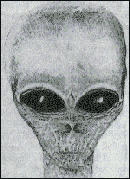 The figure here was drawn by artist
"Rosemary", following a 1972 NY abduction.
Note mottled skin.
In Matrix II(30) there is also a report suggesting that some Greys have difficulty walking. Paul Bennewitz stated in a letter: "Many in this culture (Grey culture) walk with a limp or shuffle their feet." Note the word "shuffle."
The UFO abductee who was hypnotized by Dr. Sprinkle not only described her Grey abductors’ thin bones, but also described their gait: "They shuffle, drag their feet." (20) Again, notice that she used the word "shuffle." It is worth noting the the Neilson Handbook of Paediatrics also uses the phrase "widebased shuffling gait" when describing the gait of children with progeria. (15)
Many progeria children have a condition called "coxavalga," a condition of the hip sockets which may affect their gait. (5,15) Were the two abductees above describing coxavalga when they were describing the shuffling gait of one of their Grey captors?
20. Human beings with progeria frequently have thin and high-pitched voices. (15) It may or may not be a coincidence that the vocal cords in the Greys are nonfunctional or vestigial. (7,22) What made their vocal cords vestigial in the first place? Could the circumstances have contributed to their alleged telepathic abilities?
21. There are significant differences between Greys and humans with progeria. As mentioned earlier, the brains and eyes of humans with progeria are proportionately smaller than the brains and eyes of Greys. In children with progeria, there are short, dystrophic clavicles, short fingertips. Progeria children have noses and external ears. Greys reportedly have proportionately longer arms and fingers, atrophy of the fourth and fifth digits, usually absence of toes (7) and oriental features.
But in spite of all these differences, among themselves, all humans with progeria look almost like clones, (4,5,15,23) regardless of their race or nationality.
Among themselves, all Greys resemble each other, too, so much so that they also look like clones. (6,7) It would be expected that progeria might show slight variations in its symptoms in two different species. Perhaps the Greys, not all of them, may not be clones at all, but still resemble each other because of their progeria? A lot of Greys may have to resort to cloning, since they are apparently incapable of reproducing in other ways. But not all Greys may be true clones. They may just resemble each other very strongly because of the way progeria manifests itself. Most people with progeria very strongly resemble each other, almost to the point of looking like identical twins, even though they are not related to each other.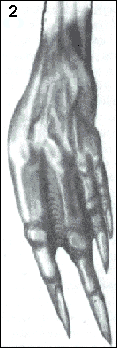
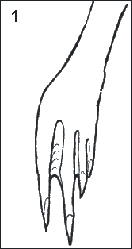 Drawing based on alleged alien hand as supplied by Leonard Stringfield (1) and Interpreted by Artist Al Reed (2,3). From Stringfield's UFO Crash/Retrievals: Amassing the Evidence, Status Report III.
The bone structure is based on the dimensions of an enlarged drawing in report #2 but with fingers spread to compare with drawing of human bones. (Also reversed to right hand for same reference as human drawing).
22.Although this disorder has many features that resemble premature ageing, it also possesses many features that are not usually seen with normal ageing. One feature that is found in progeria in human children that is not found in normal ageing is the dystrophic clavicles. (27) From most UFO reports, there is not much evidence that the Greys have dystrophic clavicles, but there is supporting evidence, albeit circumstantial, that the Greys have other bony defects such as the absence of nasal bones, the hypoplastic fourth and fifth digits on the hands, the absence of thumbs, and the absence of toes. (6,7) Also, what both humans with progeria and Greys have that is not found in senesence are the brain changes that are associated with ageing. (4,6,7,15) Most UFO abduction reports, if not all, show no evidence that the Greys are suffering from dementia. (2,3,22)
LIVE ALIEN?
There are rumours that a live alien died of unknown causes" in captivity on June 18, 1952, at an age that was relatively young for his race. (20,21) There are also rumours that a live alien was taken from a UFO crash near Roswell. This is not in reference to Gerald Anderson’s live alien, but rather to the capture of a live alien as told to Sheriff Wilcox’s granddaughter by Mrs. Wilcox. (11) The EBE (Extraterrestrial Biological Entity) was allegedly a UFO crash survivor. If the rumour is true, then what did the EBE die of? According to the rumours (reference), the EBE was a Grey (8,21). If the story is true that a Grey died of " unknown causes" in mid-1952 (20,21) then somebody died, who had most, if not all, the physical traits of progeria. Did the EBE die of some exotic extraterrestrial disease or did he die of Hutchinson -Gilford Progeria Syndrome, a disease so rare on Earth that the Air Force doctors failed to diagnose it? Progeria is not easily diagnosed today, much less so in 1952. In 1952, this disease did not receive as much publicity as it does today, and fewer doctors were familiar with it, especially Air Force doctors not specialising in paediatrics or rare genetic diseases. if the EBE had this disease, had it gotten out of control during the last year of its life?
CAN GREYS TREAT PROGERIA?
The symptoms of progeria seem to be exaggerated in the Greys (see previous list of symptoms), suggesting that Greys have a much more severe form of the disease. They have obviously found a way to treat it, because some of them grow up to be pilots and scientists and live beyond childhood, but how can they control a disease which is always progressive and always fatal in human children? Are all Greys healthy? If the Greys have progeria, can all Greys control their disease? Most reports from UFO abductees suggest that the Greys have an advanced medical technology. Can this advanced medical technology help all the Greys control their progeria if they have this disease? If they cannot cure it, can they stop its progression? We do not know if most Greys are healthy or not. But there is at least one report by abductee "Lucille" that all is not going well. (2) Lucille said that this alien society seemed to be "millions of years old." She sensed that "the society was dying, that children were being born and living to a certain age, perhaps pre-adolescence, and then dying." She said there was a "desperate need to survive, to continue their race.... Something had gone wrong genetically." (2) Most individuals with progeria die in their early teens or younger. Were the children that Lucille was referring to dying of progeria? Her abductors were the Greys. (2) Another reference says that the Greys "face extinction from incurable genetic diseases." (30) * Matrix II by Valdamar Valerian (a pseudonym) is compiled of material from many different sources, varying wildly in terms of place, time and credibility. The scientific reliability of the information is questionable, therefore, throughout this article the explanation "rumoured" is attached as it relates to Matrix II sources, (It is copyrighted by Nevada Aerial Research.)
DO GREYS HAVE PROGERIA?
If Greys have progeria, then there is a very serious situation out there. An entire civilisation may be threatened with extinction because their children and young people are dying. A possible reason why progeria may be so widespread among Greys and not among humans is probably because the Greys have been around much longer than humans and the DNA replication is probably deteriorating, making room for genetic mutations and serious genetic diseases that resemble premature ageing such as Hutchinson-Gilford Syndrome. One reason why they may want to hybridize with Homo sapiens is to add healthier DNA to their gene pool and to weed out the progeria gene. They may have a long way to go, because the progeria trait is probably dominant and not due to a recessive gene. (4) Half of all offspring born to a parent with progeria will have progeria. On Earth, most humans with progeria are sterile, but among Greys, this problem of sterility is probably bypassed by cloning and in vitro hybridization. But if the Greys clone themselves, it will only further propagate the progeria gene. What this means is that if a Grey with progeria clones itself, its clones will also have the same genes as the “parent.”
The Crypt : https://www.shyscyberchamber.com/
© shyscyberchamber.com