|
CHRISTIE'S SCULLERY
:
The entrance to the small scullery that led off
the ground-floor kitchen was camouflaged with wallpaper. The wooden door
had been shut and then papered over to hide the contents - the bodies of three
of the women Christie had lured into the flat. The discovery led to more
bodies and a police hunt for the killer. |
|
|
Brown shone his torch into the opening. At first he could not
believe what he saw. Throwing down the torch, he ran upstairs to
fetch another tenant, Ivan Williams. Cautiously, they went
downstairs and shone the torch in the opening.
Sitting on a pile of rubble and ashes was a partially clothed woman's
body. There were also two other suspicious bundles lying beneath
her. A shocked Brown raced off for the police.
When the police arrived, they tore down the partition. The woman
- later identified as Hectorina MacLennan - was wearing a white,
cotton piqué jacket held by a safety pin, a blue bra, stockings
and a pink suspender belt. Though her head hung forward, her
body was sitting upright, kept in place by her bra straps, which were
attached to a hook in the wall. Someone had stuffed an old vest
between her legs to collect the blood draining from her body.
Her ankles were tied with plastic flex and her hands bound by a
handkerchief. |
|
|
HECTORINA MACLENNAN :
Scottish, aged 26, met
Christie while looking for accommodation; gassed and strangled on 6th March 1953
her body was concealed in the scullery of Christie's kitchen. |
|
|
The bundles turned out to be the corpses of two other women - Rita
Nelson and Kathleen Maloney - wrapped in old woollen blankets, and
also with absorbent material at their crotches. All the women
had been strangled with ligatures.
The cold weather at the time had delayed decomposition, preventing the
bodies giving off a rotten stench. It also enabled the Home
Office pathologist, Dr Francis Camps, to make a vital discovery during
the postmortem - he found living sperm in the vaginas of all three
women, showing that sexual intercourse had clearly taken place around
the time of death. Dr Camps also found that the women had carbon
monoxide in their blood, evidence that they had been gassed prior to
being strangled.
The police now launched a furious search for other bodies. Using
crowbars, they ripped up the linoleum and floorboards in the back and
front rooms. |
|
|
RITA NELSON :
A prostitute, aged 25, from Belfast.
Rita Nelson met Christie in a café,
she was six months pregnant when she was gassed and strangled in January 1953,
her body was also concealed in Christie's scullery.
KATHLEEN MALONEY
:
An orphan from Southampton, aged 26, she ran away
from a convent, turned prostitute and nude model. She met Christie in a
London pub and was gassed and strangled in January 1953. Her body was
concealed in the scullery along with two other victims. |
|
|
In the early hours of the next day, 25th March, they found a fourth
dead woman beneath the floorboards of the front room. She was
dressed in her underclothes and wrapped in blankets. This was 54
year old Ethel Christie, who had not been seen since 12th December
1952. The difference between Mrs Christie and the other women
was striking, however. Although she, too, had been
strangled, there was no trace of gas in her blood, nor of semen in her
vagina.
The police called a halt for the night. Officers were posted
outside the house, and a guard remained there for several weeks.
Excavation work in the tiny garden at Rillington Place revealed an
assortment of bones belonging to two more women - Ruth Fuerst and
Muriel Eady. Medical tests showed that they had been buried for
approximately 10 years. The pathologist Dr Camps stated that
both victims had been strangled. The skull of one woman was
missing; that of the other had been smashed into little pieces. |
|
|
ETHEL CHRISTIE
:
Ethel married John Christie in 1920. After
years of separation, she joined him in London where he strangled her in bed in
December 1952, aged 54. Ethel was then buried beneath the floorboards.
Unlike the other victims, Christie did not have sex with her at the time of
death. |
|
|
This however, was not the first time the police had had dealings with Rillington
Place. IN 1949, a 19 year old woman, Beryl, and her baby daughter
Geraldine had been found strangled at No. 10 . The woman's husband,
Timothy Evans, had subsequently been found guilty of the murder of his child,
and sent to the gallows. The discovery of six more bodies, however, opened
up a new and even darker chapter in the house's history.
In the national press, detectives announced 'the most brutal mass killing known
in London'. There was one 'vital witness' they believed could help them in
their inquiries. His name was John Reginald Halliday Christie. A
description of the slight, middle-aged former tenant was circulated.
Football crowds were asked to report any sightings at one. Christie's face
appeared in every newspaper. |
|
|
UNDER THE FLOORBOARDS
:
Once the police discovered the body of Ethel Christie, which had been
wrapped in a blanket, under the floorboards of the living room, they
stripped the entire house to a bare shell in search of more bodies. |
|
|
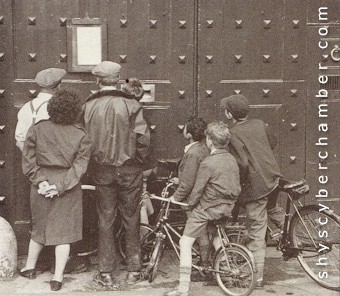
The search of the ground floor flat went on. Long rods were pushed up the
chimney. An old-fashioned copper boiler was removed. Police,
detectives and doctors came and went as crowds gathered at the entrance of the
small cul-de-sac.
Of Christie there was no sign. The police had not yet tracked him down,
but the press knew where to find his colleagues.
During the war, Christie had been a Special Constable with the emergency rescue
force at Harrow Road police station in west London. One of his former
workmates remembered Christie well. |
|
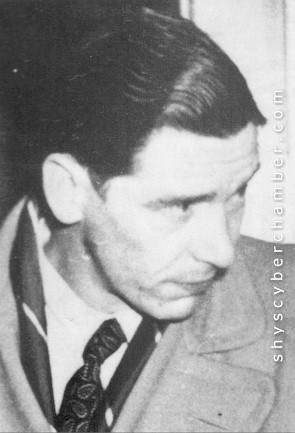
|
MEDIA INVOLVEMENT :
Once the bodies were discovered in Christie's flat, Scotland Yard
issued a photograph of the wanted man - it eventually led to his capture. |
|
|
'I worked with him on all kinds of crime investigations,' the officer told
newspaper reporters. 'He was always secluded and reticent and never mixed
with the boys. But he knew his job. In his time, he brought to
justice thieves, blackmailers, frauds-men and men who were guilty of sexual
assaults on women.'
The day Christie left Rillington Place, he booked into Rowton House, since
renamed the Mount Pleasant Hotel, in King's Cross Road, for seven nights.
But he soon moved on, wandering uneasily, across distant parts of London.
Often lost, he found himself in East Ham and Barking, miles from home.
Then he would make his way back to the North Kensington area.
Christie passed much of the time in cafés. In
one in Pentonville Road, north London, not far from King's Cross, he met a woman
called Margaret Wilson, and offered to procure an abortion for her when she
confided that she was pregnant. It was quite common for troubled, even
complete strangers to tell Christie their problems. |
|
|
CHRISTIE FOUND
:
His arrest and details of the murders became front page news. |
|
|
Though neither scintillating nor handsome, Christie was certainly aware of his
mysterious charisma. 'I could hardly go anywhere but women would want to
talk to me,' he would say later, 'dozens of them.' On another occasion, he
insisted, 'It wasn't me who did the chasing. Girls were attracted to me.'
There were dozens of supposed sightings of Christie. He had been sleeping
in a van, he had boarded a north-bound coach, he had gone abroad
somewhere. Dozens of reports were received.
A woman who lived in Rillington Place, Florence Newham, reported that she had
seen Christie hanging around the cul-de-sac. One newspaper, the Daily
Sketch, carried a photo kit of what he was believed to be wearing - a light
brown trilby, a double-breasted overcoat with padded 'spiv' shoulders, a belt
with a black leather buckle, blue tie, pink striped shirt and brown shoes. When
Christie was finally apprehended, he was wearing none of these things. |
|
|
RUTH
FUERST :
An Austrian student nurse
turned munitions worker when war broke out, and part time prostitute, she was 17
when strangled by Special Constable Christie in August 1943 and buried in the
garden. |
|
|
It was on 29th March 1953, at 11.20 in the evening, that Norman Rae, chief crime
reporter on the News of the World, received a phone call. 'You
recognise my voice?' the caller asked the reporter.
Rae did. He would have known that gravelly grate anywhere. Like
policemen, crime reporters have long memories. Rae had met Christie
before, in 1950, during the trial of Timothy Evans.
'I can't stand any more,' the voice went on. 'They're hunting me like a
dog and I'm tired out. I'm cold and wet and I've nothing to change into.' |
|
|
MURIEL EADY
:
Factory worker aged 31, lured to Christie's flat when he told her he had a cure
for her chronic catarrh. She was gassed and strangled in October 1943,
then buried in the garden near Ruth Fuerst. |
|
|
Christie told Rae, that, in return for a meal, a smoke and a warm place to sit,
he would give the News of the World a story about himself. Rae
warned that afterwards the police would have to be called in. Christie
said that he understood this, and a meeting was arranged for 1.30am that night
outside Wood Green town hall in north London.
Rae and his driver parked outside the town hall, away from the street lamp,
opened the car door and waited. There was a rustle in the bushes.
Then, by chance, two policemen approached on their beat, unaware of the meeting.
Thinking he had been betrayed Christie fled.
Two days later, on 31st March, PC Thomas Ledger saw a man leaning over the
embankment by Putney Bridge. 'What are you doing?' he asked.
'Looking for work?' The short, middle-aged man said he was waiting for his
unemployment cards. 'Can you tell me who you are?' PC Ledger
continued. 'John Waddington, 35 Westbourne Grove,' came the reply. |
|
|
RILLINGTON PLACE - BACKYARD
:
In their search for more bodies at Rillington Place the police dug up
the garden where they found the skeletons of Ruth Fuerst and Muriel Eady. |
|
|
The alert young officer studied the man's face carefully, then asked him
to remove his hat. The balding head confirmed his suspicions.
The hunt for Christie was over.
Inside the police van, Christie was asked to empty his pockets.
Various bits and pieces were pulled out, including a newspaper cutting
of Timothy Evans's trial in 1950. The story of the Evans family
was a tragic saga that had not yet faded from local memory. Could
there have been a connection between the crimes committed by Evans and
Christie? |
|
|
JOHN CHRISTIE :
Fond of his uniform, Christie, aged 12, was a model Scout in
the church troop. He was small for his age, but bright, and later became
an assistant Scout master. He also sang in the All Saints Church choir. |
|
|
Born on 8th April 1898 in Black Boy House, Halifax, John Reginald Halliday
Christie was the son of Ernest Christie, a designer for Crossley Carpets at Dean
Clough Mills. Christie senior was a founder member of the Halifax
Conservative Party, and a leading light in the Primrose League - an organisation
promoting purity among the working classes. He was also the first
superintendent at the Halifax branch of St John Ambulance Brigade.
Christie's mother, Mary Hannah, was known as 'Beauty Halliday' before her
marriage and was keen on amateur dramatics.
Christie, one of seven children, had a large share of his mother's affection,
but dreaded his disciplinarian father. 'We almost had to ask if we could
speak to him,' he would one day write while in Pentonville Prison. But the
boy had a share of his father's ill temper and meanness, and found few children
with whom to play. |
|
|
HALIFAX, YORKSHIRE :
The northern mill town of Halifax in Yorkshire where Christie spent
his early days. |
|
|
Christie sang in the church choir, and became a Scout and then assistant Scout
master. At school, he was top of the class in arithmetic and algebra.
He was good with his hands, able to repair watches and make toys. Once at
work, he emulated his father by helping in the first aid room and reading
medical books.
'I always made certain I mastered any subject I took up,' he would say later.
'But once I mastered it, my interest ended.'
Three events in his early youth had a formative influence on Christie. When he
was eight, his maternal grandfather died and he saw the body. Christie
later described the trembling sensation he felt as both fascination and
pleasure. |
|
|
SPECIAL CONSTABLE CHRISTIE :
Christie was a Special Constable and remained in uniform from 1939 to 1943. |
|
|
A second event was really a continuation of the dominance his sisters had over
him. They were always bossing him about. Then one day his elder
married sister invited him to her home in Halifax and, while she was fastening
her shoes, the young John, known as Reggie, saw her leg up to her knee.
Although told it was nothing to be embarrassed about, he blushed furiously.
The third event came in his teens after leaving school. Christie was
working in the Gem Cinema, Halifax. One Sunday after an evening service in
church, he and some friends went down a lane known as Monkey Run.
They paired off, and he found himself with a girl more experienced than himself
- one who had 'gone all the way'. For him, it would be the first time, but
he couldn't perform and the girl told another boy she saw later. He in
turn couldn't resist teasing Christie and so word got around. Christie
became known as 'Reggie-no-Dick' or 'Can't-do-it-Reggie', names called out to
him in public. He never got over the humiliation he experienced. |
|
|
ETHEL CHRISTIE :
One of Christie's most treasured possessions was this photograph of his quiet
wife, Ethel. |
|
|
There were more disasters to follow. At 17, Christie was caught stealing
while working as a clerk with the local police. He was sacked and his
father banned him from the house. Job followed job, and in turn Christie
became a drifter, clerk, shoemaker, clerk again, then out of work again.
Sometimes he would sleep on his father's allotment and his mother would take him
food.
At 18, he was called up for service in World War I and sent to France. Two
years later, in June 1918, he was gassed. Christie dwelt on this
disability at Evan's trial, but how serious it was has never been exactly
known. For a short while, however, he received a disability pension.
On 20th May 1920, he married the placid, passive and ill-fated Ethel Waddington,
who happened to be a neighbour. A year later, working as a postman, he was
caught stealing money out of letters. Christie was jailed for nine months. |
|
|
TIMOTHY & BERYL
EVANS
:
Timothy and Beryl Evans met on a blind date.
She was 18 and worked as a telephonist in a London Hotel. |
|
|
Then two years later, he was in trouble again, but was treated
leniently. Magistrates bound him over for posing as an ex-military
officer, and put him on probation for violence.
In 1924, Christie was jailed for another nine months, at Uxbridge Petty
Sessions, this time for larceny.
Accounts of his next few years vary. Christie had been deserted by his
wife, and continued to drift. In 1929, he was again before the courts for
attacking a prostitute with whom he was living. The magistrates called it
a 'a murderous attack' and sentenced Christie to six months' hard labour.
In 1933, after yet another spell in prison for stealing a car from a Roman
Catholic priest who befriended him, Christie wrote to Ethel, asking her to go
back to him. She did, and remained with him to her death. |
|
|
MRS PENRY PROBERT
:
Evans's mother, Mrs Penry Probert, fought to clear her son's name. |
|
|
Timothy Evans was born in the village of Merthyr Vales, Wales on 20th November
1924, into a Roman Catholic family. His father walked out on the family
when he was a baby, and his mother married again - to Penry Probert - when he
was five. Timothy was brought up by a grandmother.
He had a speech impediment, and his IQ was about two-thirds of the average.
He was also a pathological liar and fantasist, and was subject to screaming
tantrums when he failed to get his own way. His education was further
retarded by long spells in hospital due to a recurring swelling of his foot.
The Evans family moved to London in the 1930s, and Timothy attended school in
Notting Hill. On 20th September 1947, he married a local girl, Beryl
Thorley. |
|
|
TIMOTHY EVANS
:
Although Timothy Evans confessed to the murder of his wife, he wasn't charged as
the body couldn't be found. Later, once a more thorough search led to the
discovery of not one, but two bodies, Evans found himself firmly in the arms of
the law. |
|
|
Timothy and Beryl Evans moved into a top-floor flat at 10. Rillington Place
during the Easter weekend of 1948. Evans, a small but powerfully built
man, was 24; his wife, who was even smaller, was 19, and expecting a baby.
The couple had been married a year, and Beryl was finding married life
difficult. Her husband, a van driver, was a heavy drinker, a habitual liar
and a petty thief. He had a violent temper and, when drunk or when he
failed to get his own way, he was inclined to knock her about. Beryl, for
her part, stood up to him, and so invited further blows.
On the floor below them lived a pensioner with failing eyesight, Charles
Kitchener. And below Kitchener, on the ground floor of the terraced house,
lived the Christies - John, known as Reg, a thin, bald man with spectacles (whom
a neighbour described as 'parsonical'), and his wife Ethel, who was
large-bosomed and motherly. Ethel was kind to Beryl - particularly after
the baby, Geraldine, was born in August 1948 - and acted as a babysitter while
Beryl was at her part-time job in a shop. Beryl later lost the job after
her husband arrived there in a jealous rage and caused a scene, accusing her and
another member of staff of having an affair. Already on the breadline,
Beryl's loss of earnings reduced the couples' income even further. |
|
|
FAMILY PHOTOGRAPH
:
A photograph taken by Christie in the garden of 10. Rillington Place.
Evans stands next to his older sister Eileen, holding the baby Geraldine, and
Beryl Evans. |
|
|
There seems to be no doubt that Reg Christie found Beryl
attractive. Since his plump, plain wife had ceased to interest him, he had
been a regular frequenter of prostitutes, whom he liked to photograph naked.
What no one suspected was that by 1948 he had already raped and killed two
women.
In the summer of 1949, Beryl was dismayed to find that she was pregnant again.
It was the last straw. Life with her weak and dishonest husband was
turning into a nightmare. He had borrowed £20
(now worth at least 15 times that sum) from his employer, claiming that his wife
was ill and had to go to Ramsgate to recover, and spent it on drink. When
Beryl spoke to his employer on the phone, and told him she had not been ill, and
that her husband had not given her any money for two weeks, he lost his job.
When he found another job, Beryl began collecting £5
of his wages each Friday.
Beryl decided that she had to have an abortion; she bought herself a syringe and
some tablets. When she told her husband, he was furious - as a Roman
Catholic, he regarded it as sheer wickedness. |
|
|
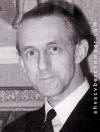 CHRISTMAS HUMPHREYS :
Despite his colourful first name, Christmas Humphreys, the prosecution counsel
in the Evans trial, was, in fact, a Buddhist. Born in 1901, he founded the
London Buddhist Lodge in 1924. He wrote a book on Buddhism that sold
500,000 copies.
Humphreys came from a legal family. His
father, Travers Humphreys, was the crown prosecutor in the cases of Dr Crippen
and the 'Brides in the Bath' murderer George Smith. As well as Evans, he
also prosecuted Ruth Ellis, the last woman to be hanged in Britain. |
|
|
Further trouble was caused by Lucy Endecott, a 16 year old blonde who came to
stay at Beryl's invitation - Beryl thought her husband was going to work out of
town, but when he didn't leave the house, she checked with the company, who had
never heard of her husband.
Lucy later described the violent quarrels during which Evans rained blows on his
wife - on one occasion, because she insisted on going to the cinema with Lucy
after Evans told her that her place was at home with the baby. Finally,
Beryl began to suspect that Lucy was interested in her husband, and ordered her
out after slapping her face. It was a violent confrontation in front of
Evans and his mother, who slapped Lucy, who in turn gave as good as she got.
Tim separated the two women and Evan's mother then suggested the police should
be called.
Lucy commented that Evans often shouted at his wife, 'I'll do you in.'
Beryl, she said, was not intimidated, and would aggravate him - on one occasion
even snatching up a bread knife. On another occasion, Timothy Evans seized
Beryl so violently by the throat that he left bruises which were still there a
month later. He also threatened to push her out of the window while she
was pregnant. |
|
|
 BERYL EVANS
:
Married Timothy Evans at 18 and was strangled when she was 20; she was
considered a sweet and pretty girl, but a little naive. Her mother was
already dead and her father lived in Brighton. |
|
|
Throughout the weekend of 5th November, the couple screamed at one another and
argued about money. Evans threatened to leave her, and she told him that
she hoped he would. The disgruntled husband went off to the cinema and
then the pub. The next morning, there was more bitterness between them and
more quarrels in the evening. But after the following day, Tuesday 8th
November, the top flat at 10. Rillington Place seemed oddly silent.
What exactly happened on that Tuesday evening will never be known for certain.
The only thing that is beyond doubt is that Beryl Evans died - strangled with a
short length of rope - and that two days later, the baby, Geraldine, was also
strangled with a tie.
Two days after this, Timothy Evans was sacked from his job when he tried to draw
his wages early, and lost his temper when his employer refused. He told
his mother that Beryl and the baby had gone to Brighton. |
|
|
GERALDINE EVANS
:
Born in 1948, a year after her parents' marriage. She was a happy child
and adored by all, especially her grandparents. She died aged 14 months. |
|
|
The following Monday he sold the furniture and Beryl's clothes, then took a
train for his boyhood home, Merthyr Vale. Two weeks later, he walked into
the police station in Merthyr Vale, and told the constable on duty that he had
disposed of his wife. Asked what he meant, he replied that he had put her
down a drain at his London home.
In the statement that he then dictated, Evans claimed that he had given his wife
some abortion medication - obtained from a man in a transport café
- and that when he came home that evening, he found Beryl lying dead on the bed,
bleeding from the vagina. He took her downstairs and pushed her head first
down a drain outside the house. Asked what had happened to the baby, Evans
claimed he had handed her over to Reginald Christie. That same evening,
Christie was arrested.
The police looked down the drains in Rillington Place, but found no body.
When Evans was told about this, he made another statement. This time, he
said that Christie had been responsible for Beryl's death. He had offered
to abort the child. |
|
|
ABORTION :
In 1949, when Timothy Evans found his wife wanted an abortion, none of today's
free counselling services existed.
The National Health Service was set up in July 1948, concentrating on free
prescriptions, dental care and spectacles. It was not geared to abortion,
mental disturbance or illiteracy.
Faced with Beryl's determination, Evans had no one to turn to. He was
trapped between his staunchly Roman Catholic family, and Christie's charlatan
expertise, and could cope with neither.
Abortion remained illegal in Britain until 1967, when the climate of opinion had
been transformed. London's first Pregnancy Advisory Service, and first
abortion clinic, opened in October 1968. |
|
|
But when Evans came back from work, Christie had told him that Beryl had died of
septic poisoning. The next day, Christie told him that he had taken the
baby to be looked after by a couple in East Acton. Christie also told him
later that he had disposed of Beryl's body in a drain.
Later Evans changed his mind and claimed that he had helped Christie carry the
body to the outside drain. It was not until Friday morning, four days
after Evans's confession, that the police finally looked in the wash-house
outside Christie's back door, and found the bodies of Beryl and Geraldine.
Evans was taken immediately to London to the Notting Hill police station.
There, that evening, he was told that the bodies had been found, and was shown a
length of rope and a tie that had been round Geraldine's neck. Evans
pointed to the latter and said: 'My tie. I strangled my baby with my tie.'
Asked later if he had been responsible for the two deaths,
he answered, 'Yes.' |
|
|
JUDGE WILFRED LEWIS
:
Judge Wilfred Lewis was in bad health during the Evans case. He
died only a few weeks after the trial ended. |
|
|
Then, in another statement, he explained how he had strangled his wife with a
piece of rope and hidden her body. 'Two days later, I strangled my baby in
our bedroom with my tie.'
There then followed another lengthy statement in which he described in detail
how, on the Tuesday evening, he had hit Beryl in the face with the flat of his
hand, grabbed a piece of rope and strangled her. Two evenings later, he
said, he strangled the baby with his tie and put her in the wash-house as well.
In this confession there was no attempt to incriminate Christie.
The next morning, Evans talked to Sergeant Trevallian, the policeman who was
keeping guard outside his cell, and who asked how he could have killed his own
baby. Evans told the sergeant that her constant crying got on his nerves. |
|
|
THE DEATH PENALTY :
In April 1948, there was a debate in the House of Commons over the death
penalty.
One of the arguments for the abolition of the death penalty was that in the
event of a miscarriage of justice being discovered, a hanged man could not be
brought back from the dead.
Sir David Maxwell Fyfe MP - a leading barrister who later became Home Secretary
- said that there was no practical possibility of a miscarriage of justice... a
jury might go wrong, the court of Criminal Appeal might go wrong, as might the
House of Lords and the Home Secretary: they might all be stricken mad and go
wrong. But that is not a possibility that anyone can consider likely.
Two years later Timothy Evans was hanged; and sixteen years afterwards he
received a free pardon. |
|
|
So, in 12 hours, Evans made three confessions to two murders. In fact,
Evans was tried only on the charge of murdering his daughter. But by the
time of his trial - which began on 11th January, 1950, at the Old Bailey - Evans
had changed his mind yet again. In prison, he had met a murderer called
Donald Hume, who had thrown the dismembered body of a car dealer named Stanley
Setty from an aeroplane. Hume had looked grave when Evans told him about
his two contradictory stories, and advised him to make up a story and stick to
it. Now, Evans's defence rested on the assertion that it was Christie who
had killed both Beryl and the baby Geraldine.
Understandably, the jury was sceptical. First Evans claimed that his wife
died while trying to abort herself, then that she died as Christie tried to
abort her, and then - three times - that he himself had strangled both Beryl and
Geraldine. Malcolm Morris, for the defence, had an almost impossible task
in convincing the jury that there was anything to be said to his client's
credit.
On the other hand, Christmas Humphreys, for the prosecution, had no difficulty
in convincing them that Evans was a pathological liar, and that his accusation
that Christie had strangled Beryl and Geraldine was merely another desperate
subterfuge. Under cross-examination, Christie gave the appearance of being
a decent citizen - in spite of the fact that the defence revealed his criminal
record. In his summing up, the judge, Wilfred Lewis, left the jury in no
doubt that he regarded Evans as both pathetic and contemptible, and that his
attempt to put the blame on Christie was a disgrace.
The verdict was inevitable. The jury found Evans guilty after 35
minutes and he was sentenced to death. His appeal was dismissed on 20th
February and on 9th March, 1950, he was hanged at Pentonville Prison.
Judge Lewis, who had been in poor health, was already dead by that time. |
|
|
THE BODIES OF BERYL & GERALDINE EVANS :
The body of Beryl Evans was found in the wash-house. It was doubled up,
wrapped in a dark blanket inside a tablecloth, and hidden behind some boards
underneath the sink. The body of baby Geraldine was found to the left of
the door, fully clothed, but with a man's tie knotted tightly round her neck. |
|
|
Three years had passed since Evans had been hanged when Christie was arrested
and found guilty of murder. The news caused a sensation - two murderers,
apparently, had lived in the same house.
Christie was sent to Brixton Prison and, once inside, made no secret of his
violence against women. Solicitors, fellow inmates and eventually the
press were treated to self-righteous, detailed accounts of his killings.
Christie compared his first victim, Austrian Ruth Fuerst, to an artist's first
painting. 'It is the same with me when I try to remember my first murder,'
he told the Sunday Pictorial newspaper. 'It was thrilling because I
had embarked on the career that I had chosen for myself, the career of murder.
But it was only the beginning.' |
|
|
ETHEL & JOHN :
Christie with his wife, Ethel, in the back garden of Rillington Place.
Little did Ethel known that she was practically standing on the remains of her
husband's victims and that she would also become a victim. |
|
|
If Christie's appearance had been shabby and anonymous, he still saw himself as
a charmer of ladies. He dismissed comparison with Boris Karloff, an actor
noted for horror films. 'More like Charles Boyer, me,' Christie would say,
referring to one of the most romantic film actors of the day. But through
his boastfulness, Christie's basic fear of women was plain. Coquettish
women, in particular, seemed to have troubled him the most. 'Women who
give you the come on wouldn't look nearly so saucy if they were helpless and
dead,' he said.
Christie also took pride in concealing his violent intentions from the women he
took back to Rillington Place, until, as he put it, 'it was too late'.
In prison, Christie astutely realised that the main issue at his trial would be
his own personality. He had always been a man of contradictions. In
the evenings, he would go out for a walk with his matronly wife on his arm,
tipping his hat to acquaintances. Yet one day he would kill her.
When he and Ethel visited her family in Leeds, Christie spoke of his big house
in London with servants. But he never earned more than
£8 a week, the going rate for a junior
clerk. |
|
|
THE HOUSE OF MURDER :
The discovery of the bodies in the scullery
started a search for more. It took the police some time before another
body was found in the living room. The flat was gradually stripped bare
and then the garden was dug up. |
|
|
In 1939, just before the war broke out, Christie had been accepted as a Special
Constable. To all intents and purposes, he seemed a reformed character.
But his petty-mindedness soon showed. He and another Special Constable
were known as 'the rat and the weasel'. Locals began to fear the sound of
his footsteps, and it was probably on the beat that he first met the tall,
dark-haired Ruth Fuerst.
The Austrian girl had come to London as a student nurse. When war broke
out she thought she would be safer here than back in Austria. She gave up
her nursing job and went to work in a munitions factory. The pay was poor
and she began to supplement her income by prostitution. Soon, she had a
baby by an American soldier.
She may or may not have met Christie while he was trying to trace a man wanted
for theft - Christie also claimed he had met her on his beat. When Ruth
asked him to lend her 10 shillings, they already knew each other, and Christie,
seeing his chance, invited her to 10. Rillington Place. Then, one hot
August afternoon in 1943, while Mrs Christie was away in Sheffield visiting
relations, Ruth called again. |
|
|
FORENSIC EXPERTS :
While forensic experts (pictured) went to work at 10. Rillington Place, it was
PC Thomas Ledger who approached Christie in Putney and, acting on a hunch, asked
him to remove his hat. Ledger recognised Christie from official
photographs. |
|
|
'I was rather backward and shy about the act of love-making on this occasion,
but she was encouraging,' Christie was later to say. 'After the affair
ended, I strangled her.' Christie went on to describe what he called the
beauty of her appearance in death, and the complete peace he felt.
He tried to dress the naked body and wrapped her in her leopard-skin coat.
At some point during this time, a messenger arrived with a telegram telling him
his wife was on her way back.
With a body on his hands and his wife about to return, Christie had to find a
hiding place for the body. Ruth was initially placed under the
floorboards. Later when Ethel, who worked part-time, was out of the house,
he dug a hole in the garden. He removed Ruth's body from under the
floorboards, placed her temporarily in the wash-house, then in the dark of night
when the neighbours wouldn't see, he buried the body in a shallow grave. |
|
|
CHRISTIE'S
HABITS :
Throughout his life, Christie paid meticulous attention to detail. When he
was in the army during World War I, one of his training instructors asked
Christie to leave his exercise book behind as an example of care and neatness
for other recruits.
Christie's fellow prisoners quickly learnt of his
obsession with physical cleanliness. When on inmate offered him a drag on
a cigarette, Christie replied, 'No thanks, it's been in your mouth. No
offence of course, but you mustn't judge me by how I look at the moment, my boy.
These aren't my proper clothes.'
On another occasion, he said to a fellow prisoner, 'I've always tried to see my
personal linen spotless.' He preferred wearing a suit, even when it had
become threadbare. |
|
|
Christie left the police at the end of 1943, and found work at the Ultra Radio
Works in west London. There he befriended Muriel Eady. He knew that
Muriel suffered from catarrh and he told her he had a remedy.
Muriel visited Rillington Place one afternoon in October 1944 and, after the cup
of tea enjoyed by all of Christie's victims, was shown a patent inhaler, which
would relieve her catarrh. The inhaler was a square jar with a metal lid
containing perfumed water. There were two holed in the lid and, unknown to
Muriel, a tube in one was connected to a gas pipe. Confident that the
perfume would disguise the smell of gas, Christie persuaded her to inhale.
Then, as Muriel became drowsy, he had sex with her and strangled her with a
stocking. 'My second murder was really much cleverer than the first one.
I planned it very carefully.' |
|
|
JOHN CHRISTIE :
John Christie, holding his hat to the
side of his head, was led into Notting Hill Gate police station after his arrest
on 31st March. The following day - April Fool's Day - he was transferred
to Brixton police station for questioning. |
|
|
Christie did plan it carefully. He knew, from his first-aid experience
with the St John Ambulance Brigade that the carbon monoxide in the gas would
make Muriel drowsy within 30 seconds. He also knew that any exertion while
in this state would exacerbate the drowsiness, making her limp and helpless.
With no resistance, it would then be easy to slip a noose around her neck and
strangle her.
The 'perfume' he used to disguise the smell of the carbon monoxide was in fact
friar's balsam, a product containing gum resin, extracted from a tropical tree,
with a camphor-like odour. It was mixed with hot water and used as an
inhalant in the treatment of colds and coughs, and was readily available
Muriel Eady was buried in the garden in a corner opposite to Ruth Fuerst.
She was missed but there was a war on and it was assumed she had been the victim
of a bomb, possibly a V1 'doodlebug'. |
|
|
BACK YARD BURIAL GROUND :
Four bodies had been found when the police
started digging up the back garden. Two skeletons were found, one of which
had a missing skull. These remains were those of Christie's first two
victims. |
|
|
As far as is known, the murders now ceased, although this is by no means a
certainty - were all the missing people victims of bombs dropping on London?
Apparently, it was another 10 years before Christie killed again.
On 14th December 1952, Christie was awakened, in his own account, by convulsions
suddenly being suffered by Ethel. His wife was by now elderly and
arthritic. Christie said he could do nothing to restore her breathing and
decided to end her misery in the kindest way. Ethel Christie died from
strangulation.
'For two days I left my wife's body in bed. And then I pulled up the
floorboards of the front room and buried her,' he later said. This act of
mercy caused him much pain, he claimed. 'From the first day I missed her.
The quiet love she and I bore each other happens only once in a lifetime.' |
|
|
LAST LETTERS :
Ethel Christie was last seen alive delivering laundry on 12th December 1952.
Two days later she was murdered - and the laundry was never collected.
For some weeks afterwards, Christie kept up the pretence that Ethel was still
alive.
Shortly before Christmas, he wrote a letter to Ethel's sister in Sheffield
claiming she could not write because of rheumatism in her fingers. Across
the top he scrawled, 'Don't worry, she is OK. I shall cook Christmas
dinner. Reg.'
In another letter that Ethel had written but not posted, Christie changed the
date from 10th to 15th December. |
|
|
Any semblance of normality Christie might have maintained vanished with the
death of his wife. He sold most of the furniture and lived in the flat
with his cat and dog to which he was devoted.
Between December 1952 and March 1953 Christie stalked, lured and murdered three
more women. In December, Kathleen Maloney, a prostitute was introduced to
Christie in a pub by Maureen Briggs, who knew Christie. He photographed
Briggs in the nude while Maloney looked on.
A few weeks later, in January, Christie bumped into Maloney and a friend of hers
in a pub in Praed Street near Paddington Station in London. They had a
drink and Maloney decided to leave as she was drunk. Christie bought her
friend a drink and left the pub. He was seen walking to the bus stop with
Maloney. This was the last time she was seen alive. Christie took
her home, sat her in a deck chair and gassed her. As she became drowsy, he
removed her pants and had sex with her. 'After that I believe I had a cup
of tea and went to bed. I got up in the morning and went to the kitchen...
She was still in the chair. I believe I made some tea then.'
He covered her head with a pillowcase, wrapped the body in a blanket and put it
away in the scullery. |
|
|
MRS. EVANS : THE WHOLE STORY :
With two killers in the same house, the one already hanged, the Sunday Pictorial
newspaper was critical of QC Henderson, who presided over the Evans case.
The newspaper went on to praise the Home Secretary, Sir David Maxwell Fyfe, for
ordering an inquiry into what looked like a serious miscarriage of justice. |
|
|
Rita Nelson, from Belfast, Northern Ireland, came to London to visit her sister
who lived in Ladbroke Grove. Nelson was known to the police in Belfast
where she had convictions for soliciting and drunkenness. In London she
worked at a Lyons teashop. She was pregnant and told her employer she had
no friends or family in London to help her, so her employer arranged for her to
enter a home for unmarried mothers. She never arrived at the Samaritan
Hospital for Women - her landlady reported her missing in the middle of January.
How Christie and Nelson met is not known. He probably came across her by
chance in one of the pubs or cafés he frequented and
offered to assist her with an abortion. To this end he took her to
Rillington Place where he persuaded her to inhale gas. Christie then
strangled her. After sex he wrapped the body in a blanket and put it in
the scullery with that of Kathleen Maloney.
Hectorina MacLennan was his final victim. She met Christie in a café
and was offered accommodation. It was something of a surprise when she
turned up with her boyfriend, Alexander Baker, in tow. Christie explained
that he had had a job transfer and would be leaving soon, which accounted for
the lack of furniture. They arranged to meet him again to confirm the
deal. However, the couple returned that same evening as they had been
locked out and asked to spend the night. They ended up staying at
Rillington Place for three nights. |
|
|
HUNTING
FOR SOUVENIRS :
For some years after the murders, until the address was changed, 10. Rillington
Place was a shrine for pilgrims and souvenir-hunters of the bizarre.
Only hours after Christie's execution, an excited young Welshman and his bride
of three days turned up. 'We've been looking forward to seeing this on our
honeymoon,' he said. People toured the house after paying five shillings
each. |
|
|
On 6th March, Christie followed them to the Labour Exchange. While Baker
went in to sign on, Christie persuaded Hectorina to visit him alone at his flat
during the afternoon. She kept the appointment while Baker waited for her
in a nearby café.
Christie gave her a drink and started to get his gas appliance to work.
She saw it, became unhappy and there was a struggle. He strangled her, had
sex with the body and then placed it in the scullery in a sitting position,
propped against Maloney's legs to keep her body in an upright position.
Later that afternoon, when Baker went to look for her, Christie said she'd
already left and showed him the flat was indeed empty - little did Baker realise
she was only a couple of paces away; the wallpaper that concealed the scullery
was probably still wet. Christie offered to help Baker look for her. |
|
|
PHOTOGRAPHING CHRISTIE :
The press gathered on a roof opposite the back of
the magistrates' court, hoping to get a photograph of Christie as he was
escorted into the waiting police van. |
|
|
Christie's pride in his artistry was undimmed. He was keen
to show that a decent, respectable grace was present in his actions. 'I
gave them a merciful exit,' he claimed later.
Christie's confessional outpourings, however, did not mean that he intended to
plead guilty to murder. He was still a ruthless calculating man, who hoped
to cheat the gallows by proving that his homicidal mania was in some way
excusable. Clearly, no jury would accept this if it believed that Christie
had killed a baby. The prosecution was equally concerned not to implicate
Christie in baby Geraldine's death as it would mean they had hanged an innocent
man.
Shortly after Evans's execution, The Man on your Conscience, by Michael
Eddows, was published. He argued strongly for Evans's innocence. The
campaign was taken up by Harold Evans, then editor of the Northern Echo
(and later the Sunday Times). |
|
|
THE SUN NEWSPAPER :
In the summer of 1983, even
The Sun newspaper, not one known for its liberal views, felt that hanging had
had its day. |
|
|
Most powerful of all Ludovic Kennedy's book Ten Rillington Place (1961),
which argued persuasively that Christie had murdered and raped Beryl Evans in
the course of pretending to abort her. Two days later, Kennedy claims,
Christie murdered the baby, telling Evans that he had taken her away to be
looked after in East Acton. Then he persuaded Evans to flee to Wales.
According to Kennedy, Evans believed that his daughter was safe and well when,
in the Merthyr police station, he confessed to 'disposing' of his wife.
But this raises obvious objection. Why did he not promptly denounce
Christie when he learned that baby Geraldine had been found strangled?
Why, on the contrary, did he not only go on to confess to Geraldine's murder,
but also to that of his wife (who, according to Kennedy, he had so far believed
died of septic poisoning)? |
|
|
TEN RILLINGTON PLACE :
Ludovic Kennedy launched a campaign for an inquiry into the Evans case with his
book Ten Rillington Place. |
|
|
The answer, says Kennedy, is that he as in such a state of shock that he was
virtually brainwashed, and would have confessed to anything. But surely no
man is going to confess in circumstantial details to killing his wife and baby
if he knows he has been framed by the real murderer?
Then what of Christie's three later confessions to murdering Beryl? The
answer may lie in a statement Christie made to the prison chaplain, the Rev. W.G.
Morgan. He explained that he had held out for a long time against his
solicitor's suggestion that he should confess to the murder of Beryl Evans, but
that he had finally been persuaded that it would help his defense of insanity.
'The more the merrier', was the phrase Christie used to explain his reasoning.
In the same year as Ten Rillington Place, Rupert Furneaux published a
book called The Two Strangers of Rillington Place. Furneaux notes that
Evans told the murderer Donald Hume - in prison - that Christie killed the baby,
while he looked on. Furneaux argues that this is true. But Evans
also told Hume that he did not kill his wife, and Furneaux refuses to accept
this, on the sensible grounds that no man would confess three times to a murder
he had not committed. |
|
|
FREE PARDON :
The report in 1966, which led to Evans's free pardon, did not say he was
innocent of murder. Chaired by a High Court judge, Justice Brabin, the 14
month inquiry concluded that Evans had probably killed his wife, but was
probably innocent of killing the baby.
In other words, the Brabin report said Evans was hanged for the wrong murder.
It did, however, say that had all the evidence been available, no jury would
have convicted Evans of either murder. |
|
|
Christie's trial began in the No. 1 Court at the Old Bailey on
22nd June 1953. In the same courtroom, some three years earlier he had
stood in the witness box at Tim Evans's trial and denied killing Beryl Evans.
Now, he would retrace his footsteps and admit that he had.
Like Timothy Evans, Christie was tried on only one sample charge. Yet by
now, the entire country knew that a mass-killer of women would be on public
view, being tried for his life. Christie had by this stage confessed to
seven killings : two women in 1943, Beryl Evans in 1949, his wife Ethel in 1952
and the other three women in early 1953. His counsel, Derek
Curtis-Bennett, QC, was eager for the courts to hear of all these cases and any
others which the prosecution may have known.
It had been a painstaking task by the police to unearth the full extent of
events at Rillington Place. At 6am on 18th May, Beryl Evan's body had been
exhumed from its grave at Kensington Borough Cemetery in Gunnersby for
examination by the leading pathologists of the day - Keith Simpson, Francis
Camps and Donald Teare. The body of Geraldine, for whose murder her father
had been hanged, lay with her mother. There had been lengthy efforts to
identify the victim's bones. In the case of Ruth Fuerst, Christie's first
known victim, her skull had been reconstructed out of 110 separate pieces. |
|
|
CHRISTIE GOING TO COURT :
Christie, for once without his hat
and trying to cover his face from the press, steps out of a prison van outside
the magistrates' court where he is charged with the murder of his wife. |
|
|
Christie wrote to an old acquaintance from prison that he was
'fuddled and dazed' by his predicament. He longed for sweets, cigarettes
and the taste of an apple but he also spoke of the prison warders'
consideration.
At the end of his formal confessions, he had written, 'I wish to state that I am
most grateful to the police in charge for the kindly way in which I have been
treated at Putney police station.'
Christie took great care in his written confessions to provide explanations for
each killing. The prostitutes had forced themselves upon him and things
got out of hand. His wife had to be put out of her pain. Eady and
Beryl Evans had also been given forms of mercy killings according to Christie. |
|
|
EXHUMATION OF BERYL EVANS :
A canvas sheet shields the grave of Beryl Evans while the police wait for the
body to be exhumed. |
|
|
The Old Bailey courtroom was packed. Distinguished people
from many walks of life were present. Christie, dressed in a blue
pinstripe suit, was charged with murdering his wife and pleaded not guilty.
Christie's counsel, Curtis-Bennett, told the jury that he would establish a
defence of insanity under the McNaughten Rules. These date back to 1843,
when defendants were not allowed to give evidence on their own behalf. The
rules state that a man is not guilty in law if, at the time of his actions, he
did not know what he was doing wrong (the rules remained on the statute book in
England until 1957).
'You can have no doubt, doctors or no doctors, that at the time he did each of
these killings, including that of his wife, he was mad in the eyes of the law,'
said Curtis-Bennett. Christie walked to the witness box, apparently almost
in tears and took half a minute to mumble the oath. He constantly clasped
his hands, pulled an ear, tugged his collar and smoothed his bad head as he
answered questions. He could recall some murders, and not others. |
|
|
DEREK CURTIS-BENNETT, QC :
Mr Derek Curtis-Bennett, QC
(second from the left), wanted to save Christie's life by proving him insane.
The jury, however, was not convinced by his argument. |
|
|
Asked by his counsel if he had committed any murders between 1943
and 1949, Christie replied, 'I don't know.'
'Do you mean you may have done?'
'I might have done. I don't know whether I did or not,' Christie said, but
he was more definite when questioned about 1949 itself.
'Did you kill the baby, Geraldine Evans?'
'No,' came Christies reply.
The judge, Mr Justice Finnemore, pressed Christie on his evidence at the Evans
trial. Christie became evasive.
'You were not lying about the baby, but why did you lie about Mrs Evan?'
'Well, I was accused of killing both of them,' Christie said. |
|
|
E.F. CAMPS :
Doctor E.F. Camps, one of the leading pathologists at the time of
Christie's trial, was brought in to examine the exhumed remains of Beryl Evans. |
|
|
The medical evidence was divided. Dr Jack Hobson, senior
psychiatrist at the Middlesex Hospital, met Christie 10 or more times in prison,
and gave evidence of his supposed horror of masturbation, and of public houses.
In fact, Christie frequented run-down pubs, and semen stains were found on his
clothing.
Hobson said that, under the McNaughten Rules, Christie was not responsible.
'The tricks of memory are avoidances of getting down to disturbing topics to
preserve his own self-respect rather than to avoid incriminating himself.'
The Crown's medical witnesses rejected this - in particular, Dr Desmond Curran
of St George's Hospital, who expressed the view that Christie was abnormal and
conceited 'but not suffering from any form of hysteria'. |
|
|
 PUBLIC INTEREST :
Public interest in the case was immense. Crowds queued for the places in
the public galleries at the Old Bailey. |
|
|
On the fourth day of the trial, the judge began his summing up.
The jury was sent out at 4.05pm and returned 82 minutes later.
'Did you find the prisoner guilty or not guilty?' the jury was asked.
'We find him guilty.'
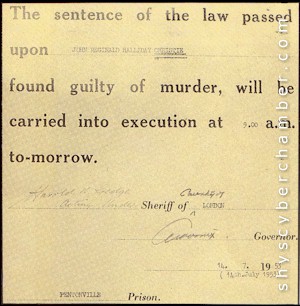
Mr Justice Finnemore donned a black cap and, through tears of pity, passed the
death sentence on John Christie, who remained completely silent. |
|
|
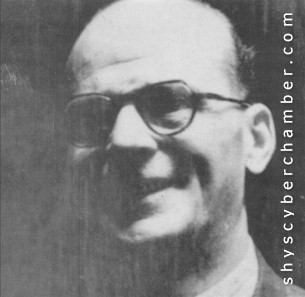
JOHN CHRISTIE :
On the surface, Christie was a genial sort of man with a pleasant smile, but
behind the facade lay a scheming killer who lured women back to his flat where
he strangled them. |
|
|
At his trial, Christie's counsel, Derek Curtis-Bennett, declared at one point
that his client was as 'mad as a March hare'. This is undoubtedly untrue:
Christie was not mad. But he did suffer from a peculiar mental disorder: a
sexual perversion called necrophilia, an erotic fascination with corpses.
When he was eight years old he experienced a trembling sensation when he saw his
grandfather's corpse. The idea of death was linked in his mind with
wickedness, forbiddenness, and therefore sex.
Only this can explain his first murder, that of a 17 year old Austrian part time
prostitute named Ruth Fuerst. |
|
|
THE PUBIC HAIRS MYSTERY :
One of the strangest items found at 10 Rillington Place was a tobacco tin
containing four lots of pubic hair. One lot may have been taken from Ethel
Christie, although the evidence was not conclusive.
The three other lots did not match the three women found in the cupboard.
It is possible two lots were taken from the two bodies buried in the garden.
But this leaves at least one lot unexplained.
At his trial, Christie said that he did not know from whom the cuttings were
taken, but he may have killed other people. |
|
|
Christie was a Special Constable when, in August 1943, he picked
up Ruth Fuerst on his beat, and took her back to 10 Rillington Place.
Ethel was at this time on holiday with relations in Sheffield. Since Ruth
Fuerst was a prostitute, Christie had no need to kill her to have sex; she
probably did not even expect payment from the policeman on whose beat she had
been soliciting.
Yet, as they had intercourse, naked on the bed, he strangled her with a piece of
rope. Why? Probably because he meant to keep her body and make use
of it until his wife returned - the murder must have been pre-planned or he
would not have had the rope conveniently at hand.
Ludovic Kennedy is probably correct when he says that 'a lifetime of repressed
masculine aggression had... come to its climacteric.'
After the murder, Christie was interrupted; a telegram from his wife
obliged him to hide the body, then bury it. And when he murdered Muriel
Eady, a colleague from work, it was also carefully planned - he had told her he
could cure her catarrh with his inhalation device. When she was
unconscious, he took her to the bedroom, and strangled her as he raped her. |
|
|
AMERICAN VIEW :
British justice won a friend at
Christie's trial, whatever the doubts about Evans's guilt. The American
playwright Robert Sherwood attended the trial, and later wrote: 'I marvelled at
the dignity and majesty, the clarity and equity of English justice... there was
a lot less fancy oratory and calculated histrionics that you would see in an
American murder trial... I could not help imagining what a trial as sensational
and revolting as this one would be like in New York, Chicago or Los Angeles.
The lawyers would be striding up and down, often soaring to the heights of
forensic extravagance.' |
|
|
He says in his confession, 'Once again I experienced that quiet,
peaceful thrill; I had no regrets.' When he killed and raped, his
inferiority complex vanished, and he became a kind of superman.
He probably had no intention of killing Beryl Evans - simply to enjoy pretending
to perform an abortion (perhaps actually perform one), and possibly, if she
could be persuaded to breathe in the gas, to make love to her. But the
sight of the body, naked from the waist down, triggered a frenzy of lust;
as she struggled, he strangled her, then possessed her. It was only then
that he realised he was in serious trouble. If her husband went to the
police, Christie would hang.
Fortunately for Christie, Evans was of low intelligence - his IQ was
about half that of Christie - and Christie found it easy to persuade him that
they would both be in trouble unless they hid the body. He later told
Evans he had hidden it down a drain. |
|
|
TIMOTHY EVANS :
Evans's willingness to follow
Christie's advice was a classic example of Christie's power over weaker people. |
|
|
It seems probable that Christie strangled Ethel - in December
1952 - because she stood in the way of further satisfaction of his craving to
have sex with corpses.
Christie now went on to kill three more women - Kathleen Maloney in mid-January,
1953, Rita Nelson a week later, and Hectorina MacLennan around 3rd March.
He probably had intercourse with the bodies repeatedly; as Kennedy says, 'After
so long an abstinence the sweetness of destroying and then ravishing female
flesh went to Christie's head.'
By now he was broke, alone and at the end of his tether; he had sold his
furniture and was weeks behind with the rent. He sublet his flat and fled
- and four days later, the bodies were found. |
|
|
'MAD AS A MARCH HARE' :
Although the defence made a
strong plea for insanity at the time of killing, the prosecution and the jury
thought otherwise. |
|
|
Professor Francis Camps, who examined the bodies in Christie's
flat, offered a glimpse of Christie's strange, morbid sex life when he told the
author Colin Wilson about an item that never came out in court - that he had
found sperm in the seams of Christie's shoes, indicating that he had stood over
the bodies to masturbate.
It must have seemed to Christie, in such a moment, that all his problems and
humiliations were behind him - that he had ceased to be Can't-do-it Christie and
had finally become a Somebody.
The act of standing above the body was not only an expression of power
over the victim, but of contempt for her. The sarcastic neighbours who
described Constable Christie as Little Hitler had more psychological insight
than they knew. |
|
|
'CELEBRITY STATUS' :
Christie, looking as if he was
enjoying all the attention rather than being charged with murder, being driven
to court. He spent his 54th and final birthday in the dock at the Old
Bailey. |
|
|
Christie's execution was only three weeks away. With his
trial over, there were clamours for a more wife-ranging inquiry. Could two
strangers really have operated independently, unknown to each other, in such a
tiny house?
Christie was sentenced on 25th June 1953. The following day, the Labour
opposition in Parliament pressed a reluctant government to review the entire
Rillington Place affair. On 6th July, the Home Secretary, Sir David
Maxwell Fyfe, appointed the Recorder of Portsmouth, John Scott Henderson, to
study whether there was any ground for thinking there may have been a
miscarriage of justice.
Mr Scott Henderson, assisted by the Assistant Chief Constable of West Riding,
Yorkshire, had to move quickly. His report had to be compiled before
Christie went to the gallows. The task was immense. Before his
appointment, he had been asked to study all the relevant documents in the Evans
case. To these were now added the Christie documents. Scott
Henderson also had to hold discussions with counsel for both Evans and Christie,
and with numerous other officials in the case. |
|
|
JOHN SCOTT HENDERSON :
Mr John Scott Henderson was
fighting against time when the Home Secretary appointed him to review and report
on the Rillington Place affair to see if there was any possibility that the law
had failed Timothy Evans. |
|
|
Mr Scott Henderson also held a meeting with Christie himself,
which lasted 75 minutes. Christie's permission for this had been obtained
by a senior police officer assisting the inquiry. The officer had warned
Christie that he would be questioned about Geraldine Evans, but gratuitously
added that there was no evidence that he had killed her.
The report, which was presented on 13th July, bewildered people on both sides of
the debate. It concluded that the case against Evans for murdering his
daughter had been overwhelming. Moreover, the report said, Evans had also
murdered his wife. In other words, Christie had told the truth at Evan's
trial, but lied at his own, and there had been two stranglers living at 10
Rillington Place.
The report presented to Parliament the following day (the day before Christie's
execution) and debated in the House of Commons two weeks later, with a number of
MP's making allegations of concealment of evidence - allegations made under
parliamentary privilege and which couldn't be repeated outside the House.
Scott Henderson came in for a lot of criticism, but he was a man of integrity
and extremely capable. According to his clerk, he was fast and to the
point and 'never wasted a word', making him the most suitable man for the job.
He later produced a supplementary report which dealt with the critical points
raised earlier. |