|
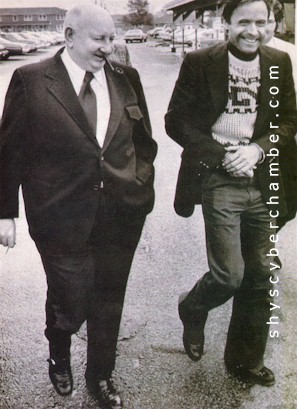
POLICE
CAPTAIN; NICK MACKIE
:
King County's police captain, Nick Mackie, holds
up a computer run with the names of 3500 possible suspects, which included
Bundy's name. With his credentials, Bundy's file ended up near the bottom
of the suspect list. |
|
|
The police reckoned that Sharon's attacker had watched her undressing
through her bedroom window, then found an unlocked door and made his
way into her bedroom.
Four weeks later, in another old house, a student friend of 21 year
old Lynda Ann Healy went into Lynda's bedroom to see why the alarm was
still buzzing at 6.00 in the morning. Lynda was a psychology
student at the University of Washington. She also had a job at
the local radio station reading the ski report on the early morning
breakfast show. For this she had to get up at 5.30am. When
her friend saw that the bed had been neatly made up, she assumed Lynda
had gone out to do her job.
That evening, Lynda's parents arrived for dinner, but Lynda was not
there. The police were notified, and detectives came round to
the house. In Lynda's basement bedroom, one of them pulled back
her bedspread and found that the sheets and caseless pillow were
stained with blood. In the wardrobe, Lynda's nightdress, also
stained with blood, hung on a peg. |
|
|
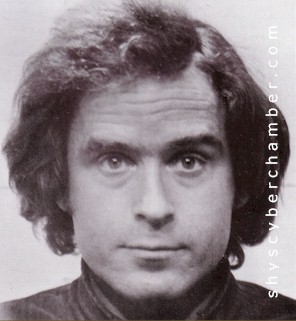
ARTISTS IMPRESSION & TED BUNDY :
After two young women disappeared from Lake Sammamish State Park, the
police issued an artist's impression of a man who had been seen trying to chat
up a number of girls. A photograph of Ted Bundy bears a striking
resemblance to the man wanted by the police. |
|
|
It looked as if the attacker had entered the basement bedroom and
knocked her unconscious. He had then removed her nightdress -
probably to put her clothes on - and remade the bed. If the
intention had simply been rape, it could have been accomplished there
and then. The inference seemed to be that Lynda's attacker
wanted to take his time, to enjoy the pleasure of possession.
A few days later, an unknown man rang the police, and told them that
Sharon Clarke's attacker was the same person who had abducted Lynda
Ann Healy. According to the caller, the man had been outside
both houses. The police never traced the caller.
Two weeks later, 19 year old Donna Manson left her dormitory on the
campus of Evergreen State College, southwest of Olympia, to walk to a
jazz concert. She never returned. Neither did Susan
Rancourt, Roberta Kathleen Parks, Brenda Ball, or Georgeann Hawkins -
all four of who disappeared on seemly innocent outings. |
|
|
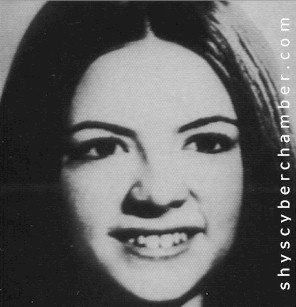
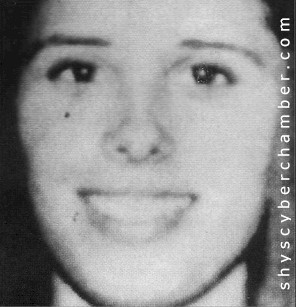
LYNDA ANN HEALY :
Aged 21, psychology student at the University of Washington, Seattle;
musically talented, she played the lead in a production of Brigadoon at her high
school and had been a soloist for the Congregational Church; at University she
worked part time, reading ski reports on local radio. Seized on 31st
January 1974; last seen wearing jeans, white blouse and boots; body discovered
in September 1074. |
|
|
By the middle of June 1974, six girls had vanished. Georgeann
had disappeared during the short walk, a distance of about 100 paces,
from her boyfriend's student residence to her own.
As July started, police in Seattle were wondering who the seventh
victim would be. The answer came in a manner that would cause
nationwide headlines.
Two girls disappeared from the Lake Sammamish State Park on 14th July
1974. But this time, the abductor had been seen by several
witnesses. The park, 20km (12 miles) east of Seattle, was a
favourite picnic spot. It was a hot day and the park was
crowded. At about midday, a girl named Doris Grayling was
approached by a wavy haired man with his arm in a sling. He
asked her if she would help him lift his boat on to his car. She
accompanied him to the car - a brown Volkswagen - but he then told her
the boat was further up the hill. Unwilling to go further with
the stranger, she excused herself and left. |
|
|
DONNA GAIL MANSON
:
Student, aged 19, at Evergreen State College,
near Olympia. Vanished on 12th March 1974, on her way to a jazz concert;
last seen wearing a striped top, blue slacks and a long black coat. Her
disappearance was at first thought to be suicide until a psychiatrist read her
notebooks and writings, and said she was not the type to kill herself. She
wasn't reported as missing until six days later, her body was never found. |
|
|
Within an hour, he had approached a pretty blonde named Janice Ott, who
was lying alone by the lake. When he asked her to help him with his boat,
she invited him to sit down and talk. People sitting only a few yards away
noted that he had an accent that might have been Canadian or even British.
They talked for ten minutes about sailing and in response to her saying 'Sailing
must be fun, I've never learned how', he offered to teach her. They set
off together. She never returned to her place at the park.
Around 4.30pm, 19 year old Denise Naslund left a group of friends to go to the
ladies' lavatory. When she failed to return, they assumed she had met a
friend for a chat. When she had still not returned after four hours, they
reported her disappearance to a park ranger.
The next day, the police learned that the young man with his arm in a sling had
approached several girls asking for help. One had refused only minutes
before Denise Naslund disappeared. |
|
|
SUSAN RANCOURT :
Student, aged 18, majoring in biology at Central Washington State
College, Ellensburg. At high school she had been a cheerleader and
Homecoming Queen; worked in a nursing home to pay her way through
college. She never went out alone except
one night, on 17th April 1974, when she went to a campus meeting before
settling off for a cinema - she never arrived. Her skull was
discovered 140km (87 miles) to the east of Taylor Mountain in September
1974. |
|
|
Because the man had been seen - and heard giving his name as 'Ted' - by
so many people, the Seattle newspapers were able to publish descriptions and an
artist's impression of the suspect. The police received many calls
informing them that the man sounded like a University of Washington student, Ted
Bundy. One of these calls was from an old friend of Bundy, crime reporter
Ann Rule; another was from Meg Anders, his girlfriend of four years' standing.
But Bundy was only one of hundreds of suspects - the number swelled to 3500 -
and at first he seemed perhaps one of the least likely. He was apparently
a decent young man who had worked for Seattle's Crime Prevention Advisory
Commission and also for King County's Law and Justice Planning Office.
Also, it seemed highly unlikely that a man who was about to abduct his victim
would use his real name within the hearing of other people. Consequently,
the Bundy file sank to the bottom of the suspect list.
Then, on 6th September 1974, hunters five kilometres (two miles) east of Lake
Sammamish State Park found some human bones in the undergrowth. Dental
charts identified them as Janice Ott and Denise Naslund. There was also a
thigh bone belonging to a third body, but this one defied identification.
As the months went by it began to look as if the Seattle murders had come to an
end. By an odd coincidence, a similar series of murders was about to begin
in Salt Lake City. Bundy had moved there to study law at the University of
Utah. |
|
|
ROBERTA KATHLEEN PARKS :
Student of religion at Oregon State University, Corvallis, 400km (250
miles) south of Seattle; aged 22; wearing a navy blue top, light green jacket,
blue slacks and platform sandals when she vanished from the university campus,
on 6th May 1974, on her way to the Student Union Building. Her skull was
discovered some 416km (260 miles) away on Taylor Mountain in September 1974,
near other victim remains. |
|
|
After the attacks on his first two victims - Sharon Clarke and Lynda
Healy - Bundy now needed to find a safer and easier method of operation.
Entering people's homes was extremely risky. Remarkably, Sharon Clarke
survived the attack in her bedroom, although she was too damaged to help the
police identify her attacker. It was probably also after his first
known murder - of Lynda Ann Healy - that Bundy first realised that killing was
an essential part of the sexual act he craved.
Donna Manson had vanished on a rainy Tuesday night in March. It was six
days before the police were notified and by then the trail was cold - there were
no clues. The assailant's new method of attack had succeeded, and he
quickly put it into practice again.
The police got their first clue to the murderer's plan of action when a female
student reported an incident at the Central Washington State College in
Ellensburg five days before Susan Rancourt disappeared. A good-looking
man, with his arm in a sling, had dropped some books, and had asked the girl if
she would help him carry them to his car - a tan VW, parked 100 paces away.
He asked her to unlock the door and get in, but she refused and hurried away. |
|
|
 GEORGEANN HAWKINS :
Student, aged 18, studying
at the University of Washington, Seattle; a particularly bright student, she was
last seen visiting her boyfriend at a nearby House of Residence just before
12.30am on 11th June 1974. Abducted soon after from a brightly lit alley;
her remains have never been found. |
|
|
One evening, three days later, Susan Rancourt, a biology student, left a
meeting on the Ellensburg campus and was heading off to meet a friend at the
cinema. On the way, Bundy must have intercepted her, and used the same
ruse to get her into the car. He cracked her skull with a metal bar, then
abducted, raped and killed her before dumping her body in the woods.
Less than three weeks later, on 6th May 1974, Roberta Kathleen Parks, a
student of world religions, disappeared on her way to meet friends at the
Student Union Building of Oregon State University, in Corvallis. The
killer had undoubtedly travelled the 400km (250 miles) south from Seattle in an
attempt to commit a crime that would not be linked to the others.
Friends of Brenda Ball said that they had last seen her talking to a handsome
man with his arm in a sling outside a bar near Seattle Airport. His method
of abduction - having proved successful - was used time and time again,
sometimes with subtle variations on the theme. |
|
|
BRENDA
BALL :
Student, aged 19, studying at the Highline Community College, Burien,
just south of Seattle. Seen talking to a man with his arm in a sling on
1st June 1974, her skull was discovered and identified from dental records, in
September 1974 on Taylor Mountain, east of Seattle, which started a search in
the area for more victims. |
|
|
Several students reported seeing a stranger on crutches, carrying a
briefcase, around the Beta House Hall of Residence in Seattle, where Georgeann
Hawkins had vanished. One girl saw the man dropping his briefcase several
times and had offered her help; but first she had to make a call at one of the
residences. When she returned he was gone.
Two months later, on a sunny summer day, the helpless man with his arm in a
sling had abducted two young women - Janice Ott and Denise Naslund - from Lake
Sammamish State Park.
The assailant was choosy when selecting his prey. The victims were all of
a similar type - in their late teens or early twenties, slim and attractive with
long, and usually dark hair, parted in the middle. Most had been students,
and all were of above average intelligence. |
|
|
 JANICE OTT
:
A petite probation case officer, aged 23; she disappeared along with her 10 sped
racing bicycle 14th July 1974, wearing cut-off jeans over a black bikini, at
Lake Sammamish State Park. Her remains were found September 1974 on Taylor
Mountain, east of Seattle. One of the oldest of the known victims, she was
also one of the few victims who was married. Her bicycle was never found. |
|
|
It was as if the killer, with his good looks and charming manner, wanted
to prove that he could lure the brightest and most attractive women to their
deaths.
In March 1975, six months after the discovery of the remains of Janice Ott and
Denise Naslund, and 10 miles away on Taylor Mountain, a forestry student found
Brenda Ball's skull.
A search of the area over the following few days yielded the skulls of Susan
Rancourt, Roberta Kathleen Parks and Lynda Healy - but no other bones. The
bodies of Donna Manson and Georgeann Hawkins are still missing. |
|
|
 DENISE NASLUND
:
Part-time office worker
studying at night school, aged 19; she vanished on 14th July 1974, from Lake
Sammamish State Park. Her remains were found in September 1974, near those
of Janice Ott, on Taylor Mountain. |
|
|
Theodore Robert Cowell was the illegitimate child of a respectable and
religious young secretary, Eleanor Louise Cowell. He was born on
24th November 1946, in Burlington, Vermont, in the Elizabeth Lund Home
for Unwed Mothers, nicknamed 'Lizzie Hunt's Home for Naughty Ladies'.
Due to Eleanor's religion, an abortion - possible but illegal - had been
out of the question. Ironically, she got no support from her
church and was ostracized for being pregnant. She didn't give up
on her faith and chose the name Theodore because it means 'gift of God'.
The father's identity was unknown.
Eleanor continued to live at home, in Philadelphia, where her parents
told neighbours that Ted was their adopted child. His grandparents
certainly treated him as if he was their own child. Ted grew up
believing that Eleanor was his sister, and that he was a late baby.
Ted's grandfather had a tyrannical temper and terrorized everybody in
the house. It was not until 1969, when Ted went to Vermont to
obtain his birth certificate that he discovered his true parentage.
When Ted was four his mother decided to make a fresh start to protect
him from gossip - she did not want her son to be referred to as a
'bastard'. So she and Ted left Philadelphia and moved 4,800km
(3,000 miles) to the west, to stay with relatives in Tacoma, near
Seattle.
To ensure anonymity, Ted's name had been legally changed to Robert
Theodore Nelson shortly before they left Philadelphia and by the time
they arrived in Tacoma, Eleanor had become 'Louise'. |
|
|
BUNDY'S TACOMA RESIDENCE :
Bundy was four years old
when he and his mother moved from Philadelphia to this house in Tacoma, near
Seattle. Bundy's mother made the move to save young Ted from the prejudice
he might have encountered as an illegitimate child. |
|
|
Louise joined the Methodist church, where, at a social function, she met and
later married John Bundy, giving Ted yet another name. Bundy was an
easy-going Southerner, who had just left the navy and found a job as a cook in a
veteran's hospital. He remained there for the rest of his working life.
Louise and John Bundy bought their own house after a while and started their own
family. Ted sometimes called Louise 'mother' and at other times used her
first name.
The young Ted found this new father dull and uncultured, but showed no
resentment towards him, nor to his half brothers and sisters who came along
later - Ted was 15 when the couple's last son was born.
At the same time, Ted did an early morning paper round and was well-known in the
area. One morning, nine year old Ann Marie Burr disappeared. She
knew Ted and followed him around like a puppy. No trace of her was ever
found.
The street outside Ann's house was being dug up at the time. It's possible
that her body was buried in a ditch, which was covered by asphalt that very day.
No connection was made between Bundy and her disappearance.
Ted was an oversensitive and self-conscious child who had all the usual
daydreams of fame and wealth. He fantasized about being adopted by the
cowboy star Roy Rogers, and actually asked his Uncle Jack, a professor of music
in Tacoma, to adopt him, |
|
|
LOUISE BUNDY :
When asked in an interview to describe the kind
of son Ted had been, Mrs Louise Bundy replied, 'Ted has always been the best son
in the world.'
Her words came out lyrically, and her clasped hands bounced in her lap.
'He was always a very thoughtful person. At times I wondered if he would
forget Mother's Day, because of the busy schedule of his life. But he
always showed up with a gift.' She recalled his interest in the law, 'He'd
always wanted to be a policeman or a lawyer.'
In her last conversation with him, on the eve of his execution, she said, 'We
just want you to know how much we love you.' |
|
|
He achieved fairly good grades at school, became an enthusiastic Boy Scout, and
was a natural athlete. He developed into an excellent skier, although the
expensive equipment he used was almost certainly stolen - by this time he had
become a thief and an habitual liar.
As a first year student, he was lonely, silent and shy. The desire to be
different and his belief that China was the country of the future led him to
study Chinese.
In his late teens, Ted became heavily infatuated with a fellow student,
Stephanie Brooks. She was beautiful and sophisticated, and came from a
wealthy, socially well-connected family.
By now, Ted had already developed something of the charm and sophistication that
made him so attractive to women - although he remained emotionally immature -
and the couple became engaged.
To impress Stephanie and her family, Ted went to Stanford University to continue
his studies. He was lonely there and his grades were poor. 'I found
myself thinking of standards of success that I didn't seem to be living up to,'
he said. |
|
|
BUNDY'S TRANSFORMATION :
When Bundy decided to complete his degree course at the University of Washington
in the summer of 1970, many of his old friends were startled by the change in
him. 'I hadn't seen him since high school,' one of them remarked at the
time, 'and I was really struck. He walked with a confident air... I
remember thinking, 'Jesus, this guy really knows where he is going'.'
Bundy's professors were equally impressed.
Recommending him for a place at law school, one later wrote, 'He conducts
himself more like a young professor than a student. I would place him in
the top one percent of the undergraduates with whom I have interacted.' |
|
|
Stephanie wearied of his immaturity, and broke the engagement. He was
shattered and deeply resentful. His brother Glenn later commented,
'Stephanie screwed him up... I'd never seen him like this before.'
Ted took a menial job in a hotel dining room and became friendly with a drug
addict.
One night, they entered an abandoned cliff-side house and stole whatever could
be carried. Bundy found it a strangely exciting experience, and began
shoplifting for thrills. On one occasion he walked openly into a
greenhouse, removed a tall palm tree, and drove off with it sticking out of the
sunroof of his car.
He also became a full-time volunteer for Art Fletcher, he black Republican
candidate for Lieutenant Governor. Ted enjoyed the sense of being a
somebody and mixing with interesting people.
In 1972, Bundy worked at a Crisis Clinic as a psychiatric counsellor.
Later, he worked for the Crime Prevention Advisory Commission. In 1973, he
began to study law, at the University of Puget Sound in Tacoma.
When Stephanie Brooks met him again, some seven years after they split up, she
was deeply impressed by the new, high-powered Ted Bundy. They talked of
marriage, and spent the Christmas of 1973 together.
The Bundy dumped her as she had dumped him. When she rang him to ask why
he had not contacted her, he said coldly, 'I have no idea what you're talking
about,' and hung up on her.
A few weeks later, as if his revenge had somehow broken some inner dam and
inspired him with a sense of ruthless power and confidence, he became a rapist
and murderer. |
|
|
TED BUNDY GROWING UP :
Bundy, aged 17 (left) at high school, and at graduation, when he was 19 (right).
Bundy spent his early teens at Hunt Junior High School in Tacoma. |
|
|
A handsome man walked up to Carol DaRonch in the shopping centre in Murray, a
suburb of Salt Lake City. It was a damp November evening in 1974 and the
attractive 17 year old was peering at a window display when the young man
introduced himself as a police officer.
He asked her whether she had left her car in the store car park, and she replied
that she had. After requesting and taking down the licence number he
explained that he and a fellow colleague had apprehended a man breaking into the
car. He asked her to accompany him to it, to see if anything had been
stolen.
The car park was some distance away, and as they walked towards it through the
drizzle, Carol noticed that the police officer was allowing her to lead the way.
She asked him for some identification. The man drew his wallet from his
inside pocket, and opened it. In the semi-darkness, she could see
something that looked like a police badge. |
|
|
HUNT JUNIOR HIGH SCHOOL IN TACOMA |
|
|
She was relieved to see that her car seemed to be undamaged, and that it was
still locked. She opened the driver's door, and told him that nothing was
missing. As the man bent over to try the passenger door, she noticed a
pair of shiny handcuffs in the inside pocket of his green sports jacket.
He explained that his colleague had taken the suspect to the sub-office on the
other side of the mall, and asked Carol if she would mind going there with him
to make a statement.
The policeman, who was about 10 years older than Carol, seemed so serious and
self-assured that she lacked the confidence to ask further questions. On
the far side of the mall, they approached a small building, which the man
identified as the sub-office.
Carol was unaware that it was really a laundromat. The man tried the side
door, announced that his colleague must have taken the suspect back to the
police headquarters, and told Carol that he would drive her there to sign a
complaint. She asked him for his name as they approached an old,
battered-looking VW. He told her he was Officer Roseland of the Murray
Police Department. |
|
|
SALT LAKE CITY :
Salt Lake City is the centre of the Mormon religion, to which Bundy
became converted after his arrest. In 1974, while studying law here, Bundy
abducted and killed a succession of women. |
|
|
The vehicle certainly did not look like a police car. It was scratched and
dented and, as he climbed in, she observed the back seat was torn. In the
enclosed space, she noticed alcohol on the man's breath. When he made a
U-turn and went in the opposite direct to the police station, vague anxiety
suddenly turned to alarm. Minutes later, the VW turned into a dark side
street and screeched to a stop outside a darkened high school, the front wheel
bouncing up on the pavement.
It had taken Carol a long time to realise that she was being kidnapped, but as
soon as she did she made a grab for the handle and threw open the door.
With terrifying speed, the man seized her wrist and snapped a handcuff on it.
But as he tried to grab the other wrist of the screaming girl, he made a mistake
and closed the handcuff on the same wrist. Then he pulled out a gun,
pointed it at her head, and threatened to kill her if she made another move.
Too terrified to care, Carol grabbed the handle, opened the door again and fell
out. The man was following her, with a metal bar in his hand, when they
were illuminated by the headlights of an oncoming car. As Carol ran
towards it, screaming, the VW accelerated away.
Half an hour later, the frightened girl told her story to a sergeant at police
headquarters. He noticed a few spots of blood on the white fur trim of her
coat - blood from scratches that Carol had inflicted on the face of her would-be
abductor - and he slipped them off for forensic examination. |
|
|
CAROL BARTHOLOMEW & TED BUNDY
:
Ted Bundy with Carol Bartholomew at a party in 1975. She never suspected
his true character and spoke of him as an attractive friend. |
|
|
In Viewmont High School, 27km (17 miles) north of Murray, an audience of
students and parents was preparing to watch a comedy called The Redhead.
The drama teacher, Jean Graham, was similar in appearance to Carol DaRonch -
pretty, with long brown hair parted in the middle. Minutes before the
curtain was due to rise, Jean was approached by a tall good-looking man who
asked her if she would go to the car park and identify a car.
Jean Graham was in a hurry, so she told the man she did not have time. But
she took a good look at him, and observed that he had brown wavy hair and a
moustache, and wore a well-cut jacket, dress trousers and patent leather shoes.
The man was persistent. In the first intermission, he was still there, and
half an hour later, he again asked her to go with him to the car park. 'It
will only take a few seconds,' he said. But she was still in a hurry and
declined. |
|
|
DEBBIE KENT
:
A student at the Viewmont High
School, Bountiful, Utah, aged 17. She had arranged to collect her brother
from a bowling alley after attending a performance of a play with her parents
was abducted from the school car park, on the 8th November 1974. |
|
|
In the audience that night sat 17 year old Debbie Kent, together with her
parents. Debbie was not entirely happy as she had left her brother Blair
at a bowling alley, promising to pick him up after the play. The play was
overrunning and Blair would be wondering what had happened to her.
Debbie's father was recovering from a heart attack, and she was anxious not to
worry him. So half an hour before the end, she decided to skip the rest of
the play, to drive over to collect her brother.
Jean Graham was seated in the back row as the play was drawing to a close, when
the door opened and a man came in and sat down in the seat opposite. He
was breathing heavily, as though he had been running, and the people in front of
him looked round irritably. When the curtain came down, he stood up and
hurried out.
As the school slowly emptied, Debbie's parents waited nervously for her to
return. Eventually, they decided to walk to the home of friends who lived
nearby. It was only as they were crossing the car park that they saw their
car was still there, and realised that their daughter had not made the trip to
the bowling alley.
The following morning, police investigating Debbie's disappearance searched the
school grounds. Just outside the south door, not far from the car park,
they found a handcuff key.
Residents in a nearby block of apartments described hearing two piercing screams
coming from the car park, sometime after 10.00 the previous evening. It
was when the police discovered that the handcuff key fitted the handcuffs taken
from the wrist of Carol DaRonch that they began to piece together what had
probably happened to Debbie Kent. |
|
|
CRIMINAL
CHARACTERISTICS
:
In 1961, two American psychologists, Samuel Yochelson and Stanton D. Samenow,
began a programme to study criminals in St Elizabeth's Hospital , Washing DC.
Both were liberals who believed that criminals were really victims of society,
people with deep psychological problems. The conclusions they reached
dismayed them both.
In their book The Criminal Personality,
they concede that the chief characteristics of the criminal were weakness,
immaturity, vanity and self-delusion. Criminals lacked self-discipline and
were often cowards. For example, they preferred to let their teeth rot
rather than face the dentist's drill. They also said that the greatest
fear of criminals was that others would see some weakness in them. They
were hypersensitive to what was said to them and reacted angrily to being put
down. The book, written a decade before Bundy was caught, gives a
disturbingly accurate picture of Bundy's personality. He found himself
unable to cope with normal challenges of life. Rejection and humiliation
led to obsession. |
|
|
Carol's description of the 'policeman' and Jean Graham's description of the
persistent young man were too close for coincidence. After his failure to
seize Carol, he had tried again. Debbie Kent had been grabbed as she
walked into the car park. She had time to scream before she was rendered
unconscious - with the iron bar.
Why did her attacker return to the auditorium? Probably because he knew
that her screams had been overheard and did not want to be seen driving
away in his easily identifiable VW. If he had stayed where he was, any
watchers in the apartment building would lose interest. So he went back
into the school, waited until the play was over, then drove away with his
unconscious victim. All this indicated exceptional coolness. |
|
|
MELISSA SMITH
:
The 17 year old daughter of the police chief of Midvale, Utah, abducted and
strangled while walking home from a local pizza parlour on 18th October 1974,
she was wearing blue jeans and a blue shirt over a flower patterned blouse when
she disappeared. |
|
|
In fact, Debbie Kent was the fourth girl to disappear in Salt Lake City area in
five weeks. The first had been 16 year old school cheerleader, Nancy
Wilcox. Nancy had quarrelled with her parents on 2nd October, and
apparently accepted a lift in a VW similar to the one that Bundy owned.
She had not been seen since.
On 18th October, Melissa Smith, the 17 year old daughter of the Midvale police
chief, walked to a local pizza parlour to chat with a friend who worked there.
Melissa had been warned by her father to be careful, since he had, in his
profession seen so much violence.
Melissa left the pizza parlour shortly after 10pm to return home via various
short-cuts, before going on to an all night party. She never arrived home
- she was last seen in the car park at the pizza parlour. Nine days later,
her naked body was found in Summit Park, violated and strangled, her face so
battered that even her father failed to identify her at first. |
|
|
LAURIE AIME :
Almost 1.8 metres (6 foot) tall
and seventeen years old, Laura was seized around midnight on 31st October 1974,
after leaving a Halloween party to hitch-hike home. She was wearing blue
jeans and a sleeveless sweater when she disappeared, her body was found on
Thanksgiving Day. |
|
|
On 31st October, another teenager, Laura Aime, set out for a Halloween party.
She was almost 1.8 metres (6 feet) tall, and had a reputation for being able to
take care of herself. Around midnight, she seems to have accepted a lift.
Her body, beaten and violated, was discovered in the mountains four weeks later,
on 27th November 1974.
Early in the morning of Saturday 16th August 1975, Sergeant Bob Hayward drove
slowly through a quiet neighbourhood of Salt Lake City, on the look out for
drunken drivers. In Brock Street, he turned on his headlights,
illuminating a parked VW. The car lurched into motion and took off at high
speed. Since it was driving without lights, Hayward followed it, switching
on his red spotlight. After jumping two red traffic lights, the driver,
realising that he could not outrun the police car, turned into a deserted petrol
station.
The tall, good-looking man who climbed out and walked towards the police car was
dressed in dark clothes. When Haywood asked for identification, the man
produced his driver's licence. It revealed him to be Theodore Robert Bundy
of 565 First Avenue, Salt Lake City. |
|
|
565 FIRST AVENUE, SALT LAKE CITY :
The house at 565 First Avenue,
Salt Lake City, where Bundy rented an apartment. Cutouts from magazines
adorned the walls, and a bicycle wheel, from which kitchen utensils hung, was
suspended from the ceiling. |
|
|
Asked why he had tried to evade the police officer, he explained, somewhat
implausibly, that he had not realised he was being followed by a police car.
He had spent the evening, he said, at a drive-in movie - The Towering Inferno -
at Valley View. But Hayward recalled passing the drive-in earlier, and had
noticed that it was playing a triple bill of westerns. He asked Bundy if
he could look inside his car.
The passenger seat had been removed, and in the open bag on the floor bedside
it, Hayward discovered a brown, knitted ski balaclava and a mask made out of a
lady's stocking with eye-holes cut in it. Nearby on the floor lay a steel
bar, and in the boot of the car, he found a pair of handcuffs. Hayward
turned to the young man and snapped handcuffs on his wrists. 'You're under
arrest,' he said. |
|
|
SERGEANT ROBERT (BOB) HAYWARD :
Sergeant Robert Hayward of the Utah
Highway Patrol was suspicious of the VW that sped off as he approached it in his
patrol car. But for the acumen of Hayward, Bundy may never have surfaced
as a chief suspect for the 'Ted' murders. |
|
|
Three days after Bundy's arrest in Salt Lake City on the 16th August 1975, a
group of detectives sat down to their usual Tuesday morning meeting in the
Temple of Justice.
The detectives investigating the murder of the police chief's daughter, Melissa
Smith, reported no progress, as did those investigating the disappearance of
Debbie Kent from the school car park.
Detective Daryl Ondrak then described the arrest of Bundy the previous Saturday,
and displayed the stocking mask and the iron bar. Bundy had now been freed
on his own recognizances, but all agreed that it looked as if the suspect had
been on his way to a burglary. Homicide Detective Jerry Thompson frowned
when he heard the name Bundy - it seemed familiar.
Back in his office, he opened the suspects drawer, and there found what he was
looking for - a thin file marked Bundy. A Seattle detective, Bob Keppel,
had given him the information contained in the file. Bundy was a suspect
in the 'Ted' murders of the previous year, and now he had moved to Salt Lake
City, but Keppel had decided that he was clean - a hard-working law student fro
the University of Washington who simply did not seem the sex maniac type. |
|
|
NANCY WILCOX :
Cheerleader for her high
school, aged 16, disappeared on 2nd October 1974. Her body has
never been found, but as she was last seen in a yellow VW, she probably
met the same fate as Bundy's other victims. |
|
|
The iron bar, the handcuffs and the stocking mask seemed to cast doubt on this
diagnosis. At the same time, Thompson remembered something else - the
attempted kidnapping of Carol DaRonch from a car park at a shopping centre.
She had also been handcuffed and threatened with an iron bar, and her abductor,
like Ted Bundy, drove a battered Volkswagen.
When Bundy was re-arrested, he showed no sign of concern. He knew enough
about the law to realise that the burgling-tool charge was only a misdemeanour
that could not be made to stick.
Under questioning, he showed the coolness and casual self-confidence that would
become familiar to the detectives trying to prove him guilty of murder. He
wore the stocking mask when skiing to keep his face warm; he had found the
handcuffs in a garbage can; the ice pick and iron bar were part of his car
tool-kit. As to searching his apartment, he gave his permission freely. |
|
|
CAROL DARONCH :
When shown mug-shots of a clean-shaven Bundy taken in August 1975, Carol DaRonch
was not sure it was her attacker. However, when confronted with pictures
taken of him with a moustache in 1974, the year of the attack, she was certain. |
|
|
Naturally, the police found nothing suspicious - Bundy had had almost a week to
clear up. But when Thompson noticed Colorado holiday brochures, he
recalled that several girls had vanished during the past year. Asked if he
had ever been to Colorado, Bundy flatly denied it. The brochures and a map
had been left in his apartment by a friend, he said. In a drawer, Thompson
noticed a bunch of credit card receipts, and slipped one into his pocket.
Back in his office, Thompson contacted the Colorado police and discussed the
disappearances there. The map, he told them, looked new and unused.
But one of the ski brochures had a cross next to a hotel called the Wildwood Inn
in Snowmass.
There was an exclamation at the end of the line. 'A girl called Caryn
Campbell disappeared from there in January. Her body was found a month
later. She had been raped and battered to death.'
Suddenly, it was all looking far more promising. And if Carol DaRonch
identified Bundy as her abductor, they would have a case. But Thompson met
an unexpected setback. |
|
|
A COLORADO KILLING :
On the 11th January 1975, Caryn Campbell, a 23 year old nurse, and her fianc� Dr
Raymond Gadowski, a divorc�,
and his two children, checked into the Wildwood Inn in Snowmass Village,
Colorado. Caryn took the children skiing while Gadowski attended a medical
symposium on cardiology. The following evening they went out to dinner
with another doctor. On the way home, Caryn and the doctor began arguing
about the relative merits of two magazines.
Back in the Wildwood Inn, she asked Raymond
Gadowski to go to their room to fetch a copy of the magazine she preferred.
He protested that he was too tired and handed her the room key.
Twenty minutes later Gadowski said, 'Come on kids, lets see what's keeping
Caryn.' But the room was empty. Caryn Campbell had disappeared.
On 17th February, the attention of a driver was attracted by the frantic cawing
of crows. He saw a woman's naked body lying face down in the melting snow.
Caryn Campbell had been raped, and killed by blows with an iron bar to the back
of her head. |
|
|
Carol had been so shattered by her experience that her memory was poor.
Looking through a pile of mug-shots on one occasion, she agreed that the one of
Bundy looked a little like her abductor, but that was as far as she would go.
When they took her to see Bundy's VW, it was to discover that it had been
recently re-sprayed.
On 1st October, Thompson's luck began to improve. Bundy was taken to the
Hall of Justice for a line up. The women who were there to identify the
abductor were Carol DaRonch, Jean Graham and a student from Viewmont High
School.
Although Bundy had shave his moustache, cut his hair and changed the part to the
other side, all three identified him. Judge Cowans signed a complaint
charging Bundy with aggravated kidnapping and attempted criminal assault.
Within 24 hours, the name Ted Bundy was known to headline writers across the
United States.
By now, the bones of four more of the Seattle victims - Lynda Healy, Susan
Rancourt, Kathy Parks and Brenda Ball - had been discovered on Taylor Mountain,
32km (20 miles) from Seattle. The implications were horrible. Their
abductor could have had only one purpose in taking them there - to be able to
take as much time as he liked with his sexual assaults, before killing them. |
|
|
BUNDY'S GIRLFRIEND :
After Bundy's arrest in 1975, detectives went to see his girlfriend, Meg Anders.
She had contacted the police after the Lake Sammamish killings to report her
suspicion that Bundy might be the 'Ted' of the headlines. Now she gave her
reasons: he had crutches and plaster of Paris in his room, as well as several
articles of women's clothing; and he went out in the middle of the night - he
was never with her on the nights women disappeared.
In addition, Bundy had bought a book called The Joy Of Sex, and insisted on
trying sodomy and bondage. She refused to permit any more bondage after an
occasion when Bundy half-strangled her while she was tied up. But what
worried her the most was that after Bundy had moved to Utah, a friend from Salt
Lake City had told her that a similar series of abductions had started there. |
|
|
The implications of the double-disappearance from Lake Sammamish State Park were
just as bad. A man who abducts and rapes a girl would hardly be expected
to abduct another girl a few hours later. Ted had wanted to experience the
pleasure of violating two girls at the same time, possibly in front of each
other.
Clearly, he was more than a sex killer - he was sadistic, and the news that he
had been charged made nationwide headlines. But within eight weeks, he was
out on bail - his mother had borrowed the money. She, of course, had no
doubt of his innocence.
Nor had his student friends in Salt Lake City - they were convinced that the
police were out to frame him. Two ex-girlfriends were less certain. |
|
|
CREDIT CARD
CLUE :
The evidence that first pinned down Ted Bundy as a multiple sex killer was a
series of credit card receipts. Bundy had told Salt Lake City detectives
that he had never been in Colorado. But the credit card receipt Jerry
Thompson took from Bundy's room was for petrol bought in Glenwood Springs,
Colorado on 12th January 1975 - only a few miles away from Snowmass Village,
where Caryn Campbell had disappeared on the same day.
On 15th March, Bundy had bought petrol in Golden,
Colorado, close to Vail, where 26 year old Julie Cunningham vanished the same
day. The attendant clearly remembered the battered Volkswagen. On
16th April, Bundy bout petrol in Grand Junction, Colorado, the same day Denise
Oliverson disappeared from Grand Junction. The petrol station manager
identified a photograph of Bundy.
With such damning evidence, the Colorado police were confident of a conviction
against Ted Bundy. But Bundy cheated them of this satisfaction by
escaping. |
|
|
For the past five years he had been more or less engaged to a girl in Seattle,
but she had started to experience doubts when she saw an artist's impression of
the abductor in the newspapers. When she found plaster of Paris in his
drawer, she finally telephoned the police to relay her suspicions. A more
recent girlfriend described how Ted like to tie her up with nylon stockings
before having sex. Such behaviour would not, of course, provide the
evidence that would prove Ted was a killer.
What did look more promising was the fact that Bundy's blood group was the same
as that of the blood found on Carol DaRonch after her struggle with her
abductor. Also, strands of hair found in his car were virtually identical
with those of Carol DaRonch and Melissa Smith.
A decade later, after the discovery of genetic fingerprinting, the blood alone
would have established Bundy's guilt or innocence. But in 1975, neither
the blood nor hair evidence was conclusive. Nor was the fact that the
credit card receipts proved that Bundy had been in Colorado, around the dates
when girls had disappeared.
When Bundy finally walked into court in Salt Lake City on 23rd February 1976,
another thing became immediately evident - most of the spectators assumed that
the police had made a mistake. This decent-looking, clean-cut, obviously
articulate man could not possibly be the serial killer: he looked more like a
young executive. In spite of Carol DaRonch's identification, the case
against Bundy looked thin and circumstantial. This was his main line
of defence - that he had been the victim of a series of incredible coincidences. |
|
|
THE SEARCH FOR BUNDY :
Police with trained sniffer dogs
search the outlying areas of Aspen after Bundy's leap for freedom from the Court
Library. |
|
|
Bundy's case continued to look convincing until he stepped into the witness box
on the fourth day of trial. It was not that there was anything wrong with
the way he presented himself - it was just that he seemed too plausible, too
clever. Explaining why he had driven away from the police car, he told the
court that he had been smoking marijuana, and had thrown it out of the car as he
drove off.
He seemed a little too smart and confident to be innocent. In his closing
arguments, the prosecutor admitted that the evidence was circumstantial.
But when he went on to point out that the odds against such a body of evidence
leading to the wrong person were massive, everyone in the court recognised the
power of his argument. Even so, the prosecutor felt that the verdict was
likely to go against him.
It was not until the following Monday, when Judge Stewart Hanson declared, 'I
find Theodore Robert Bundy guilty of aggravated kidnapping', that he knew he had
won. Bundy sobbed and pleaded with the judge not to be sent to prison.
The judge was unmoved, and sentenced him to between one and fifteen years in
prison. |
|
|
TED BUNDY RE-CAPTURED :
Recaptured after his first escape from jail in Aspen, in 1977, the exhausted
Bundy gave himself up when police stopped the stolen car he was driving.
Soon he was plotting his second flight from jail, which took place some six
months later. In New Years Eve, 1977, Bundy escaped from Garfield County
jail. This time he remained free for over 12 months. |
|
|
One thing had become obvious: if Bundy was the man who had abducted Carol
DaRonch from a shopping centre, then he was also the man who had kidnapped
Debbie Kent from the car park at Viewmont High School. This in turn meant
that he was a leading suspect in other Salt Lake City abductions. And
since his credit card receipts revealed that he had been in Colorado several
times in 1975 - when five young women had vanished - it began to seem highly
likely that Ted Bundy was a mass sex-murderer.
In January 1977, Bundy was moved to prison in Aspen, Colorado. The
Colorado authorities were beginning to build up a convincing case that he had
been responsible for the abduction of the nurse, Caryn Campbell, whose mutilated
body had been found two years earlier.
A man answering Bundy's description had been seen in the hotel on the evening of
her disappearance. Also, a third lot of hair found in Bundy's Volkswagen
match Caryn Campbell's, and the crowbar found in his car matched the depression
found in Caryn's skull. |
|
|
WANTED BY THE FBI :
During October 1978, following Bundy's second escape, the FBI
placed Bundy on their list of 10 most wanted fugitives, and the poster was
circulated to police departments throughout the United States. |
|
|
A credit card receipt showed that Bundy had been in the area when a girl named
Julie Cunningham had vanished, and a petrol station attendant had identified
him. Altogether, the new case against Bundy looked rather more convincing
than the previous one in Salt Lake City.
In the Colorado jail, Bundy was a popular prisoner. His charm,
intelligence and sense of humour convinced many of his fellow prisoners of his
innocence. He had decided to act as his own defence counsel, and this led
to the decision to allow him in court without manacles.
District Attorney Frank Tucker described him as 'the most cocky person I have
ever faced'. But Bundy was certainly becoming increasingly bitter,
aggressive and dispirited as the time of his trial approached. |
|
|
BUNDY IN CHAINS :
With a track record of escaping from jailers,
Bundy found himself in handcuffs and manacles whenever he was not within the
confines of his cell. |
|
|
Bundy appeared in court in Aspen on 7th June 1977. He listened to the
public defender arguing against the death penalty. During the lunch hour,
he strolled into the library on the second floor.
Minutes later, a woman saw a man land on the grass verge below the window and
limp off down the street. She asked a policeman: 'Is it normal for people
to jump out of windows around here?' Cursing, the officer rushed up to the
library. Bundy was no longer there.
He was in fact, already in a nearby river gorge, stripping down to his shirt and
shorts to make himself look like a hiker. Then, with his clothes stuffed
into his sweater, he strolled off along the road to Aspen Mountain.
Further up the mountain, he found refuge in an unoccupied cabin, where he hid
for two days. But when he set out again, Bundy somehow managed to retrace
his steps and wander in a circle.
After stealing a Cadillac, he was spotted by police, and re-arrested only blocks
away from where he escaped a few days earlier. For the next six months,
legal arguments dragged on. The prosecution wanted to introduce evidence
about the other girls who had vanished in Utah. Bundy fought back, using
endless delaying tactics.
In December, 1977, Bundy was transferred to Garfield Count Jail, Colorado
Springs. On 31st December, a guard left the breakfast tray outside Bundy's
cell and saw a figure asleep in the bunk. At lunchtime the tray remained
untouched. The figure had been a pile of books. A hole in the
ceiling showed how, with the aid of a hacksaw blade, Bundy had made his escape.
By the time the alarm was raised, Bundy was in Chicago. |
|
|
THE CHI OMEGA SORORITY HOUSE :
The Chi Omega Sorority House where four women were attacked in their beds on the
same evening. Inset: Margaret Bowman was one of the two killed. She
had been strangled, then her skull had been crushed with a wooden club. |
|
|
Tallahassee, the state capital of Florida, lies around 4000km (2500 miles) from
Seattle in the south-eastern United States. The news that Ted Bundy had
escaped from Colorado had hardly penetrated this far.
In the students' lodge house known as the Oak, nobody paid much attention to the
new arrival - Chris Hagen - who had taken a shabby room for $80 a month.
The few who had talked to him found him intelligent and charming, but he seemed
to prefer to keep himself to himself. What no one guessed was that Hagen
was short of money, and was stealing to keep himself alive.
At 3am on Sunday, 15th January 1978, Nita Neary said goodnight to her boyfriend
and let herself in the Chi Omega Sorority House through the back door.
Someone had left the lights on, and she turned them off. Then she heard
the sound of footsteps on the stairs, and saw a man hurrying towards the front
door. As he opened it, she saw that he was wearing a dark cap, and was
carrying some sort of wooden club. |
|
|
MARGARET BOWMAN :
Art history student, aged 21 was the daughter of wealthy Florida parents. |
|
|
Nita assumed that one of the students had sneaked a man into her room. But
there was something furtive about this man's behaviour that worried her.
She ran upstairs and roused her roommate, telling her what she had seen.
As they were deciding what to do, a door opened upstairs and a girl staggered
out, clutching her head. They recognised Karen Chandler, and noticed that
her hair was soaked with blood. They rushed into the room Karen shared
with Kathy Kliener, and found Kathy sitting up groggily in bed, blood streaming
down her face. The police were there within minutes. They quickly
discovered that two more girls - Margaret Bowman and Lisa Levy - had been
attacked and that Margaret was dead, strangled with a stocking. Lisa Levy
died on her way to hospital. Margaret's pants had been torn off so
violently that her skin had been grazed. One of Lisa's nipples had almost
been bitten off, and blood was running out of her anus and vagina. The
medical examiner also discovered a bit mark on her left buttock. |
|
|
LISA LEVY :
Fashion and merchandising student, aged 20, from St Petersberg. |
|
|
An hour and a half later, in a small house just six blocks away, Debbie
Ciccarelli was aroused by loud bangs apparently coming from the next room,
occupied by Cheryl Thomas. Minutes later, she heard whimpering noises.
She roused her roommate, and they both listened to the sounds.
Debbie tried dialling Cheryl's phone number. As the telephone rang, there
was a bumping noise and a sound of running feet. Minutes later, the house
was swarming with police who had rushed over from the Chi Omega residence.
Cheryl Thomas was semi-conscious, and the bloodstained bedclothes had been
pulled from the bed. A wooden club lay on the floor nearby. Cheryl,
like Karen and Kathy, would survive the brutal beating, only after coming close
to death. |
|
|
OAK ROOMING HOUSE :
Police investigators search the Oak Rooming House where Ted Bundy, alias, Chris
Hagen, lived for five weeks. He rented a small room, which he was later to
describe as 'filthy'. It was furnished with a single bed, a char, a table
and a chest of drawers. Other lodgers in the Oak said he was quiet and
unobtrusive, though they noticed he drank a lot and didn't keep fixed hours,
sometimes staying out late. |
|
|
The Chi Omega murders made nationwide headlines - although no one thought of
suggesting that Bundy might have been in Florida. In the Oak, Chris Hagen
continued to keep himself to himself. He often seemed to be drunk late at
night.
In fact, he was now living mainly on theft - of credit cards and items from
supermarkets. He was also becoming an expert at stealing women's purses.
Then, on 5th February 1978, he stole a white van from a car park and drove off
in the direction of Jacksonville.
Two days later, on Wednesday 8th February, a sloppily dressed man with a two day
growth of beard approached 14 year old Leslie Parmenter in a Jacksonville street
and tried to engage her in conversation, but he seemed confused and unsure of
himself.
At that moment, her 20 year old brother drove up - he intended giving her a lift
home - and asked the stranger what he wanted. The man mumbled something
and wandered off towards his white van. Danny Parmenter followed him and,
as he drove off, noted down the registration number of his van. |
|
|
KIMBERLY LEACH :
Schoolgirl attending Lake City Junior High, aged 12, Bundy's final victim. |
|
|
The following morning, Chris Hagen left the local Holiday Inn without paying the
bill for his room, and drove around aimlessly until he found himself near the
Lake City Junior High School.
Minuted into her first gum period, 12 year old Kimberley Leach realised she had
left her purse in another room, and asked to be excused to go and fetch it.
But it was not until 2.00 that afternoon that someone noticed she had not
returned, and rang her mother.
That same afternoon, Chris Hagen was back in Tallahassee. The following
evening, he took a girl out to dinner, using a stolen credit card, and behaved
impeccably. But later that night, after a policeman had looked searchingly
at the stolen van, he left the apartment by means of the fire escape, stole an
orange VW in which the owner had left the keys and headed west towards
Pensacola.
In the early hours of the morning of 15th February 1978, Patrolman David Lee saw
an orange VW driving erratically out of an alleyway. He radioed the
licence number, and moments later was told that it was stolen. When he
flashed his lights, the car accelerated for a moment, then the driver pulled
over. |
|
|
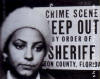 FRANCES MESSIER :
Frances Messier stands outside Bundy's room in the Oak where she was also a
lodger. She saw him on an almost daily basis and once went out to dinner
with him. |
|
|
Lee ordered the driver to get out and lie die. But as the suspect obeyed,
he kicked the policeman's legs from under him, and took to his heels. Lee
pulled out his gun and fired; the man collapsed on the pavement. But as
Lee bent over him, the man hit him on the jaw. They struggled for a few
moments, then Fee finally managed to snap the handcuffs on the man's wrists.
As they drove off towards the police station, the handcuffed man remarked
gloomily, 'I wish you'd killed me.'
Back at the station, the suspect insisted that his name was Kenneth Misner and
supported his story with identification papers and a birth certificate.
But the police soon learned that the papers had been stolen from a real Kenneth
Misner in Tallahassee. It was another 24 hours before the Pensacola
interrogators discovered - through overhearing the prisoner's phone
conversations - that they had arrested a man named Ted Bundy. |
|
|
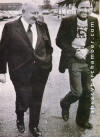 RECAPTURED IN PENSACOLA :
Captain Harper of the Pensacola police escorts Bundy from the circuit court
shortly after he was recaptured.. |
|
|
In the early hours of the morning, a demoralised and exhausted Bundy talked into
a tape recorder. His aim, he explained, was to try and make his
interrogators understand his problem. It had all started, he said, when he
had seen a girl rising a bicycle: 'I knew I had to have her.' And although
she had escaped, his future course was now determined. 'Sometimes I feel
like a vampire,' he said, but he denied responsibility for the Chi Omega attack.
It was nearly two months later, on 7th April 1978, that a highway patrolman
looked into an old shed near the Suwannee River State Park and saw a foot
wearing a sneaker. It was the naked, decomposing body of Kimberly Leach.
Injuries to the pelvic region suggested sexual attack.
The cause of death was homicidal violence to the neck region. One sickened
lawman declared, 'We're gonna send that Bundy to the electric chair.' But
Bundy's hour of weakness had passed. He was once again insisting on his
total innocence, and that his apparent connection with a chain of sex murders
was pure coincidence. |
|
|
BUNDY IN COURT :
Bundy with his legal knowledge was eloquent and confident in court. He
maintained his innocence and insisted that he was the victim of a series of
bizarre coincidences, rather than a serial sex killer. |
|
|
Bundy was right about one thing. All the evidence against him was
circumstantial - all, at any rate, except for the bite on Lisa Levy's left
buttock.
Three weeks after Kimberly Leach's body had been found, policemen held the
struggling Bundy down and took an impression of his teeth. Although this
impression would eventually convict Ted Bundy of Lisa Levy's murder, he fought
back on a legal technicality.
A forensic odontologist, Dr Richard Souviron, had used Bundy's impression as an
example at a forensic seminar. Dr Souviron claimed that 'this suspect's
teeth matched the bite marks on the victim's buttock'. The media got hold
of the story, and although no names had been mentioned at the seminar, the media
knew, because of the details, who Souviron was referring to and ran the story.
Bundy asked for this evidence to be dismissed as it would prejudice the trial.
His request was denied. |
|
|
THE MANY FACES OF BUNDY :
A man of many guises, Bundy's appearance changed regularly. His surviving
victims often failed to recognise him in identification parades. He was a
chameleon, his looks, character and even his name being changed to suit his
circumstances. Some of his many face;
1) In 1975 he was the smiling
college graduate
2) As a convict in Salt Lake City
3) In Jail in 1977
4) Back in jail after being
recaptured in 1978
5) A few days after he was caught
for the Chi Omega killings in Florida. |
|
|
According to the defence, the warrant that led to Bundy having his teeth
impressions taken forcibly had been obtained without sufficient reason as Bundy
was not suspected of the Chi Omega murders at the time. The request was
dismissed.
Once again, Bundy had decided to act as hi sown defence lawyer, and his delaying
tactics succeeded in getting his trial postponed from October 1978 to June 1979.
Then he changed his mind and decided to accept a defence team. On 31st May
1979, after Bundy had filed a secret motion, he and his defence team had a
private meeting with the judge in his chambers. The details of the meeting
were not disclosed, but rumour had it that plea bargaining was involved.
According to the Deputy State Attorney, Jerry Blair, Bundy was apparently
prepared to admit his crimes and plead guilt to the murders of Lisa Levy,
Margaret Bowman and Kimberley Leach. In return, he would face the lesser
charge of second degree murder, which did not carry a death sentence. So,
although Bundy would have faced three consecutive 25 year sentences in jail, he
would escape the electric chair. |
|
|
COURTROOM JOKES :
Having already received two death sentences,
Bundy was still able to laugh at a courtroom joke. |
|
|
Bundy withdrew his motion at the last minute and sacked his defence team.
claimed that one of them, Mike Minerva, was trying to coerce him into admitting
his guilt. Under the circumstances, the state attorney refused any further
plea bargaining. It was the third major mistake of Bundy's criminal
career. The first two had been the careless driving offences that had led
to his two arrests. This third mistake would prove fatal.
The trial began on 7th July 1979, and Bundy scored an initial success by having
the trial moved from Tallahassee to Miami, on the grounds that Tallahassee
jurors would be prejudiced. But from then on, Bundy was losing ground
fast. The evidence against him was damning.
There was Nita Neary, who had seen him leave the sorority house; and the
stocking mask found in the room of Cheryl Thomas, which was virtually identical
with the one found earlier in Bundy's car. Above all, there was evidence
of the teeth impressions - dental experts testified that the bite marks found on
Lisa Levy's left buttock matched Bundy's teeth. |
|
|
THE DEFENCE :
Bundy made life almost impossible for his defence, and it was undoubtedly his
interference that finally led him to the electric chair.
While still in jail in Colorado, Bundy contacted attorney
Millard Farmer, founder of Team Defense, an organisation for helping murderers
faced with the death penalty. Bundy and Farmer became friends. When
he heard that Bundy had been arrested in Florida, Farmer groaned, 'He's got
himself arrested in the Death Belt of America, And Florida is its buckle.'
To Bundy's fury, Farmer was not allowed to defend him in Florida - his
reputation for courtroom histrionics had influenced the judge against him.
But it was Farmer who negotiated a deal with the prosecution. If Bundy
would plead guilty to three murders, there would be no death penalty.
Bundy agreed, then changed his mind. He sacked his defence team and took
on the role himself. In spite of a brilliant final defence speech by
Public Defender Margaret Good (sitting next to Bundy in photograph), he lost. |
|
|
Bundy scored a success when the judge ruled that the tapes of his confessions to
the Pensacola police were inadmissible because his lawyer had not been present.
But while Bundy himself continued to believe he was doing well, no one else in
court could doubt that that the case against him was overwhelming.
Public Defender Margaret Good made a powerful speech in Bundy's defence, but on
23rd July 1979, the jury took only seven hours to find him guilty on a long list
of indictments.
Asked if he had anything to say, Ted Bundy put on another of his displays of
injured innocence, and replied with tears in his voice: 'I find it somewhat
absurd to ask for mercy for something I did not do.' |
|
|
BUNDY'S ANTICS :
Acting as his own defence lawyer, Bundy examines enlarged photographs of his own
teeth, which the prosecution claimed matched bite marks found on Lisa Levy's
buttock. |
|
|
Judge Edward D. Cowart sentenced Bundy to die by electrocution, concluding, 'I
bear you no animosity, believe me. But you went the wrong way, pardner.
Take care of yourself.'
The first of many books on Ted Bundy concluded with those same words. But
the Bundy story was by no means over. From the Raiford Penitentiary, where
he was placed on death row, Bundy continued to fight for his life. On 7th
January 1980, he was tried in Orlando for the murder of Kimberley Leach.
Medical evidence indicated that the girl had been raped in the van, dressed
again, then taken to the hut and assaulted again - it appeared that she had been
stripped and sodomized. |
|
|
NITA NEARY :
Nita Neary said she believe Bundy was the man she saw on the night of the Chi
Omega murders. Bundy's defence team tried to prevent her from giving
evidence, but the judge overruled them. |
|
|
On 7th February 1980, Bundy was again found guilty. Again, he burst into
tears. Two days later, he married a girl named Carole Boone, a divorc�e
with a teenage son. He had met her some years earlier and she had stuck by
Bundy, after Meg Anders had left him.
Time ran out for Bundy. His appeal had been turned down, and the date set
for his execution. At 7am, on 24th January 1989, Bundy with his head
shaved clean, was led into the execution chamber at Starke Prison, Florida.
Behind a glass wall, an invited audience was waiting to witness his death.
His arms were strapped to the chair and straps were placed around his chest and
over his mouth. A steel cap was fastened to his head.
At 7.07am, the executioner threw the switch, and Bundy's body strained in the
chair. A minute later, the current was switched off, and Bundy was
pronounced dead. Outside, a crowd cheered as the execution was announced. |
|
|
LOUISE BUNDY :
Louise Bundy, Ted's mother, spoke to her convicted son on death row for the last
time on the night before he was due to die in the electric chair. Her last
words to him were, 'You will always be my precious son.' |
|
|
 Carole Ann Boone had a baby
by Ted Bundy. Although conjugal visits are not allowed, prison guards will
turn a blind eye, perhaps having been bribed, and allow couples to be intimate.
The baby was a girl and looked like her father.
The final number of Bundy's
victims will never be known. Although he was officially a murder suspect
in five states, Bundy told detectives that he had killed in six states.
The FBI estimated that there had been 36 victims. Bundy told them to add
one digit.
In 1974, the police 'lent' the
remains of Denise Naslund to her mother, Eleanore Rose. The remains were
placed in a pink casket for a memorial service and then returned to the police
for the purpose of evidence. The police lost the remains and Eleanore Rose
sued, winning undisclosed damages. In 1988, some of Denise's favourite
possessions, along with a note from her mother, were placed in a pink casket and
given a final memorial service. |
|
|
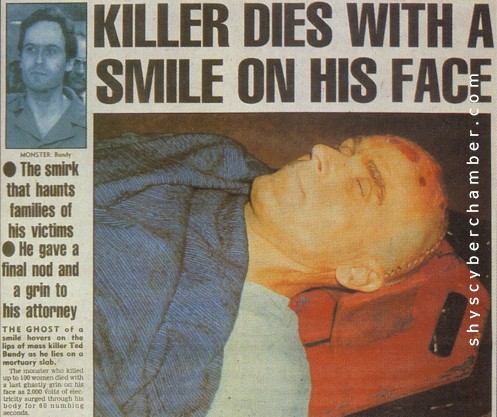
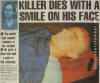 KILLER DIES WITH A SMILE ON HIS FACE :
Pictures of Ted Bundy's body, showing the shaven head and burn marks from the
electrodes, appeared in many newspapers. |
|
|
The remains of two of Bundy's
victims have never been named - identification was impossible. When the
police asked Bundy for help he refused and said there were three victims that he
would not name.
After Bundy made the
headlines, a number of women claimed that they had been attacked by Bundy, but
had managed to escape. Some of the claims were true - they could be
substantiated; others were doubtful, the attacks having taken place when Bundy
had been known to be in another state. One of the most moving claims came
from Ann Marie Burr's parents. Aged nine, she had disappeared without
trace one morning while the 15 year old Bundy was on his paper round in Tacoma.
Bundy was not suspected of the crime at the time - there was nothing to link him
with her disappearance - but, in retrospect, it seems likely that she was
Bundy's first victim. |
|
|
BACK TO TOP |