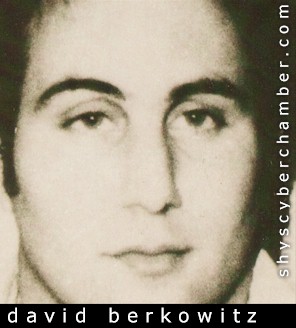
|
|
The first time police considered the possibility
that there was a serial killer on the loose came a month later. Shortly after
midnight on 27th November, sixteen year old Donna DeMasi and her friend,
eighteen year old Joanne Lomino, were walking home from the cinema. Donna
noticed a man standing in the shadow of a lamp post and said: 'Joanne, there's a
guy watching us over there. He's kind of scary. Let's walk faster.'
The two girls were only a couple of hundred yards from Joanne's house but, as
they quickened their pace, they were aware that the man was following them. As
they reached the front door and Joanne started to fumble with her keys, the man
walked towards them, pretending to ask for directions. 'Say, could you tell me
how to get to...' he said.
Joanne and Donna, still nervous, ignored his question and turned back to the
door. As they did so, the man pulled a gun from his waistband and fired twice.
The first round smashed in Joanne Lomino's spine; the second passed through the
base of Donna DeMasi's neck. The girls managed to stumble into some bushes, as
the gunman let fly three more rounds, all of which missed.
Donna and Joanne were rushed to the Jewish Hospital in Queens, where Donna was
found to be suffering from a broken collar-bone but was soon able to make a
complete recovery. Joanne was less fortunate. A bullet had severed her spinal
column and she was paralysed from the waist down.
The similarities between this attack and the Lauria/Valenti shootings were
obvious. In both cases the victims had been young, pretty and of Italian
extraction; both sets of victims had been returning home late at night; both had
been attacked by an unknown assailant armed with a .44 Bulldog revolver. But
there was a problem. Jody Valenti had described her attacker as having curly
black hair, whereas both Joanne Lomino and Donna DeMasi were certain that the
man who attacked them had shoulder-length blonde hair. This description was
confirmed by an independent eye-witness who had seen a man running away from the
scene of the crime, carrying a handgun. |
 |
[
Christine Freund ]
Christine Freund was shot while sitting in a parked car with her boyfriend,
John Diel, who survived the attack. Christine was hit in the right temple and
neck. She never saw her killer. |
|
|
On the night of 29th January 1977, eight weeks
after the shooting of Lomino and DeMasi, twenty six year old Christine Freund
was out on a date with her boyfriend, thirty year old John Diel. They had been
to see the new hit movie Rocky and then gone on to a wine bar in Queens for a
late supper. Midnight found the young couple parked in a side street in John's
Pontiac Firebird. It was a cold night and their breath had fogged up the
windows. Suddenly there was a roar of gunfire and the car's passenger window
disintegrated. This first shot was followed by a second and third. Christine
slumped forward onto the dashboard with two bullet wounds to her head. Diel
staggered out of the car, unhurt but hysterical. He tried to flag down passing
cars but no one would stop. Finally someone did call the police and an ambulance
rushed to St John's Hospital, but she died four hours later. |
|
|
[
John Diel ]
German born John Diel, aged thirty survived the .44 killer's fourth
attack which killed his girlfriend Christine Freund. The police did
not realise they were dealing with a serial killer and Diel himself
came under suspicion. |
|
|
The suddenness of the attack and the fogged
windows meant that Diel was unable to furnish police with a description of the
attacker. Again ballistics established that the gunshots had been from a .44
Bulldog revolver, but there the similarity with the earlier killings ended. |
|
|
[
Virginia Voskerichian ]
She died instantly when Berkowitz shot her at point blank range in the face.
She raised some books she was carrying in a vain attempt to protect herself from
the bullet. |
|
|
The next shooting came five weeks later, on 8th
March, in the middle class New York suburb of Forest Hills. It was shortly after
7.30pm and Virginia Voskerichian, a Russian language student, was walking home
after a day in the library of Columbia University. She had a pile of text books
under her arm as she strolled along Exeter Street.
Suddenly she found herself face to face with a young man walking in the opposite
direction. Virginia stepped to one side to allow the man to pass, but instead he
pulled a revolver and aimed it at her head. Virginia tried to shield her face
with her books, but the gunman was less than three feet from her when he pulled
the trigger. The bullet tore through the book, passed through Virginia's upper
lip, shattered her front teeth and lodged in her skull alongside her spinal
cord. Virginia staggered back into a clump of bushes and died almost
immediately.
When the police arrived in Exeter Street an eyewitness described a young man he
had seen running from the direction of the dead girl. He was, the witness said,
young, about five feet eight inches tall, and wearing a black Balaclava helmet.
The description was too vague to allow police to say with any confidence whether
there was a connection between Virginia's murder and the recent spate of
shootings in the New York area. The following day, however, the situation
changed dramatically. Detailed examination of the bullet extracted from
Virginia's brain revealed it bore distinctive markings that confirmed beyond any
doubt that it had been fired from the same gun as the one that had killed
Christine Freund. Further ballistic investigation indicated that the gun had
also been responsible for the Valenti/Lauria and the Keenan/Denaro shootings.
There was no longer any doubt: there was a serial killer loose in New York.
Within days of the murder of Virginia Voskerichian, police announced the
formation of 'Operation Omega', a task force under the leadership of Deputy
Inspector Timothy Dowd. Their sole brief was to identify and arrest the man they
nicknamed the '.44 killer'.
The Omega team were immediately deluged with phone calls - at the peak of the
investigation these averaged at more than 5,000 per day. Most of the calls were
from well-meaning, public-spirited citizens, whose sole aim was to help the
police with their investigation. But these legitimate callers were interspersed
with a host of cranks, hoaxers, malicious mischief-makers, disgruntled
neighbour's, spurned wives and deranged individuals anxious to confess to any
highly publicized crime. The result was that the task force was vastly
overstretched and progress was nil.
Deputy Inspector Dowd was in no doubt that if his team failed to identify the
.44 killer, he would strike again. It was a race against time, and that time
finally ran out on 17th April 1977. |
|
|
[
Valentina Suriani & Alexander Esau ]
Valentina Suriani, aged eighteen, died in her boyfriend's lap as Berkowitz
fired through the car window. Alexander Esau was also hit in the head and died
in hospital eighteen hours later. They had been parked very near the spot where
the first victim had been shot. |
|
|
It was just after 3am and eighteen year old
Valentina Suriani and her boyfriend, Alexander Esau, were sitting in his Mercury
Montego in a side street in the North Bronx, a few blocks from where Donna
Lauria had been shot nine months earlier. The couple's passionate embrace was
suddenly and catastrophically interrupted by the roar of gunfire and the
disintegration of the car's passenger window.
The first two shots demolished the top of Valentina's skull, killing her
instantly. The third bullet hit Alexander in the side of the head. He managed to
crawl out of the car before losing consciousness. He died eighteen hours later
in hospital.
Police were soon swarming all over the place. One of the officers noticed an
envelope lying on the pavement a few feet from the car. Breaking every rule of
scene of crime procedure, he picked it up. It was addressed to Captain Joseph
Borelli, Dowd's second in command in the Omega task force. It was the first
tangible clue to the identity of the .44 killer but, by the time it reached the
New York Police Department forensic laboratory, the envelope had been handled by
no fewer that eight pairs of hands. If the writer had left any fingerprints,
they had been long since obliterated. The letter itself had only part prints on
it, as though the writer had held the paper with his fingertips. |
|
|
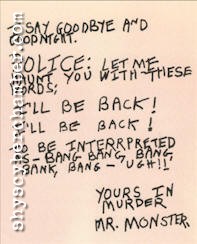 [
Borelli Letter ]
The letter left at the scene of the Suriani/Esau killing, addressed to
Captain Joseph Borelli, might have provided the police with
vital fingerprints - had the envelope not been handled by at
least eight police officers before being sent to the Fingerprints
Section of the New York Police Department. The letter itself had only
bare fingerprint traces, as though the writer had held the paper with
the tips of the fingers. After his arrest, Berkowitz denied that the
purpose of the letter was to gain publicity. |
|
|
The contents of the letter, however, were much
more revealing. It was a rambling, angry, four-page self-portrait written in
block capitals. Experts concluded that it was either the work of a madman, or
someone who wanted to give the impression that he was insane. The author was
particularly indignant at a police psychologist's suggestion that he was a
misogynist.
"I am deeply hurt by you calling me a wemon (sic) hater," he complained. "I
am not. But I am a monster. I am the 'Son of Sam'. I am a little brat. When
father Sam gets drunk, he gets mean. He beats his family. Sometimes he ties me
up at the back of the house. Other times he locks me in the garage. Sam loves to
drink blood... 'Go out and kill', commands father Sam... Behind our houses some
rest. Mostly young - raped and slaughtered - their blood drained - just bones...
I feel like an outside. I am on a different wavelength from everyone else -
programmed too (sic) kill."
Further on in the letter he taunted the police.
"Attention all police: shoot me first - shoot to kill or else keep out of my
way or you will die!" The writer ended the letter: "I say goodbye and goodnight.
Police: Let me haunt you with these words; I'll be back! I'll be back! To be
interrpreted (sic) as bang bang bang bang bang - ugh!!! Yours in Murder, Mr
Monster." |
|
|
[
Jimmy Breslin ]
On 1st June 1977, the New York Daily News's correspondent Jimmy Breslin
received a chilling letter from the Son of Sam.
Rather than print the letter in full, the paper's editor ran a series of
'teaser' articles over the next few days in a bid to increase its
circulation. |
|
|
The very existence of the Borelli letter was kept
secret for several weeks and was used primarily to build up a psychological
picture of the author and to eliminate professional 'confessors' from police
enquiries. One of the few people outside the Omega team who was allowed to read
the letter was veteran New York Daily News columnist Jimmy Breslin. He honoured
his promise to Dowd that he would not publish the contents, but he did refer to
the letter on several occasions in his column.
The .44 Killer obviously read Breslin's column, because six weeks after the
Suriani/Esau killings he mailed a second letter, addressed to the journalist at
his office. Again the letter was long and rambling. |
|
|
[
Breslin Letter ] |
|
|
"Mr Breslin, sir," it started, "I don't think
that because you haven't heard from (me) for a while that I went to sleep. No,
rather I am still here. Like a spirit. Thirsty, hungry, seldom stopping to rest;
anxious to please Sam. I love my work. Now, the void has been filled." He signed
the letter: "In their blood and from the gutter. 'Sam's Creation' .44"
Then in a bizarre postscript in which he pretended to give the Omega team a few
hints: "Here are some names to help you along. Forward them to the police for
use by the N.C.I.C: 'The Duke of Death', 'The Wicked King of Wicker', The Twenty
Two Disciples of Hell', 'John Wheaties - rapist and suffocater of young girls'.
PS: J.B. Please inform all the detectives working the slayings to remain."
A week after Breslin received his letter, on 6th June, The Daily News published
an edited version of it. The net result of this was the newspaper achieved a
record circulation of 1,116,000 copies, there was a massive public outcry about
law and order in New York, and the .44 Killer was re-christened 'Son of Sam'.
The police, however, were no closer to catching him. |
|
|
[
Salvatore Lupo ]
Salvatore Lupo at the Elephas disco, where he spent the evening with Judy
Placido before they were both shot. |
|
|
On 26th June 1977, three weeks after the
publication of the Breslin letter, Son of Sam struck again. Judy Placido, a
seventeen year old school girl, spent the evening at the Elephas Discotheque in
Queens. She was celebrating her high school graduation. She had been a classmate
of one of Son of Sam's most recent victims, Valentina Suriani, and had attended
her funeral.
Judy left the club with a young man called Salvatore Lupo. The couple drove off
in Sal's car and parked in a side street. They were actually discussing Son of
Sam when the side window of the car disintegrated.
"All of a sudden," Judy said later, "I heard echoing in the car. There wasn't
any pain, just ringing in my ears. I looked at Sal and his eyes were wide open,
just like his mouth. There were no screams. I don't know why I didn't scream,
I'll never know, I just didn't."
It was not until she looked in the rear view mirror and saw her face covered
with blood, that Judy realised that she had been shot. In fact she had been hit
three times in the head, neck and shoulder. Sal had been shot in the right
forearm. They both got out of the car. Judy collapsed almost immediately, but
Sal managed to reach a bar and raise the alarm.
Both Judy and Sal recovered from their injuries, but they could not give the
police a description of their attacker, who was automatically assumed to be Son
of Sam. One witness did come forward to say that he had seen a stocky young man
running away from the general direction of the shooting, but even if this was
the attacker it told the police nothing useful. |
|
|
[
Stacy Moskowitz ]
Stacy Moskowitz and Robert Violante had no idea they were in such terrible
danger. Stacey was a twenty two year old telex operator. She was hit by two
bullets, one grazing her scalp and the other lodged in the back of her brain,
but she was still conscious when the first ambulance arrived. |
|
|
On 31st July 1977, Son of Sam killed for the last
time. It was a year and two days after his first attack, which had resulted in
the death of Donna Lauria. Twenty two year old Stacy Moskowitz, a telex
operator, spent the evening at the cinema with her new boyfriend Robert Violante.
After the film, the couple went for a meal and then drove off in Violante's
Buick to the softball ground on Shore Parkway, a favourite spot for courting
couples. They were kissing when the gunfire started. Violante did not hear the
shots. 'I heard like a humming sound. A humming. A vibrating. First I head glass
break. Then a humming. hen I didn't hear Stacy anymore. I didn't feel anything,
but I felt her fall away from me.' |
|
|
[
Robert Violante ]
Robert Violante and Stacy Moskowitz were taken by surprise when the gunman
fired into their car at point-blank range. The attack left his girlfriend dead
and him blinded for life. |
|
|
What had happened in fact was that Robert Violante
had been shot twice in the face, which had both blinded him and caused his ear
drums to implode. He later partially recovered his hearing but he was blinded
for life. Stacy, who had been shot once in the head, died in hospital 36 hours
later.
Another young couple, Tommy Zaino and Debbie Crescendo, were sitting in a car
that was parked a few yards ahead of the Buick, and witnessed the attack in
their rear-view mirror. They saw a stocky young man with stringy fair hair
approach Violante's car from behind. He had crouched by the passenger window and
fired four shots into the car. The gunman had then run out of the park. The time
of the attack, according to Zaino, was exactly 2.35am.
The Omega team now had two descriptions of a man with longish blonde hair, and
two that spoke of dark, curly hair. There were two possibilities. Either Son of
Sam was wearing a wig for some of the killings or, more alarmingly, they were
dealing with two separate killers using the same gun.
A host of other witnesses came forward who had been in the region of Shore
Parkway in the early hours of 31st July. Several of them mentioned a yellow
Volkswagen that had been parked nearby and had sped of at great speed shortly
after the shooting. One couple had seen a young man wearing a denim jacket and
what they thought to be a cheap, blonde wig jump into a pale coloured sedan and
drive off. |
|
|
[
Cecilia Davis & Snowball ]
At about 2.30am Mrs Cecilia Davis took her dog Snowball for a
walk along the softball park where Robert Violante and Stacy
Moskowitz were attacked. On her way home she saw a dark-haired
man walking away from the park and she recognised him as the
driver of a Ford Galaxie that had parked there earlier. |
|
|
The most important witness, Mrs Cecilia Davis, did
not come forward immediately, however. Two days after the Moskowitz/Violante
shootings, Mrs Davis a forty nine year old widow, told a close friend that she
was certain that she had not only seen, but had also been seen by, Son of Sam.
Her reluctance to contact the police was based on sheer terror and the
understandable assumption that the killer might come looking for her if he knew
she was a threat. Her friend, however, managed to persuade her to exercise her
civic duty and, on 2nd August, three days after the shooting, Mrs Davis finally
contacted the police.
A few hours later, Mrs Davis was visited by Detective Joseph Strano from the
Omega task force. Ms Davis gave him a detailed account of what she had seen on
the night of 21st July. She had returned home at about 2am and was sitting in a
friend's car, which was double parked outside her apartment, a block away from
the Shore Parkway softball ground. |
|
|
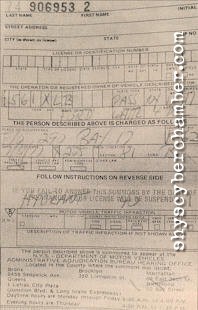 [
The Parking Ticket ]
The crucial witness in the Son of Sam case, Cecilia Davis spoke three days
after the Moskowitz murder.
A day and a half of interviewing by Detective Strano, Mrs Davis produced the
evidence that would trap the Son of Sam. Asked whether there was anyone else in
the street when she left her apartment, she mentioned two patrolmen - one in the
car, another outside, writing parking tickets. Strano was sceptical; according
to reports, no tickets had been issued in that neighbourhood that night. But a
search finally turned up the summons that led to Berkowitz. |
|
|
As Mrs Davis was about to get out of the car, she
had noticed a yellow Ford Galaxie parked beside a fire hydrant some distance
behind. A young man had walked up to the car and ripped a parking ticket from
the windscreen, shoved it into his pocket and then climbed behind the wheel.
Seconds later, the Galaxie had pulled up behind the car in which Mrs Davis was
sitting, and the driver, unable to pass, had tooted his horn. Mrs Davis hurried
out of the car and, as she headed for her front door, she had looked more
closely at the driver of the Galaxie. He was a white male in his early twenties
with thick, black, curly hair.
A few minutes later, just before 2.30am, Mrs Davis had come out of her apartment
again and taken her dog for a walk across the softball park. She had noticed
three cars parked there. Two of these were later confirmed as having belonged to
Robert Violante and Tommy Zaino. The third was a yellow Volkswagen. On her way
back home from the park, Mrs Davis said that she had seen a dark haired young
man dressed in a denim jacket striding across the street, away from the parked
cars. The man had looked at her and glared. Mrs Davis was certain that he was
the same man she had seen earlier driving the Ford Galaxie.
Initially, Detective Strano showed little interest in the Ford Galaxie. If Mrs
Davis was right, the car and its driver had left the scene at about 2.20am, a
full fifteen minutes before the shooting. And the man in the denim jacket who
had glared at her did not match the description of the gunman furnished by Tommy
Zaino. But being determined to tell her story, Mrs Davis proved a persistent
witness, and Strano decided to check all parking tickets issued by the local
police on that night. |
|
|
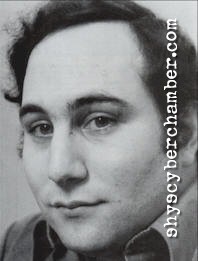 [
David Berkowitz ]
A photograph taken of Berkowitz taken in 1979 during an interview in Attica
Prison. He was never sure of his identity and suffered terrible feelings of
rejection.
He took his hatred out on those he felt rejected him most - young women. |
|
|
The search was conducted with no real sense of
urgency since Strano and his colleagues were convinced that the missing
Volkswagen was the killer's vehicle. On 9th August, however, ten days after the
shooting, the citation finally surfaced. It had been issued at 2.18am on 31st
July to a yellow Ford Galaxie. The car was registered to a David Berkowitz of 35
Pine Street, Yonkers, New York.
Detective James Justus of the Omega task force was assigned to run a check on
Berkowitz. He telephoned the Yonkers police headquarters and his call just
happened to be taken by an operator called Wheat Carr. He told her that he
wanted to make enquiries about David Berkowitz in connection with the Son of Sam
killings. There was a long silence and Wheat Carr muttered: 'Oh my god!'
When the operator recovered her composure, she explained that not only was David
Berkowitz known to the Yonkers police department, he was also known to her
family. Berkowitz was a neighbour of her father, Sam Carr, and over the past few
months her family had been terrorised by him. Berkowitz had sent them anonymous
letters, had fire-bombed their house, had shot their dog and had accused them of
witchcraft. Of course her father had notified police, but he was never able to
prove his accusations and so no action had ever been taken against Berkowitz.
Other complaints about Berkowitz's behaviour had also been registered with the
police. These ranged from threatening conduct to malicious damage, but none of
them had been serious enough to arouse the interest of the over-stretched
Yonkers police department. |
|
|
[
David Berkowitz ]
David Berkowitz's pasty face appears to be permanently set in a vacant smile.
Obsessed by violent sexual fantasies as a young teenager, he remained a loner,
dropping out of high school and briefly serving in the army. At the age of
twenty one he started lighting fires, keeping a meticulous record of 1,488 arson
attacks. Then he turned to murder. |
|
|
The Omega task force was still not viewing David
Berkowitz as a serious contender for Son of Sam when, on Wednesday 10th August
1977, they despatched detectives Ed Zigo and John Longo to Yonkers to interview
him.
When the two detectives arrived at Berkowitz's Pine Street address, the first
thing they noticed was his yellow Ford Galaxie parked outside the apartment
block. Detective Zigo decided to search the car. On the back seat he found a
duffle bag containing a Commando Mark 111 semi-automatic rifle with four loaded
magazines, an Ithaca 12-gauge shotgun and two .22 rifles. Then Zigo looked in
the glove compartment and found an envelope. Written in block capitals, it was
addressed to his boss, Deputy Inspector Timothy Dowd. Zigo was no longer in any
doubt. He called Omega headquarters and said: 'We've got him.' |
|
|
 [
David Berkowitz ]
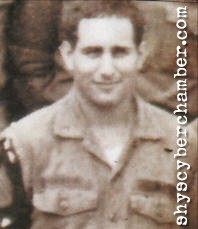
After school, Berkowitz joined the US Army. He qualified as a sharpshooter
with an M-16 rifle and went to Korea. There he became a Baptist. |
|
|
Other police officers from Omega were soon on the
scene. They were fairly sure that Berkowitz was in his apartment and he was
probably armed. They decided to stake out the building and wait for Son of Sam
to show up himself.
Six hours later, at 10pm, David Berkowitz, a plump, dark haired, young man,
walked out of the apartment block and made for the Ford Galaxie. He was carrying
a triangle shaped brown paper bag. The waiting detectives had no doubt as to the
nature of its contents. They allowed Berkowitz to get into his car and, just as
he was starting the engine, Detective William Gardella walked up and tapped on
the driver's window. 'Freeze, Police!' he shouted. |
|
|
[
David Berkowitz ]
David Berkowitz called a news conference at his prison in 1980, demanding the
right to handle his own legal affairs. Sentenced to spend the rest of his life
behind bars, he had abandoned his defense of madness and admitted that he had
carefully planned each attack. |
|
|
Berkowitz appeared totally unconcerned. 'The guy
turned around and smiled at us,' said Gardella later. 'He had this stupid smile
on his face, like it was all some kid's game.'
Berkowitz continued to grin at Gardella as Detective John Falotico opened the
car door and pressed his .38-calibre service revolver into Berkowitz's temple.
Berkowitz climbed out of the car and placed his hands on the roof.
'Now that I've got you,' Falotico asked, 'what have I got?'
'You know,' Berkowitz replied.
'No, I don't. You tell me.'
'I'm Sam,' Berkowitz beamed. |
|
|
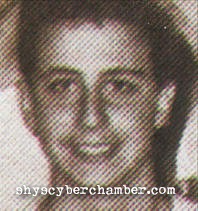 [
David Berkowitz ] |
|
|
The podgy, twenty four year old postal worker was
taken down to police headquarters, where he cheerfully confessed to all the Son
of Sam shootings, starting with Donna Lauria and ending with Stacy Moskowitz.
Not only was he totally co-operative, he also transpired to have an incredible
memory. He described each shooting in minute detail, and left detectives in no
doubt that he was indeed the sole culprit of the shootings. |
|
|
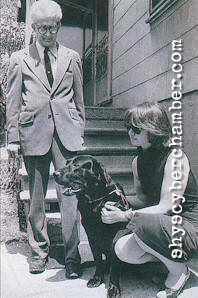 [
Sam Carr, Wheat Carr & Harvey ]
David Berkowitz invented a bizarre story that his neighbour's dog, Harvey,
was a demon that had possessed him. |
|
|
Berkowitz was particularly anxious to explain his
motive for the killings. He was, he said, acting on the orders of his neighbour,
Sam Carr - hence his nom de plume 'Son of Sam'. These orders to kill were not,
however directly from Carr, he explained, but were transmitted to him by Carr's
demon dog, a black Labrador called Harvey, the same dog which Berkowitz had shot
and wounded some months earlier.
Despite Berkowitz's bizarre behaviour, his defense team's attempt to establish
his insanity failed. Several eminent psychiatrists were unanimous in their
opinion that Berkowitz was faking insanity, and that he was perfectly fit to
stand trial.
At his arraignment on 23rd August 1977, David Berkowitz - Son of Sam - pleaded
guilty to six counts of murder. He never faced trial, but was sentenced to a
total of 365 years in prison with no possibility of parole. |
|
|
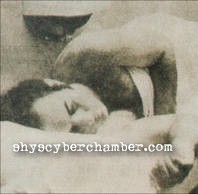 [
David Berkowitz ]
A full page photograph of David Berkowitz asleep in his cell in
Kings County Hospital appeared under the headline in red print:
SAM SLEEPS. |
|
|
On 10th July 1979, David Berkowitz was the victim
of a razor attack in the Attica cell block reserved for high-risk prisoners.
Another inmate slashed him with a razor, making a cut from the left side of his
throat to the back of his neck, which required 56 stitches. If the cut had been
slightly deeper, it would have killed him. Berkowitz declined to say who had
tried to kill him. He later expressed the opinion that the attempt had been
inspired by the 'occult' group with which he had been involved in a belated bid
to ensure that he kept his vow of silence. |
|
|
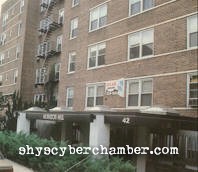 [
Berkowitz's Apartment Block ]
In the wake of the Berkowitz murders, the landlord of his Yonkers apartment
block changed the buildings number to deter ghoulish souvenir hunters. |
|
|
After the Son of Sam murders, Berkowitz's
apartment block became a place of pilgrimage for sensation seekers. They stole
doorknobs, cut pieces of carpet, even chipped pieces of paint from Berkowitz's
door. In the middle of the night, people shouted, 'David, come out' from the
street (even though he wasn't there).
In short, it was a remarkable example of what Bertold Brecht once described as
the 'criminal-as-hero' syndrome. After his arrest, Berkowitz's apartment
remained empty, and a quarter of the building's tenants moved out, even though
the landlord changed its number from 35 to 42 Pine Street to try and mislead
souvenir hunters. |
|
|
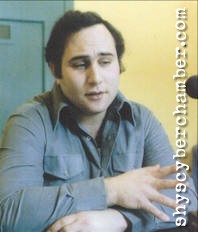 [
David Berkowitz ]
In February 1979, David Berkowitz held a press conference at Attica Prison at
which he claimed that his story about Sam Carr and demon possession had been a
hoax. He said he had brought the .44 pistol, knowing precisely what he intended
to do. |
|
|
In a 1993 interview for American TV, Berkowitz,
speaking from prison, apologized for the murders. The forty year old said: 'I
did take some lives and I'm very sorry for that.' Berkowitz is believed to be a
born again Christian, buying bibles to send overseas. |
|
|
BACK TO TOP |