|
|
However, who can condemn the media circus that followed? For perhaps it was not the
blood and gore and spittle of the usual sensationalism that often follows a murder. Here,
there was more. The graveyard, being dug up by the shovels-full, was unearthing more than
bone. With each stab of a shovel into the dirt humankind itself was feeling the eerie pain
of reality: that there exists in a dark corner of Man a skeleton that may come out of the
closet at any moment, shouting.
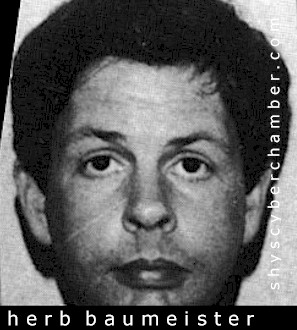
The killer, the psycho, the demon, whatever you want to call Herb Baumeister, was a man
with a surface so normal that, when his deeper psyche was discovered, made those who knew
him wince. He was a family man, an entrepreneur who supported local charities. He looked
normal and talked normal…until you really got to know him.
"He fit all the components of a serial killer," Vandagriff says in a
not-at-all- surprised tone, "among them the ability to keep his crimes in control and
silent under an everyday nonchalance. He was a business owner whose store many townspeople
frequented. My own office was only a mile and a half away from his place. I never met him,
but from what I understand he wasn’t the type of guy you’d at first suspect of
being a sexual psychopath."
Vandagriff pauses and thinks about what he just said. In addition, his voice that reeks
of experience in dealing with the darkest side of humanity, grows more assertive as he
adds, "The danger signals are always there in people of Baumeister’s caliber.
Trouble is the public ignores them. In Baumeister’s case, even his wife ignored them.
Lethargy - it’s the serial killers’ greatest strength."
The following story is based on a couple of existing sources, but is very largely a
product of an interview with Vandagriff who shared his reminiscences and insight with Dark
Horse Multimedia. His input helped to, you pardon the expression, flesh out the skeleton
of a truly macabre but remarkable story in the annals of America’s serial killings.
Herbert Richard Baumeister was born April 7, 1947, to Dr. Herbert E. and Elizabeth
Baumeister in the Currier & Ives Butler-Tarkington area of Indiana. A sister, Barbara,
was born in 1948 and two brothers followed after, Brad in 1954 and Richard in 1956. As the
father’s medical practice progressed -- he was an anesthesiologist -- the family
eventually moved to affluent Washington Township.
Herbert’s childhood seemed normal, according to the book, Where the Bodies are
Buried, by Fannie Weinstein and Melinda Wilson. However, they continue, "by the
time he reached his adolescence, it became apparent that something about him wasn’t
quite right." A close school pal named Bill Donovan recalled that Herb would fall
into strange reveries, often pondering repulsive things like what it would be like to
taste human urine. And doing strange things. One morning on the way to school, he picked
up a dead crow that had been hit by a car, shoved it in his pocket, then while the teacher
wasn’t looking dropped it on her desk.
Irresponsible and often combustive, Herb’s behavior soon caught the attention of
his father, who secreted his son off to mental examinations. A lengthy series of tests
eventually diagnosed the boy as schizophrenic, having a two-or-more-sided personality
base. However, there is no record of further treatment.
Because his high school, North Central, focused on sports activities, pedantic bookish
Herb could not become part of the "in" crowd. He tried to be one of the bunch,
but, "he just didn’t blend in," recalls Donovan. He withdrew to himself and
spent many hours alone. As for his interest in dating, friend Donovan answers, "Zero,
I never saw him date."
In his college years, he remained as ever directionless. He dropped out in his freshman
year, returned for a semester here and there throughout the next four years, but never
graduated. Nevertheless, through his father’s persistence -- his father was a
respected man in town -- the Indianapolis Star, the major newspaper, hired teenage
Herb on as a copyboy. Garry Donna, an advertising executive who worked for the paper,
remembers that Herb was "sensitive" as to the way he was viewed and treated by
the higher ups. He obsessively wanted to be somebody. He dressed well and was eager --
but, again, did not fit in.
One odd incident occurred when Herb offered to drive Donna and his friends to the IU
football game in hopes that he might become one of the gang. When the day came, he showed
up in a hearse, probably acquired through connections with the hospital where his father
worked, and, with lights flashing, raced to the game, laughing all the way. "People
started pulling off the road," recalls Donna. "He even wore a chauffeur’s
cap. He thought it was kind of funny." Donna, however, his friends and their dates,
wondered what kind of oddball was at the steering wheel.
And the weirdness continued. Say Weinstein and Wilson, "It wasn’t long after
he started working at the Bureau of Motor Vehicles -- another job his father is rumored to
have secured for him -- that Herb began...ranting and raving at fellow employees for no
apparent reason...His tenure over the years (marked) odd behavior, according to former
co-workers and others." One Christmas he "raised eyebrows" by sending
co-workers a card with a photo of him and another guy dressed in drag.
Despite his in-house personality conflicts and erratic deployment, the bureau
nonetheless noticed an apparent go-get-‘em attitude mixed with a high degree of
intelligence; it wasn’t long after that he earned the title of program director.
Where others might have at this point taken the challenge with an exerted professionalism,
Herb’s antics increased and flourished. "Herb had displayed what those who knew
him characterized as a bizarre sense of humor," Weinstein and Wilson attest.
"While at the BMV, it took the form of urinating on his boss’s desk...It was no
secret around the office who the culprit was: Still, Herb somehow managed to avoid being
fired (until) he urinated on a letter addressed to the Governor of Indiana."
In November, 1971, Herb had married Juliana (Julie) Saiter in the United Methodist
Church in Indianapolis. Julie was a college graduate and was introduced to him by a mutual
friend. She was attracted to the tall, light haired, boy-faced Baumeister and, in their
initial chat, they discovered they shared many things in common. Both were Young
Republicans and both yearned to have their own business one day.
Julie quit her job as a high school journalism instructor in the latter half of the
1970s to concentrate on having a family. Besides, Herb was earning decent wages at the
BMV. Three children followed: Marie in 1979, Erich in 1981 and Emily three years later.
When Herb was asked to leave the BMV, the ever-faithful Julie returned to teaching to
supplement her husband’s income through an assortment of odd jobs. He eventually
wound up working for a thrift shop and, although he felt menial at first, soon realized
the potential available in a place like that. He and Julie talked it over and, based on
Herb’s acquired knowledge of running such an outlet over the three years he worked
there, decided to invest what money they had into their own store. They borrowed $4,000
from Herb’s now-widowed mother and in 1988 opened Sav-a-Lot Thrift in conjunction
with the highly respected Children’s Bureau of Indianapolis, a centenarian charity
benefiting the area’s families.
The shop, located on 46th Street, sold used clothing, household goods and a number of
second-hand items. The inventory technically belonged to the charity, which in turn
received a contracted percentage of the proceeds. Shoppers found the Sav-A-Lot tidy and
offering only quality merchandise; it became a popular place to shop for families on a
budget. In no time, Herb and Julie Baumeister received high praise from the Children’s
Bureau, whose human cause greatly benefited from the couple’s obvious management
skills. The store earned $50,000 its first year. Soon, they opened a second store.
Successful business people now, in 1991 the Baumeisters moved from their middle-class
home into the fashionable Westfield district, nearly 20 miles from Indianapolis, in
Hamilton County. Here they bought, on contract, an elegant Tudor-style home called Fox
Hollow Farms, complete with four bedrooms, an indoor swimming pool and a riding stable.
Its eighteen-and-a-half acres provided the country tranquility in which Julie always hoped
to be able to raise her children.
The couple was living "the American dream."
On the surface.
"(Herb) called the shots and Julie always went along for the ride," explains
John Egloff, the Baumeister’s one-time lawyer, who felt Julie was forced to live in
Herb’s shadow. In Where the Bodies are Buried, he discusses his perception of
the couple. "Whenever they disagreed about what should be done with respect to a
particular matter, Herb would basically take over the conversation. He’d say, ‘Julie,
that’s not what we’re going to do...’. Julie deferred to Herb, but she wasn’t
very happy about it."
More than once, the couple split, albeit briefly.
The house itself seemed to adopt the tension within its walls. Neighbors and business
associates who entered the Fox Hollow estate later recalled the rooms as being cluttered
and unkempt. The Baumeisters, they said, lacked order. Or, more appropriate, ignored it.
The once groomed grounds of the manor house became overgrown.
Julie would often take the children to visit Grandma Baumeister weeks on end at her
condominium on Lake Wawasee. The couple would tell their friends that Herb didn’t go
along because of business pressures.
Behind the bedroom door, there was little pacification to their marital problems.
"Julie later admitted that she and Herb had engaged in sex only six times in the 25
years they were married," detective Vandagriff explains. And, according to authors
Weinstein and Wilson, Julie never saw her husband nude. "Herb dressed in the bathroom
(and) when it came time to go to bed he would always put on pajamas (slipping) between the
sheets." He was ashamed of his skinny body.
"That should have been a tip-off to Julie that something was wrong,"
Vandagriff adds, reflecting again on those "danger signals" of bad, bad things
to come. "But, she was an over-trusting woman who, despite their problems, put
complete stock in her husband’s actions."
Julie, probably in trying so hard to reconcile their differences, threw her mental
state into a complete dependency on Herb. "I think deep inside she chose not to see
the signals," Vandagriff continues.
And that may have been the reason why she believed a preposterous alibi in 1994. Son
Erich had been playing in the family’s wooded back yard when he found, half buried, a
complete human skeleton. Showing the gruesome discovery to his mother, Julie anxiously
awaited her husband’s arrival that day home from the shop. When she showed him the
curiosity, he explained (in quite a monotone) that it had been one of his doctor father’s
dissecting skeletons; he had had it stored in their garage and buried it in the yard only
after he decided to clean out the garage.
Simple explanation, said he. Subject closed.
Virgil Vandagriff has been in the law enforcement arena -- and has seen and heard
enough drama in his life as a Marion County sheriff -- to immediately spot trouble lurking
in the shadows around the corner. He began his successful private investigations firm in
Indianapolis in 1982, conducting that business part time until he retired from the county
in 1989. Since retirement, his firm, located on the west side of town, operates virtually
around the clock. He is one of the most respected people in town; hi-tech and astute, the
graying and dignified Vandagriff has a reputation for getting the job done.
One of his more popular cases is the locating of missing persons. "The way it
works here in Indianapolis is that persons are not classified as ‘missing’ until
they are gone 24 hours," he explains. "The case then goes to a district
detective and if they don’t find them in 30 days it travels to the Missing Persons
Bureau for them to investigate. Now, to the general public, this seems like a lot of red
tape and highly absurd. Parents don’t want to wait to find out what happened to their
kid, and wives don’t want to wait to see what happened to their husband. They come to
me."
When the mother of 28-year-old Alan Broussard approached him in early June of 1994 to
tell him her son was missing, Vandagriff didn’t alarm. Many cases, he states, usually
turn out to be mere runaways with little or no foul play involved. He nevertheless began
to investigate the case. Alan Broussard, he learned, had had his share of troubles. A
heavy drinker, he was also gay in a community that pretty much shunned that lifestyle. He
was last seen, in fact, leaving a gay bar called Brothers. Virgil issued posters
throughout Indianapolis and elsewhere that ran Alan’s photo and asked for information
from any citizen who might have seen him.
If Vandagriff at first perceived no ill intent behind Alan’s disappearance, his
perception of what most likely did happen to the man changed quickly. Before the end of
July, he became convinced that, as he puts it, "Indianapolis had a serial killer on
its hands." Three incidences occurred, tumbling on top of each other.
First, Vandagriff learned that an Indianapolis police detective named Mary Wilson was
working on the disappearance of other gay men throughout the area, all similar to the
Broussard mystery. Even their physical appearances and ages paralleled.
Second, he came across a small article in a magazine called Indiana Word about a
man named Jeff Jones who had disappeared mid-1993, a year earlier. This gay lifestyle
publication, which Vandagriff’s investigators picked up while scouting the gay bars
for information on Broussard, reported that Jones, 31, had evaporated into thin air from
the streets of Indianapolis. Vandagriff, in researching Jones, discovered that the
prodigal shared a background of like social indifference and wayward habits as the others.
But, what convinced Vandagriff to regard these vanishings as more than circumstantial
was the event of yet another disappearance. The latest took place in July. This
time, Roger Allen Goodlet, 34 years old, left his mother’s place, where he lived, to
visit a gay bar on 16th Street. As with the other two men, roughly the same age and with
the same casual approach to life, Roger was swallowed into oblivion.
As with Mrs. Broussard, Goodlet’s mother came to Vandagriff because she didn’t
want to wait the obligatory legal period. She "wept as she told Virgil about Roger,
his childhood demeanor, his trusting nature, his tendency to drink too much -- the whole
litany of factors that made Roger vulnerable alone out on the streets," to quote the
book Where the Bodies Are Buried. To Vandagriff, listening to her recite "felt
like a repeat… of (those) sessions with Alan Broussards’s mother."
"The fates of these three men were too close to ignore," he notes.
Vandagriff and his investigator, Bill Hilzley, scoured the gay bars in town, but didn’t
come up with much. Owners and frequenters of the establishments seemed too frightened to
talk. They did learn,. however, that Goodlet had left Our Place with another man (whose
description remained vague) in a light blue car with an Ohio license plate.
Unfortunately, Vandagriff found the police "disinterested" in the information
he supplied. But, the private detective was not to be discouraged; he knew he was on to
something important and had enough experience under his belt to comprehend the logic in a
case like this. Sometimes breakthroughs come from the strangest places and in the most
unexpected fashions -- and, as he surmised, one indeed presented itself in August, only
weeks after he entered the case..
A fellow named Tony Harris (real name withheld per his request) had known Roger Goodlet
from the gay bar scene. He had seen Vandagriff’s posters and believed he had stumbled
onto some information that might solve the puzzle over Roger’s whereabouts. His story
was incredible, but he swore it was true: He had been with a man whom he was sure was a
serial killer. When he tried to tell the local police, they treated him like he was crazy;
the FBI suggested he had been on a drug trip. Phoning Roger’s mother, she put him in
touch with detective Vandagriff.
Tony Harris had seen and talked to the killer. In fact, in retrospect, he seems to
have miraculously escaped with his life. Over the next several weeks, Tony made several
visits to Vandagriff’s office, each subsequent one yielding a little more information
as he recalled it -- or chose to tell it. Simply, Tony feared for his life. But, as he
came to know and trust Vandagriff and his secretary Connie Pierce, he opened up more and
more each time. His interviews were recorded with his permission.
|
 |
501 CLUB |
|
|
According to Tony, he had chanced upon his suspect in a local gay bar in town; the 501
Club; actually, he had seen him before in Indianapolis’ gay night scene, but couldn’t
place him -- tall, lanky and silent -- but they had never spoken. On this particular
August evening, what had drawn Tony’s attention to the man was the extreme way he
seemed to scrutinize the Roger Goodlet/Missing Persons poster that hung behind the bar
counter.
"I just had a feeling by the way he was captivated by that poster that he
was the man who killed my friend Roger," Tony told Vandagriff. "Something in his
eyes."
Tony’s story unfolded. Suspecting this stranger of Roger’s disappearance, he
introduced himself to the man in hopes to find out what he might know. The man, who called
himself Brian Smart, evaded Tony’s subtle inquiries about Roger, but, smiling,
invited Tony out for the night. He explained he was a landscape artist from Ohio,
currently living in an empty house outside of town that he was preparing for the new
owners yet to move in. "Let’s go back there for a cocktail and a swim," he
asked Tony. Tony reluctantly agreed. And then a night of abstract weirdness began.
Outside, they got into Brian’s gray Buick with an Ohio license plate. They headed
north on Meridian Street where "it turned into U.S. I-31...the downtown expanses
disappearing behind them as the greener suburbs emerged," writes Fannie Weinstein and
Melinda Wilson in Where the Bodies are Buried. "Tony didn’t often venture
this far north of Indianapolis, but he knew they were heading into ‘rich people’
territory." They finally drew off the highway "somewhere past 121st
Street," made several more turns, then entered a quiet locale "dotted with
expensive new homes and horse farms, set off by split-rail fences. At an asphalt driveway
marked by a sign atop a landscaped stone embankment, Brian slowed. Something ‘Farm’
was all Tony could make out on the sign."
The Buick paused before what was a large Tudor country mansion, unlit. They alighted
from the auto and entered the dark house through a side entrance, passing through the
garage where Tony spotted several cars parked, among them an antique car. Entering the
house, Tony thought it seemed haphazardly furnished; even in the moonlit dimness, he could
see that there were items of furniture and boxes everywhere. He followed Brian through a
succession of rooms until they came to a descending stairwell. "C’mon,"
Brian motioned down, "there’s electricity in the basement," and led him to
a large recreation room at the bottom of the steps. Like the upper quarters, this room
with its wet bar and connecting indoor pool might have been pleasant were it not for an
array of clutter. The site of mannequins around the room, staged in various poses, shot a
chill through Tony.
"I get lonely down here," Brian noticed Tony’s interest in the grotesque
forms. "They give me company."
Refusing to take a drink as offered, Brian noticed his host’s countenance darken.
Nevertheless, Brian insisted that they party, but first excused himself briefly. Upon his
return, he seemed looser, less timid; gabbier. "Tony thought for certain that he must
have done some drug in his absence -- cocaine, he speculated.," Weinstein and Wilson
add. "He’d seen the same buoyancy in other people who were coked up."
Brian convinced Tony to go for a swim in what, he discovered, was a lap pool with equal
depths at both ends. While the guest swan naked, Brian talked about a number of subjects.
Eventually, however, his expression changed. "I just learned this really neat
trick," he whispered, gathering up the hose that lay serpentined on the edge of the
pool. "If you choke someone while you’re having sex it feels really great. You
really get a great rush...
"You just want to pinch these two veins," he continued indicating the
carotid
arteries in his own neck. "And it’s such a great buzz. You should see how
someone looks when you’re doing it to them. Their lips change color -- that’s
how you can tell it’s working."
Listening to this Brian, if that was his real name, carry on about his asphyxiatic/
sexual delights now convinced Tony that Brian had murdered Roger -- and God knows who
else!
"Do it to me!" Brian said. He stripped and lay down on a foldout couch in the
corner of the room and directed Tony to slip the hose about his throat. As he did so, he
masturbated.
"By then, Tony was so horrified, so numb, he felt compelled to do whatever Brian
wanted . Too, it was clear...that Brian had been through this routine many times,"
Weinstein and Wilson resume. "The only way to find out how these particular sex games
ended, Tony reasoned, was to take it all the way with this guy."
Tony placed Brian’s hands on his neck now and lay down, awaiting the next step
with horror. Brian instinctively took the bait. Bending over his new playmate, Brian tied
the choker tight around his throat, his face flushed with anticipation. As the garroting
became intense, as the blood pressure mounted in his head, Tony didn’t wait for
further results. He feigned unconsciousness.
Eyes closed, he felt Brian ease up. A silent pause. Brian whispered his name. Another
pause before he began shaking him violently. When Tony opened his eyes and grinned, Brian
raged. "You scared the shit out of me! You know you can die doing this! There have
been accidents!"
With that, Tony decided to be frank:" Is that what happened to Roger
Goodlet? Was he one of your accidents? Were there others?"
If Tony hoped, however, to raise a confession, he was disappointed. Brian only stared
at him, not comprehending, lost in a daze of whatever substance he had ingested. His only
response was a fool’s grin. "Brian acted as if the whole thing...were an amusing
little game that he controlled completely," continue the two authors of Where the
Bodies Are Buried.
Eventually, Brian’s speech slurred and he was overcome with sleep. This gave
Tony a chance to scout the upper quarters of the house, for he didn’t believe Brian’s
story that he was only the landscaper here nor that the estate’s owners had not yet
moved in. His doubts were confirmed, for in the dark house above he encountered children’s
toys and women’s clothing in all the rooms; the place was obviously lived in for some
time. Now, if only he could find out Brian Smart’s real name. This one sounded phony
and, he figured, the police would love to have this dude’s real identity.
Creeping back downstairs, he began fingering through Brian’s tossed-off trousers
for a wallet. But, when the other snorted and shook, as if awakening, Tony dropped the
trousers. Unfortunately, before he had another opportunity to spy, Brian awoke.
It took some convincing, but Tony finally made Brian drive him back to town. Dressing,
searching for his car keys, he then led Tony back to the Buick, which he nosed back toward
the direction of Indianapolis.
"Hey, you’re a good sport," Brian congratulated his partner. "You
really know how to play!" As the car rolled into town, he made Tony promise to meet
him at the 501 Club the following Wednesday.
Tony wasn’t very clear where Brian’s house was actually located, but it
seemed to be in either Westfield or Carmel, both very exclusive suburbs in Hamilton
County. By the directions given, Vandagriff knew the place was outside Marion County, in
which Indianapolis sits. The trouble was that the vague description of the house as stated
by Tony could fit almost any one of a hundred estates in that area. All he had to go on
was that a sign posted near the driveway read something about "Farms"
But, Vandagriff drew anxious as the appointed Wednesday neared for Tony’s and
Brian’s rendezvous. He posted one of his men, Steve Rivers, outside the bar while
Tony loitered inside. Because Tony had spotted several cars in the deviant’s garage,
Rivers’
watchful eyes studied the faces of anyone in any automobile that seemed to cruise by.
No one fit Brian’s description: brown-haired, long-faced, pale.
By the time the bar closed that evening it became apparent, much to Vandagriff’s
disappointment, that Tony Harris had been stood up.
Realizing that he had uncovered a much larger case than that of a missing person,
Vandagriff notified the Indianapolis Police Department. While the police had earlier sent
Tony and his incredulous story packing, Virgil took Tony Harris and his information to the
one person in the department whom he believed would see the value in the tale. She was the
no-nonsense detective Mary Wilson who, Vandagriff knew, was already working on a number of
other missing persons cases. He found in her a ready ear.
Mary Wilson, dark-haired, pretty and in her mid-forties, had steadfastly worked her way
up through the ranks of the Indianapolis Police Department, from "beat cop" to
detective. She had served in the sex crimes division, where she quickly learned the
pathology of sexual criminals and the aberrations connected with their acts. By the time
she transferred to Missing Persons, she realized that people aren’t always as they
seem on the surface.
"Mary liked almost everything about missing persons cases," says authors
Fannie Weinstein and Melinda Wilson in Where the Bodies Are Buried. "The sense
of closure that came with finding people. Talking to family members and friends. Retracing
someone’s steps. Following every lead to its logical end, like unraveling all the
threads in a piece of cloth. It was the purest kind of police work there was, as far as
she was concerned."
In fact, she had been the principle investigator in the Jeff Jones disappearance, the
case that Vandagriff had read about in the Indiana Word and whose details matched
so closely with those of the missing persons reports for Roger Goodlet and Alan Broussard.
Mary, as it turned out, was investigating disappearances of other Indianapolis men, too.
Those of 20-year-old Richard Hamilton, 21-year-old Johnny Bayer, 28-year-old Allan
Livingstone, and others dating back to the early ‘90s. All homosexuals.
Mary recognized Tony Harris as perhaps the long-lost "connection" that might
help tie these many disappearances into one nutshell. He had actually survived a night
with the possible killer and was willing to talk about his experience, in all its sordid
and mind-bending details. Repeating his story to Mary, he then accompanied her on the
prowl through the northern suburbs to find the scene of his "nightmare". Pulling
into one gateway after another, none of the private manors struck a familiar chord. And in
the meantime, Mary designated plainclothesmen to field the gay bars in town -- the 501
Club, the Varsity and Our Place -- where they talked to the bar owners and their
frequenters for information that might identify the elusive kidnapper and throttler.
"Get me this guy’s license plate number," she told Tony, "and we’ll
take it from there." Quote Fannie Weinstein and Melinda Wilson, "(Mary) wasn’t
sure Tony could come up with the number. But he and his friends had a better shot at it
than she did. They were in the bars, and there was the chance that Brian might show up
again there."
Tony still continued to drop in at Vandagriff’s office to speak randomly to Connie
Pierce, with whom he felt a bond. Open-minded and sympathetic, Connie also matched her
boss’ perception of crime fighting in that all pursuits are fair game. While
Vandagriff utilized all the high-technology components of law enforcement, Connie knew
that he wasn’t beyond using such means as hypnosis, for instance, to help solve some
300 crimes.
It was Connie’s idea to call a friend of hers, a psychic named Wanda, who lived in
Ohio. She related the facts derived from the tape recordings that Vandagriff had made of
Tony’s interviews in hopes that Wanda might shed some light on the whereabouts of the
house with the mannequins. While she couldn’t pinpoint a location, Wanda’s words
made Connie shudder:
"I see a man tied to a bed, handcuffed, spread-eagled. I see pictures being taken
while he is being strangled. The tongue is swollen, quite long coming out of his mouth.
And the eyes -- oh! That’s a hell house! Tell Tony never to go there again!"
Impressed with the woman’s dramatic warning, Vandagriff continued to check on the
house’s identity through more routine means.
"My clients had paid me what they could afford to investigate the disappearances
of their sons, and even though the Indianapolis police had taken up the case I felt like I
just couldn’t drop it in their laps and walk away," he explains. "The money
I was paid had long been used up on equipment and man-salary, but that didn’t matter;
when I feel I’m onto something...well, that’s my nature. Hey, I knew we were
talking murder here," he deliberates, "the existence of a what I smelled as a
serial killer."
He dispatched one of his investigators, Bill Hilzley, who had been a state trooper for
many years and knew the highways and byways of the Indianapolis area, to search the
country suburbs. .His quest brought him to a property sign at the end of a long driveway
in Westfield marked, "Fox Hollow Farms." He was aware of Tony Harris’
statement about seeing a sign outside Brian’s house that read "Farms
something," and thought he would investigate.
The estate Hilzley came upon greatly resembled Tony’s description, large, run down
and morbid. Nobody seemed to be home, so he parked his Isuzu and peered through several
windows hoping to catch sight of an indoor pool or to smell the sharp odor of chlorine.
Knowing that he was stretching the legalities of his job, he didn’t tarry, but felt
sure that this might be the place that Tony had visited. It belonged, he found out, to a
family named Baumeister. Vandagriff ordered aerial shots made of the property. When he
showed the photos to Tony, however, the latter digested them a moment before replying,
"No, I don’t think so...the driveway is too short from what I remember it to
be."
|
|
|
Herb Baumeister continued to live his facade. His marriage to Julie continued on its
on-the-surface normalcy and their two Sav-A-Lot stores continued to occupy much of their
daylight time. The cracks that had, up until the mid 1990s, been invisible to others were
now beginning to manifest. The strains of a sexless, loveless marriage were appearing in
the mannerisms and on the expressions of especially Julie. People at home and in the neighborhood were talking. Professionally, their business began suffering. By the end of
1994, the Sav-A-Lots had taken a plunge. Shoppers declined; bills soared. Julie, tired of
the bickering, the financial dilemmas and of a fairy tale life that never quite matched
Cinderella, threatened divorce. As another new year opened, however, she did not act.
Instead, she sat by and watched her business decline, her marriage sour and her husband
grow stranger.
At the work place, Herb’s ever-darkening moods were venting on his employees. He
demanded grueling work and unfair attention from them, acting as if he were some sort of
king who deserved the peons’ praise; he fired those who wouldn’t comply to
unjust treatment. Yet, his own workaday behavior was a farce – he would, say his
employees, disappear for hours, then return reeking of alcohol and barking orders through
whiskied breath. The once-tidy stores had become, under the lack of Baumeister attention,
sloven. "Everything was so dirty," remembers one of Herb’s clerks,
"Everywhere you looked there were mountains of garbage bags. It was like working in a
garbage heap."
Almost a year had passed since Virgil Vandagriff and Mary Wilson had begun their search
for a man named "Brian Smart". His real identity and his house of mannequins
remained a mystery.
"Whatever leads we could have taken went nowhere," Vandagriff states.
"Personally, I didn’t feel there was a whole lot of cooperation between the city
police and the Hamilton County officials whose attitude I sensed was one of ‘These
folks here are rich and therefore above suspicion.’ But, in truth, there weren’t
many hard leads, so we couldn’t push too far."
"Hamilton was Indiana’s fastest-growing, wealthiest county, its median family
income of $87,168 more than twice that of the rest of the state’s," to quote the
book, Where the Bodies Are Buried, "The average home went for $106,500 …Just
a swift 25-minute highway commute north of Indianapolis, (it) was dotted with
picture-perfect older communities…postcards of suburban middle America."
The hard lead that Vandagriff and Wilson wanted did finally leap forward. Assuming the
situation had cooled enough for his reappearance on the gay scene, Herb Baumeister decided
to stop in at the Varsity Lounge on the evening of August 29, 1995. Present at the bar was
Tony Harris who, having given up hope of ever seeing "Brian Smart" again,
refrained from jumping out of his shoes with excitement. He chatted with Baumeister
nonchalantly and then, at evening’s end, managed to record the license plate number
of the pickup truck in which Baumeister drove away. The next morning, hearing what Tony
had accomplished, Mary Wilson cheered.
Plate number 75237A belonged not to anyone named Brian Smart, but to a Herbert R.
Baumeister of Westfield, Indiana. He lived in an estate called Fox Hollow Farms with a
wife and children. The manor house, Mary learned, boasted a swimming pool in the
basement.
Now, the police were closing in and Herb began to unravel.
Mary and her boss, Lt. Thomas Greene, approached Baumeister at his Washington Street
store on November 1 after first surveying his actions for a term. Without pretense, Mary
told him straight out why they were there – they were investigating the disappearance
of several young men in the Indianapolis community; that he was suspect; and they wanted
to search his home. With the snub of a suffering saint, he refused, telling them that
further communication must be channeled through his lawyer.
In the car afterwards, Greene told Mary that he thought Herb was not only "nervous
beyond belief," but "one of the weirdest guys I ever saw."
Not to be outdone by Herb’s refusal, Mary attempted to out-angle him. She
approached Julie Baumeister who. as co-owner of Fox Hollow, could legally authorize a
ground-search of the connubial property. The detective found Julie just as stubborn as
Herb had been, however. Evidently, Herb had told Julie that he was being falsely accused
of theft and, if approached, "Do not, under any circumstances, allow the police to
conduct a search." But, when Mary confided in the wife, explaining the real reason
for their quest, "Julie looked at Mary as if she’d just dropped a nuclear bomb
in her lap," declare authors Weinstein and Wilson. "When she recovered enough to
speak again, she informed Mary…that they could not search her home. She was polite,
but still stunned, almost beyond words. Mary gave Julie her card and urged her to call if
she changed her mind." Julie’s refusal, the law knew, did not indicate her
guilt. It was typical of the reaction of a wife who denies she has wedded someone with
such a dark side.
So much that, as things soured more and more at the Baumeister residence (obviously
brought on by the tensions Herb was feeling by the police inquiries), Julie even phoned
Mary Wilson one morning to blame her for causing her domestic life to worsen. "The
police are not coming to my house," she screamed, " tearing through things,
upsetting my children, all on the word of a psycho named Tony Harris whom my husband never
even heard of!"
Vandagriff, as a private detective, denounces the waiting game, played by the county
police at this point. "Mary Wilson, who wanted a search warrant, was unable to get
one issued because Hamilton County was out of her jurisdiction. Hamilton County, in the
meantime, would not cooperate. Why? Who knows? Whether it was their timidity to confront
an otherwise-law-abiding citizen until they had conclusive proof, or whether they really
didn’t believe Baumeister was guilty, I don’t know, but it might have saved a
lot of trouble and the six-months wait it eventually took for Julie to finally open her
back yard for inspection."
It wasn’t until June of 1996 – six months, as Vandagriff states --that Julie
came to her senses. Over that time, her husband had become a paranoid wreck; when the
Children’s Bureau decided to cancel its contract with the two failing Sav-A-Lot
stores in May, he seemed to go off the deep end. Home life for the woman was now
intolerable; both she and Herb had initiated separate divorce proceedings; and her mind
continued, through it all, to replay the doubts about Herb’s sanity that Mary had
force-fed into her consciousness. Suddenly, she realized that she felt no loyalty to the
thing that had been her husband.
On June 23, she called her lawyer, Bill Wendling, and told him to get in touch with
Mary Wilson. Herb was currently out of town with son Erich visiting his mother at Lake
Wawasee and she wanted to take this opportunity to tell Mary about the bones she had found
in her back yard.
The following day after Julie’s lawyer notified her, Mary Wilson drove
anxiously to Fox Hollow Farms.. Accompanying her were two very skeptical Hamilton County
officials, Captain Tom Anderson of the County Sheriff’s Office and a detective, Jeff
Marcum. In truth, Anderson was sure that the "human remains" Wilson hoped to
find would turn out to be animal bones. He was not too shy, even to Mary’s face, to
directly apprise the woman’s suspicions as "bullshit".
Julie Baumeister, with attorney Wendling at her side, met the law enforcement people at
her front door that afternoon and led them through the house to the wooded back yard.
There, she pointed to the spot where, two years earlier, her son Erich had found a
skeleton. The reason she had not notified the authorities until now, she claimed, was
because she had believed Herb’s story about the bones being no more than a dissecting
skeleton; his recent erratic actions, however, filled her with new doubts.
The yard, at first glance, looked normal. But, as the men began to kick through the low
grass and patches of dirt just beyond the back patio, they encountered a bone about a foot
long, charred from having been burned. They weren’t sure if it was human. Then, as
their eyes focused on the area immediately around them, it quickly became apparent that
those many pebbles and rocks strewn across the flat cover were not pebbles and
rocks – but fragments of bone. Lawyer Bill Wendling, watching the police scoop up one
chipped and broken bone after another, now looked down at his own feet. Like evidence that
followed the old adage, "so obvious, it’s unclear," he realized in a chill
that he too was standing on what resembled bone chips – here where the Baumeister
kids played their innocent child games. At one point, he leaned over to pick up what were
obviously human teeth. Pieces of bone lay everywhere.
Still, the county people on site were unconvinced that what they were gathering and
taking photographs of were human. On this point, they drastically contended with Mary
Wilson. Say Weinstein and Wilson in Where the Bodies Ate Buried: "Unlike her
law enforcement counterparts from Hamilton County, (Mary) had heard the fear in Tony
Harris’ voice. She’d seen first hand how nervous Herb had been and how he had
done everything in his power to keep her off his land, including lying to Julie about
their
investigation. Now she knew why."
She delivered the bags of "evidence" to Forensic Anthropologist Stephen
Nawrocki at the University of Indiana for an examination. His answer was fast-coming:
"They’re human. They’re recent. And they’ve been burned."
The next day the police returned to the scene of what looked like one of the worst
crimes Indiana ever encountered. It began to appear now that Herbert Baumeister’s
homemade graveyard might contain the remains of those many young homosexuals who, over
several years, had vanished from the streets of Indianapolis.
|
|
|
FORENSIC
ANTHRONPOLOGIST, STEPHEN NAWROCKI (middle) & HIS TEAM |
|
|
This time, other officials joined the original search party to conduct a thorough
"dig" of the premises. Among the group was a prosecuting attorney named Sonia
Leerkamp and a half-score of detectives. Nawrocki came too, with two assistants, Matt
Williamson and Christopher Schmidt, to perform a scientific exhumation of the what was
obviously a secreted cemetery. The anthropological team began the hunt by placing small
orange flags into the ground wherever a bone fragment appeared. In only a half-hour, they
dropped nearly a hundred such markers. Summing it up, Nawrocki exclaimed, "It looks
like a mass disaster scene."
While the dig continued into the late hours, other policemen checked out the interior
of the Baumeister home. They found the mannequins, the wet bar, the pool, just as Tony
Harris had described them. However, they uncovered something that Tony had not seen the
evening of his encounter with Baumeister -- a semi-hidden video camera that, the police
immediately suspected, had been used to tape the strangulations. The case was turning more
bizarre hourly.
Julie grew anxious about the safety of her son Erich who was with Herb at Lake Wawasee.
Reality seeping in, she feared the limits to which Herb might go if he found out what was
happening at home. Prosecutor Leerkamp and a county judge drew up custody papers to remove
the boy from his father’s presence.
Efforts were made by Baumeister to hold onto his son, but came to no avail. He had no
reason to suspect that his secret had been literally uncovered back at Fox Hollow, and he
figured this custody action was just a ploy by Julie to counteract his latest divorce
movements. When the police showed up with the proper papers to escort the child home, Herb
released him calmly and without menace.
Back at the estate, plenty was happening. County interrogators, led by sheriff’s
detective Kenneth Whisman, were beginning to put the pieces of the Baumeister puzzle
together. Compost piles yielded heavy degrees of bones where, it appeared, the killer had
burned his corpses under piles of leaves and garbage. They interviewed Tony Harris who
told them of Herb’s obsession with strangling and "sexual asphyxiation." A
big question they had had – "How could Herb have strangled and burned and buried
these men without his family’s knowledge?" -- was answered in an interview with
Julie herself. She explained that sometimes, for several months at a time, especially
summers, she and the children visited Widow Baumeister, leaving Herb alone at home.
Balancing the times of the victims’ disappearances with the periods that she and her
brood were away, the incidences matched.
Meanwhile, the excavations in the back yard went on without pause. The number of
diggers had swelled to about 60 volunteers, mostly off-duty policemen and firemen. The
first couple days’ search had produced an amazing 5,500 bones, teeth and bone
fragments, which, according to Nawrocki, made up about four bodies. After they had combed
the entire 18 acres of the Baumeister property, members of the team were soon to learn
that their search was far from over.
|