|
shyscyberchamber.com
|
|
THE ATTIC
:
What's In A Face? |
Date
Added
MAY 2004 |
|
The motorist could hardly believe his eyes. It had looked like a bundle of
rags at the side of the road, but something about it seemed odd.. He
stopped to have a closer look, and to his horror discovered the almost
unrecognisable remains of a corpse.
Police called to the scene just outside Manchester quickly established that the
body was that of a man and that he had been murdered. The skull had been
fractured by a blow and the victim had also been garotted with a length of wire.
The body had been set alight after death.
But who was he? Burning the body had made the face unrecognisable, and no
one with his general height and build had been reported missing in the Greater
Manchester area.
After a period of getting no further with the case, the investigators decided to
reconstruct the features of the victim. They sent the skull to Richard
Neave of the University of Manchester, one of the world's leading exponents of
the art of facial reconstruction.
Neave was told that the dead man had probably been Chinese or Malaysian, and was
most likely in his mid-20s. With this information he began to model the
victim's features in clay on to a cast of the skull. Some of the victim's
longish hair had survived, and it was included in the model.
The completed bust was not much help at first, since nobody could suggest an
identity. Perhaps the victim was from another area? If so, he could
have been murdered hundreds of miles away before being dumped by the side of the
road. As a result, the reconstruction was shown nationwide on the BBC's
Crimewatch programme. Within hours of its broadcast a man from Leicester
called to say that it looked like his uncle, Sabbir Kassam Kilu, who had
disappeared just before the body was found.
Investigations showed that the body was indeed Kilu. He had
fallen foul of his wife's family and been killed by them. His wife,
brother-in-law and sister-in-law were later convicted of his murder. |
 FACE RECONSTRUCTION
:
Reconstruction of the face of a nameless skeleton found at Blenheim Palace
(above) led to its identification as murdered Finnish nurse Eila Karjamailen. |
|
FAMILIAR FEATURES
Sabbir Kassam Kilu was in fact Asian and in his 40s, so the likeness created by
Neave had the wrong ethnic group and wrong age. Nevertheless, people are
extremely good at recognising familiar features. Evidently there had been
enough similarity in Neave's model to strike a spark of recognition in Kilu's
nephew, and his identification enable the police to solve a particularly nasty
crime.
Identification seems a simple process. After all, we do it every day.
We see our friends and our neighbours, and have no problems in putting a name to
a face. 'Someone you know well goes into hospital,' says Richard Neave, 'and you
don't see them for six weeks. They come out looking thin and haggard, but
even though their appearance may have changed dramatically, you can still
recognise them, maybe comment on how poorly they look. You don't say, Who
are you?'
Neave works by moulding clay on to a cast of a skull. He first builds up
the muscle groups and then adds a layer of clay to represent the skin. |
CAUGHT AFTER 17 YEARS
:
|
|
John List was first sought
by the FBI in 1971, when he disappeared after murdering his wife, mother
and three children. Despite the massive manhunt, the fugitive eluded
the best efforts of the police. |
In
1971, a mild-mannered accountant, John List murdered his wife, mother and three
children and then seemed to just disappear into thin air. The Police in
New Jersey were at a dead loss. As the years passed, the List killings
became just another one of the many unsolved crimes.
|
|
Artist Frank Bender had
only a 20 year old photograph to work with when he was asked by the
television company to produce a bust of List as he might look 17 years
after his disappearance. |
Then in 1989, the TV programme
America's Most Wanted featured the List case and called on the specialist skills
of artist Frank Bender to produce a facial reconstruction. Working from an
old photograph, Bender produced a bust of John List, but aged by 17 years.
|
|
Researchers discovered that
the fugitive had had a hearty appetite, and in 1971 his hair had been
receding. So the bust was of a much heavier man, now almost totally
bald. |
The TV station received hundreds
of calls, many identifying a man called Robert Clark who lived quietly in
Richmond, Virginia.
|
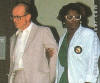 |
Busted. A United
States Marshall brings John List in to face justice 17 years after he
murdered his wife, mother and three children. |
The FBI called on Clark, who
protested his innocence. But although he could change his name and his
address, he could not change his fingerprints. Seventeen years late, John
List, alias Robert Clark, was returned to New Jersey to face prosecution on five
counts of murder. |
|
LANDMARK SITES
The depth of flesh on a human face is fairly standard and well known at key
'landmark' sites on the skull, and the depths elsewhere are averaged between
these known points. There are difficulties with individual features - but
an experienced modeller will be able to make a reasonable estimate as to what
type of nose fits a certain face. For instance, a long, thin face will
generally have a long, thin nose, while broader features will be reflected by a
broader nose.
'There was a case in 1983,' Neave recalls. 'A skeleton was found in the
grounds of the Duke of Marlborough's estate at Blenheim in Oxford. There
was nothing by which the remains could be identified, and eventually the skull
was brought to me. It became clear as I worked on the head that this was
an absolutely classic north European Scandinavian face, so that's how I
completed it.
'The police continued to search the area, looking for anything with a
Scandinavian link, and also checked for missing Swedes and Finns.
Eventually they found a passport and some clothes belonging to a 23 year old
Finnish nurse named Eila Karjamailen, who had disappeared while backpacking
through Europe some time before. The reconstruction looked like the
passport photo, so the police checked with Helsinki. Dental records from
Finland showed that this was indeed Eila. They never did find out who
killer her, but at least they found out who she was.' |
RECONSTRUCTION AND
COMPARISON :
|
 |
Once a skull has been
scanned (pictured left) the computer generated image can then be 'fleshed'
out (pictured right) using a database of appropriate muscle and skin
thicknesses. |
|
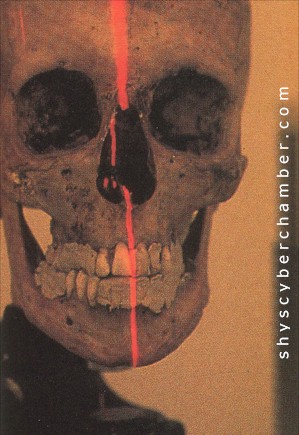
The high-tech method of facial
reconstruction starts with accurate measurements of the skull by using the
reflections of a laser beam. As the skull is rotated the colour laser
scans the whole surface of the skull. The resulting measurements, accurate
to fractions of millimetres, are then interpreted by modelling software to build
up a three-dimensional image.
|
|
An image of a skull
(pictured left) is carefully compared with that of a photograph (pictured
right) to see if they belong to the same person. |
|
Modern digital film and computer
technology enable investigators to quickly compare an unidentified skull with a
photograph of the person it is suspected to have come from. The idea is to
overlay the photograph with an image of the skull. If the angle view and
magnification of the images are the same, and if the skull is indeed that of the
person in the photo, the images should coincide with key areas. Two
important comparisons are the nasal aperture and the nose, and the orbits of the
eyes. |
|
COMPUTERS REPLACE CLAY
Clay modelling is the oldest technique used in reconstruction. The
pioneering work was done in the 1920s by the Russian palaeontologist Mikhail
Gerasimov, and all the work carried out since then is a refinement of his
techniques. But it is being supplemented by - and may ultimately be
replaced by - modern high-technology. Lasers and computers can be used to
create a graphic image in the same way that the medical artist uses clay.
The skull is scanned in all dimensions by a laser, and the resulting
measurements are fed into a computer, which can then produce a highly accurate
three dimensional image of the skull called a wireframe. Data on standard
skin and muscle thickness are kept in a data bank, and using this information
the image of the skull is 'fleshed' out. Common facial and racial
characteristics can also be added to the program.
'There are problems of course,' says Dr Peter Vanezis, formerly of the Charing
Cross and Westminister Medical School. 'At the end of the day the computer
cannot produce as good an image as the medical artists, at least using current
technology. And then there is the problem of over finishing the
image. If you put too many details in, then it acts against recognition.
The hair might be different, and someone will say that although it looks a bit
like their cousin X, who is missing, the hair is wrong so it can't be them.
'Funnily enough, you have a better chance of identification with a generalised
image because people recognise shapes. They will not be able to tell you,
most of them, how they recognise somebody - it is very intuitive.
Psychological studies show that what they recognise is the forehead, the eyes
and the mouth and much more rarely the nose.' |
KILLED IN BATTLE :
|
|
This skull, part pf a
skeleton unearthed in the Ukraine during 1948, could have been buried for
three years or thirty. |
In 1948 a skeleton was found in a
trench in the Ukraine. The skull had been severely damaged and the police
thought it might be the body of a woman who had been reported missing less than
a year before. As there was no way of confirming her identity the skull
was sent to Professor Mikhail Gerasimov at the Laboratory for Plastic
Reconstruction in Moscow. Gerasimov was a palaeo-anthrapologist whose
field of study was ancient human remains. In the early 1920s he learned of
the work carried out by pathologist A.D. Grigoriev in Moscow, which correlated
the dimensions of the skull and the appearance of the face. Gerasimov went
to work for Grigoriev, and built up enough data on skin and flesh thicknesses to
attempt facial reconstructions.
During the next 20 years he became the world's first expert on forensic
reconstruction and was called upon to help out in more than 140 criminal cases.
|
|
| Gerasimov
first modelled the major muscle groups of the face (1). Then he began to
model the skin (2). The face that emerged was classically broad and
Slavic (3), and was identified as Valentina Kosova, killed during the
Second World War. |
Gerasimov thought that the
Ukraine skull had been damaged by shell splinters, which indicated that it was
probably a wartime casualty. The police were sceptical of this new
technique, and they remained certain that the remains were those of a murder
victim.
Gerasimov's reconstruction revealed a young woman's face with pronounced
Slavonic features that did not look like the missing woman. The
investigators circulated photographs of the bust and within weeks the head was
identified as being that of Valentina Kosova, who had disappeared in early 1941
as the Germans fought their way through the Soviet Union. Gerasimov had
been right all along - the skeleton was a victim, not of murder, but of war. |
|
DEAD ACCURATE DATA?
Computer modelled facial reconstructions are the future, however, and at
Sheffield University the technique continues to be developed and refund with
funding from the Home Office. One of the limitations of early computer
programs was the quality of data. For many years forensic scientists
relied on skin-depth data collected from cadavers in the early part of the
twentieth century. These measurements have always been considered suspect
for a number of reasons: the sample size was small, tissues alter size
after death, and the data did not take into account variations due to age, sex
or ethnic origin. Computed tomography, known as CT or CAT scans, can
provide a wealth of tissue data that will eventually provide a far more accurate
database for the modelling software to draw upon. Refining the data into
'datasets' applicable to individuals of a particular age, sex or ethnic group
will further enhance the forensic scientist's ability to recreate a recognizable
face from a fleshless skull.
GENETIC VARIATION
However sophisticated the software becomes and however fast the computers,
creating an exact replica of a person's face from the bare bone of their skull
will, in the foreseeable future at least, remain a Holy Grail. This is
because a number of our soft-tissue features, such as ears, noses and lips
exhibit a wide variety of forms determined to a large degree by genetics.
Until we can 'read' a person's DNA with sufficient proficiency to predict the
size and shape of the nose, forensic science will have to content itself with a
'reasonable likeness' based on the best available data and a dash of artist
invention.
But reconstruction is not the one way in which to identify the skull. The
Charing Cross and Westminister Medical School has also used computer and camera
technology to make identifications using the superimposition of images.
First made use of in the 1930s and 1940s in notable investigations such as the
Ruxton and Dobkin murder cases, image superimposition is essentially a technique
for confirming identity. It involves comparing a photograph of a skull
with a photograph of the suspected victim. |
HIGH TECH DETECTIVES :
|
|
|
|
|
Using computer modelling software facial reconstructions can be produced
rapidly t help identify the victims of terrible accidents or crime. |
The identification centre at London's Charing Cross Hospital once
resembled a TV studio. Today much of the technology is both smaller
and more powerful. |
The final product of all the technology should be a recognizable image if
the dead person's face that will aid in the identification of the victim. |
Computer technology is the key to
modern facial reconstructions and comparison. Medical artists require a
few days to complete a reconstruction, while a computer can complete the process
in a matter of seconds. It is also easier to change a computer model.
If more information on the age or the race of the victim becomes available, a
sculptor may have to start all over again, but the computer operator can simply
add the new information to the existing image and modify it all at the touch of
a button. |
|
A TIME CONSUMING PROCESS
'In those days, you had to compare the photograph with a traced overlay,' says
Dr Vanezis. 'Your image of the skull had to be in exactly the right
position, angle and magnification as the photography you were comparing it with.
What you were looking for was a match in the brow ridges, the orbits of the
eyes, the jaw line and the outline of the skull. It sometimes took a lot
of photography and a long time to get it right.
'Using video was a big step forward. We have one video camera on the skull
and a video image of the photograph. We can combine the two images using a
mixer. Having a zoom lens means that you can get the magnification right
very quickly, and you can just adjust the angle and attitude of your subject
skull as required. You can do various wipes - horizontally, vertically,
diagonally - and you can see almost at once whether you've got a match.'
'It's not conclusive proof of identity,' Dr Vanezis warns. 'Given the
state of the art, what we're doing is providing corroborative evidence.
But we're getting better all the time.' |
|
BACK TO TOP |
|
 Check out
the
latest
Crypt Polls!
|